



Naturalistic ABA Therapy Explained for Families
Learn how naturalistic ABA therapy works, how it differs from discrete-trial training, what evidence shows, and what families can expect in sessions.

Your child reaches for the same toy again and again, the therapist sits on the floor beside them, and a tiny moment turns into learning. A request, a turn, a look, a word, it all happens inside play instead of at a stiff table. That's the heart of naturalistic ABA therapy, a child-led way of teaching skills through everyday moments that already matter to families.

Parents often hear a few different terms at once, naturalistic ABA, NDBIs, incidental teaching, response training, and it can all sound more confusing than it needs to be. In plain language, these approaches aim to teach a child with autism in the flow of real life, during play, meals, getting dressed, reading, or building with blocks.
That's why families are hearing more about this style now. It feels closer to how children naturally learn, and it can be easier to picture at home, in clinic sessions, or at school. The history matters too, because a major 2015 consensus paper brought together these approaches into a clearly defined evidence-based family of methods, after decades of development that included earlier milestones like incidental teaching in 1983 and response training in 1987 2015 consensus paper on NDBIs.
For stressed caregivers, the big idea is simple. Learning doesn't have to mean sitting still and repeating flashcards. It can happen while a therapist follows your child's lead, joins the game, and helps a useful skill show up in the moment.
Table of Contents
- Child-led play and natural reinforcement
- Incidental teaching and motivation-focused response training
Introduction to Naturalistic ABA Therapy for Families
A family may first hear about this approach while trying to make sense of therapy options. The terms can blur together, so it helps to separate the idea from the labels. Naturalistic ABA therapy is a way of teaching skills inside everyday routines, so the child can practice communication, turn-taking, or asking for help during the moments that already matter at home.
That is different from the old picture many parents expect, where learning only happens at a table with a pile of materials. Here, the routine itself becomes part of the lesson. A snack, a bath, getting dressed, or playing with a sibling can all hold a teaching moment, and the child may not notice a hard break between therapy and daily life.
Why families hear about it so often
Families hear about this approach because it matches the way children use skills. A request made while reaching for a toy is easier to understand than the same request practiced in isolation. A turn taken during a game feels like real social learning, not a drill.
Researchers have also grouped these methods under Naturalistic Developmental Behavioral Interventions, or NDBIs, which helps parents know they are not dealing with a vague buzzword. The term points to a family of approaches built around child interest, real routines, and meaningful reinforcement 2015 consensus paper on NDBIs. That matters for families choosing care, because it gives them a clearer way to compare services and ask better questions.
A useful question is simple: where will my child use this skill?
If the answer is “during meals, play, dressing, or family routines,” then the therapy is aiming for life outside the session, not just performance inside it. For parents weighing options, that can make planning feel less abstract. It also helps when thinking about cost, because time spent learning in daily routines may feel more practical than paying for sessions that do not connect easily to home life.
Practical rule: if a skill can be practiced in real life, naturalistic ABA teaches it in real life.
That is why the approach often feels easier to picture. It lets families see how learning fits into ordinary days, instead of asking them to imagine therapy as something separate from home.
How Naturalistic ABA Therapy Works in Everyday Moments
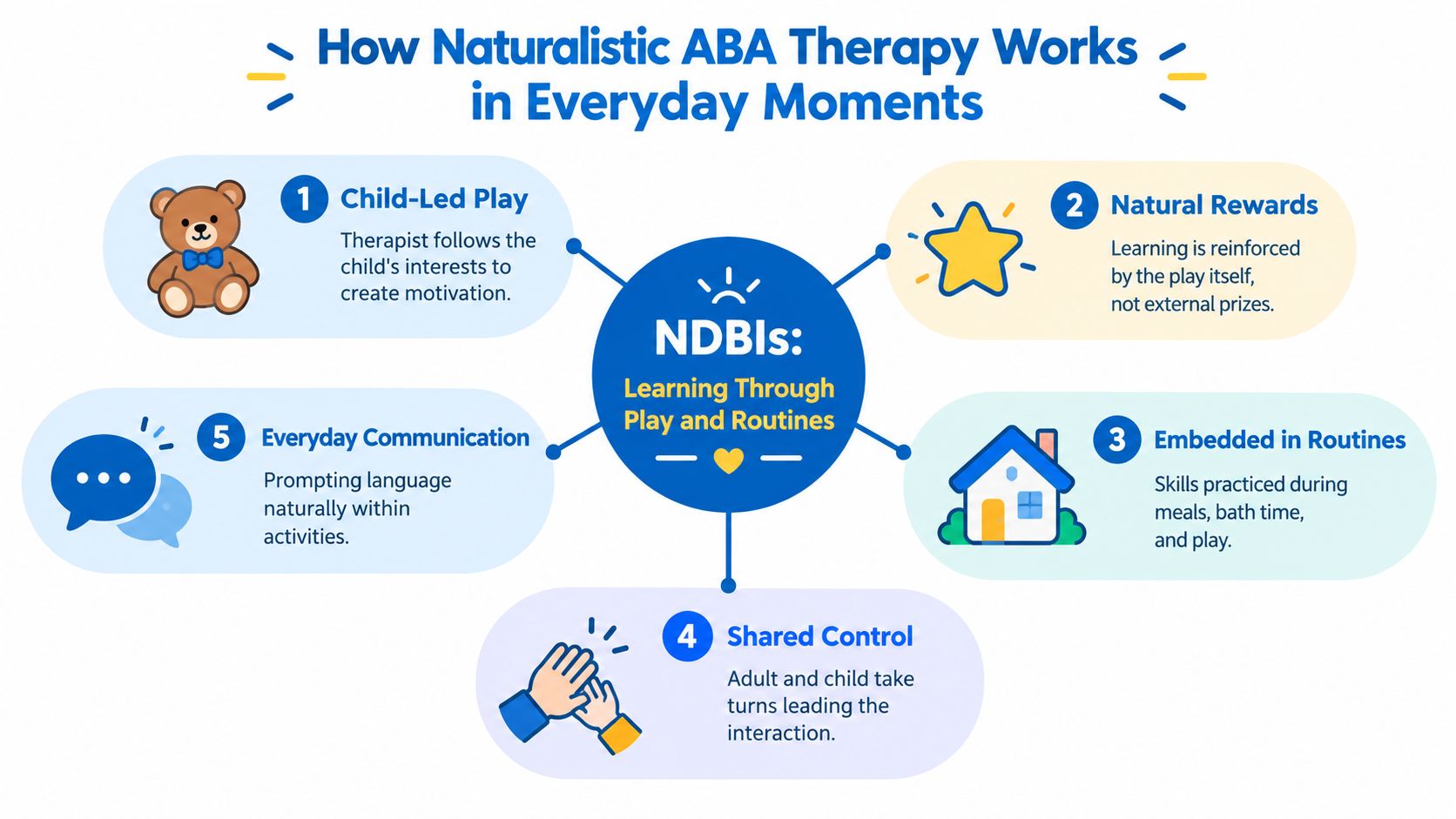
A child reaching for a snack, a toy, or a favorite book already has a reason to communicate. Naturalistic teaching uses that moment instead of setting it aside. The idea is simple, children often learn more easily when the lesson is tied to something they want to do right now. Language starts to make sense because it is useful in the same moment, not just correct on a worksheet.
Child-led play and natural reinforcement
In naturalistic ABA, the adult starts by following the child's interest. If trains are the focus, the therapist may use trains to practice requesting, waiting, or taking turns. If a child keeps opening cabinets, the adult can shape a simple request for help or a sign for “open.” Learning stays in the child's world, so the skill has a place to live outside the session.
The reward also stays tied to the activity. That is natural reinforcement. If a child says “ball,” the ball comes back. If a child asks for a turn, the turn happens. The child learns that communication changes what happens next, and that connection is easier to understand than a separate reward that arrives later.
Incidental teaching and motivation-focused response training
Parents may also hear incidental teaching and a motivation-focused response training approach. Incidental teaching uses a natural opening, such as a tightly closed snack jar, to invite communication. The motivation-focused response training approach builds on the child's interest, response to social cues, and willingness to participate, so the teaching stays active and meaningful.
These methods can happen at home, in a clinic, or at school. A therapist might work during art time, circle time, or a backyard game, as long as the activity gives the child a real reason to respond. That is why these sessions often feel less scripted than table work. For parents who want a plain-language overview of how this fits into daily life, building communication skills in everyday moments offers a helpful companion explanation.
The pattern is easy to follow. Interest comes first, interaction comes next, and the skill is practiced inside the moment.
Learning is strongest when the child has a reason to care about the moment.
When a session is done well, it feels like play with a purpose. The child stays engaged, the adult keeps shaping the interaction, and everyday routines become places where learning can happen naturally.
Naturalistic ABA Therapy Compared With Discrete Trial Training
Parents often hear naturalistic ABA and discrete trial training as if they're rivals. They're not. They're different ways of teaching, and many strong programs use both depending on the skill, the child, and the setting.
The easiest way to think about it is this. Naturalistic ABA is like learning to speak while playing a game with someone. Discrete trial training is more like practicing the same skill in short, clear rounds so the child can focus on one piece at a time. Both can be useful, but they feel very different.
A simple side-by-side look
| Feature | Naturalistic ABA Therapy | Discrete Trial Training |
|---|---|---|
| Setting | Built into play, routines, home life, classroom moments | Usually more structured and controlled |
| Adult role | Follows the child's lead, then shapes the moment | Leads the teaching step by step |
| Child role | Active, interested, often moving and exploring | Focused on a specific response |
| Prompting | Embedded in the activity and conversation | Clear, repeated prompts for a targeted skill |
| Reinforcement | Comes from the activity itself, like getting the toy or turn | Often more separated from the activity |
| Best fit | Practice in everyday life and generalization | Learning a new skill with extra clarity and repetition |
When each style can help
A child might learn to request a snack during play in a naturalistic session, then practice the same request at a table with more structure. That blend can be useful because some skills need extra repetition before they show up naturally. Other skills, especially communication and social interaction, may be easier to grow inside a routine the child already enjoys.
Families sometimes worry that one style is “better,” but that's usually the wrong question. A better question is, what does my child need right now? A child who needs predictable steps may benefit from more structure. A child who gets stuck in formal settings may thrive when learning is woven into movement, toys, or shared play.
Practical rule: the right method is the one that helps your child use the skill outside the lesson, not just during it.
A short, parent-friendly comparison of these two styles is also available in best autism therapy. For many families, the most realistic plan is not choosing one forever, but finding a program that can blend both approaches wisely.
What Research Shows About Benefits and Outcomes
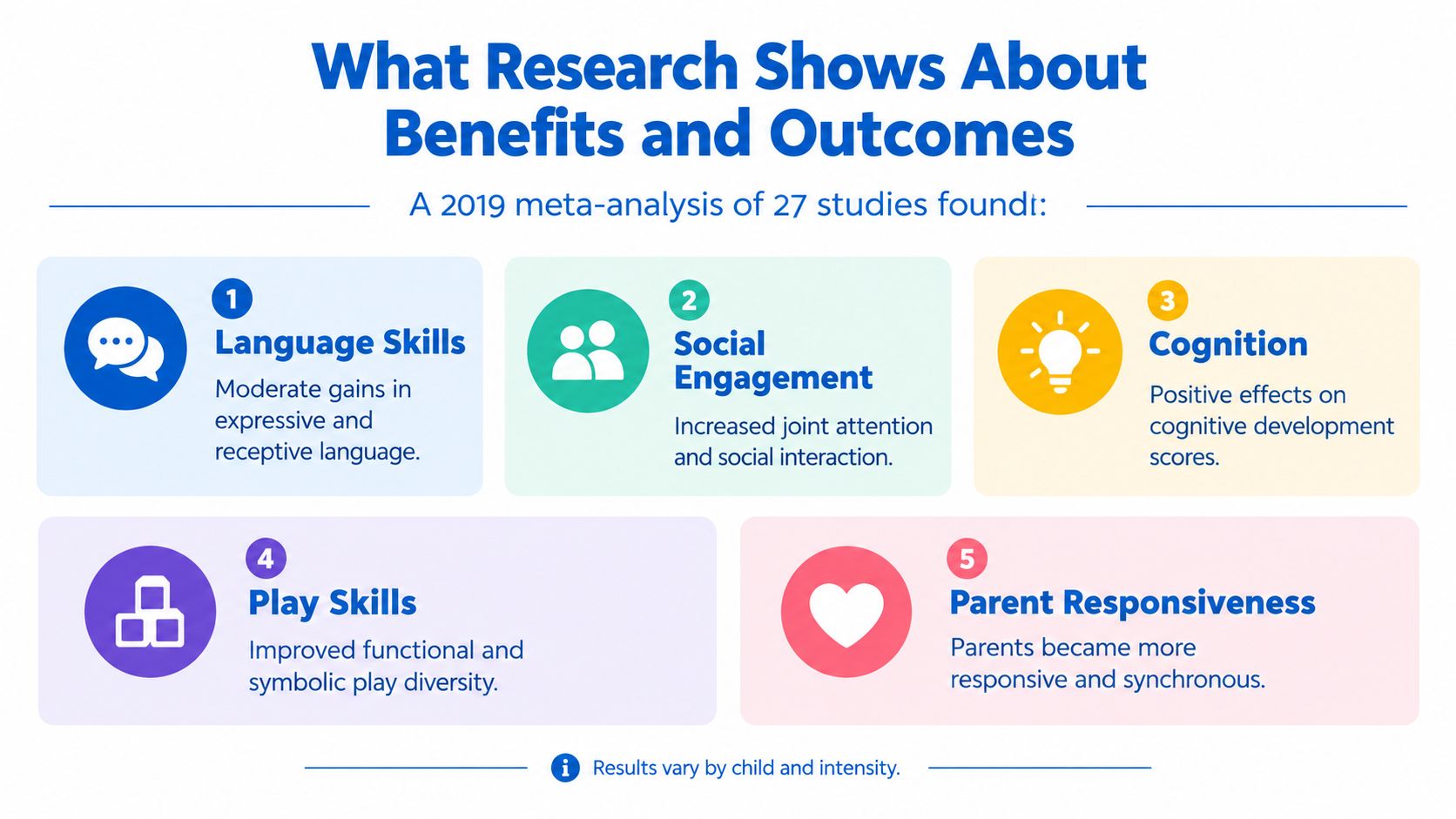
Families often want a simple answer here: does naturalistic ABA help? The research says it can, and the strongest studies point to gains in several everyday areas, not just performance at a table. A 2019 meta-analysis reviewed 27 studies on NDBIs for young children with autism and found measurable benefits in expressive language, social engagement, cognitive development, autism symptom severity, play, joint attention, and receptive language 2019 meta-analysis. That matters because these are the skills children use while playing, talking, and moving through daily routines.
Where the strongest gains showed up
The clearest gains were in social engagement, with an effect size of g = 0.65, and overall cognitive development, with g = 0.48. In plain terms, the evidence looked strongest in the areas families often notice first, such as connecting with others and using thinking skills more flexibly.
Language gains were present too, but they were smaller. Expressive language showed a positive effect size of g = 0.32, and receptive language showed g = 0.28. Play skills improved as well, with g = 0.23, while joint attention was a smaller change at g = 0.14. Those numbers fit the reality many parents see, where progress often starts in small, practical steps before it becomes obvious in daily life.
What the numbers mean for families
The same review found a reduction in autism symptom severity at g = -0.38. That does not mean a child stops being autistic. It means studies found broad developmental gains that can make everyday routines easier to share and support.
The review also noted publication and reporting bias for language outcomes, so the findings should be read with care. Children differ. Goals differ. Service intensity differs too. Still, the overall picture supports naturalistic ABA as a helpful approach when goals are tied to the child's real routines, from playtime to family interactions.
Research helps most when it shapes the next conversation with your provider, not when it turns into a promise that every child will progress the same way.
What to Expect in a Naturalistic ABA Therapy Session
A good session usually starts calmly. The therapist watches what the child reaches for first, then joins without taking control. That first move matters, because it tells the child, “I'm here with you, and I'm following your lead.”
A session often unfolds in small steps
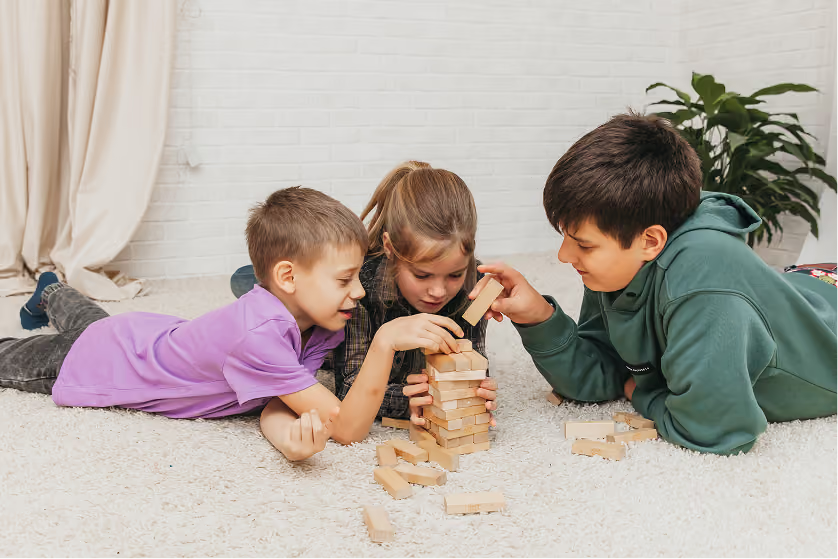
The therapist might sit on the floor with blocks, drive cars back and forth, or read a favorite book with the child. While the play keeps going, the therapist looks for moments to invite a response, like holding a preferred item just long enough for a request, or pausing during a song to encourage a gesture or word. The child gets a chance to communicate for a real reason.
Parent involvement can happen in different ways depending on the setting. Sometimes a caregiver watches and joins in near the end. Sometimes the therapist coaches the parent in the moment so the same skill can show up later at home. That kind of follow-through is one reason families often like this style, because the learning isn't sealed off from the rest of the day.
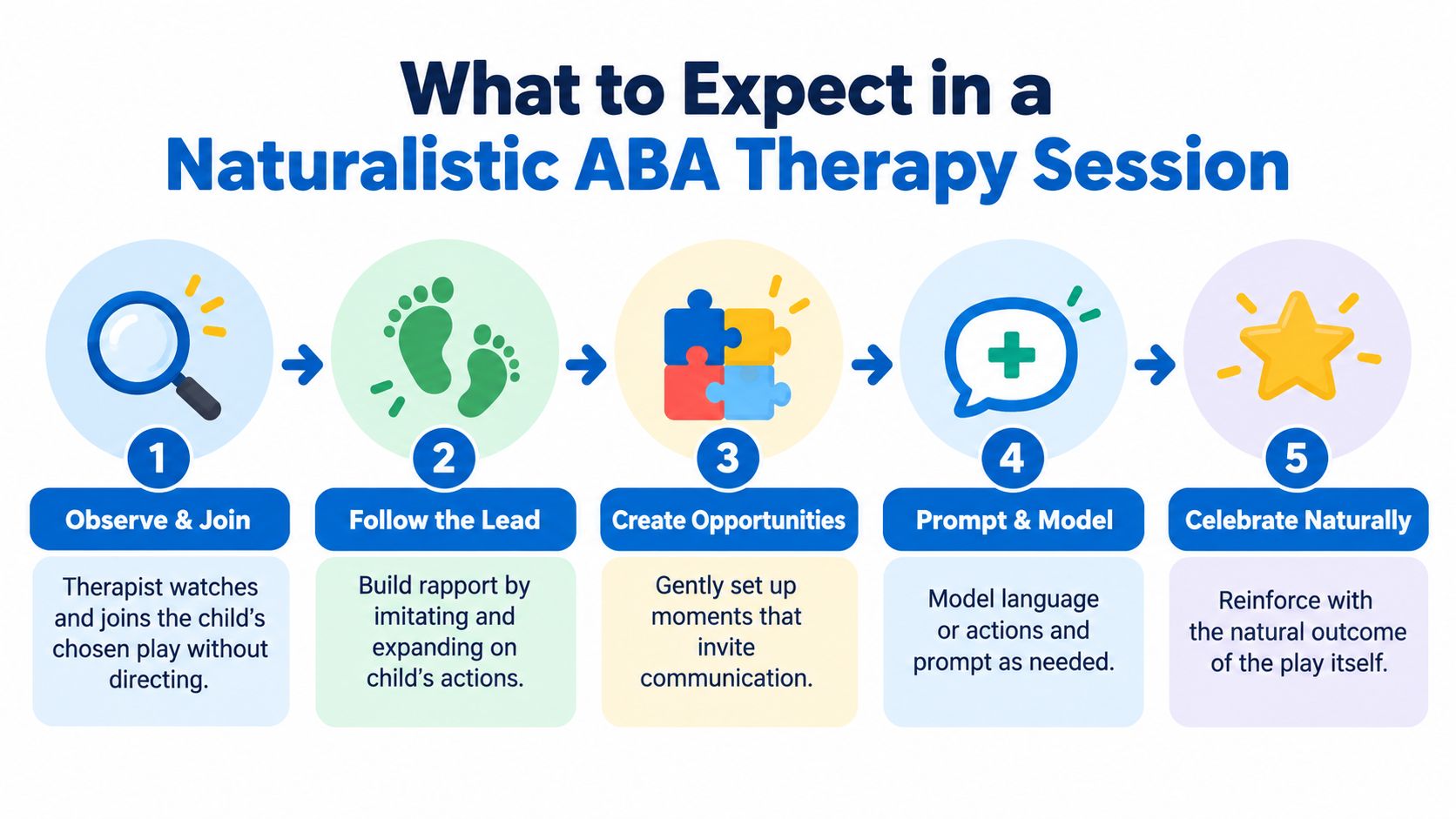
Here's a simple flow families often recognize:
- Observe and join. The therapist sees what interests the child and enters the play naturally.
- Follow the lead. The child keeps control of the activity while the adult builds connection.
- Create a reason to communicate. A pause, a choice, or a small challenge opens the door.
- Prompt and model. The adult shows the word, sign, or action, then gives help as needed.
- Celebrate with the natural outcome. The toy moves, the snack comes, the turn happens.
Data collection still happens in the background. The therapist may be noting how often a child requests, responds, or stays engaged, but that shouldn't make the session feel cold or mechanical. The goal is to weave skill practice into ordinary routines, not turn the child's day into a drill sheet.
If you're trying to understand a first assessment before therapy starts, what to expect during your first ABA assessment can help you feel more prepared.
Choosing the Right Fit and Understanding Your Options for Care
The best fit usually depends on three things, your child's communication level, your family's routines, and the goals you want to work on first. A child who already uses words may benefit from a different session rhythm than a child who uses gestures, pictures, or a communication device. If a therapist mentions pairing naturalistic strategies with AAC, that means they may be thinking about ways to support communication with pictures, a device, or other tools when speech is limited.
Questions that help you compare providers
- How do you adapt sessions to my child's communication style? This helps you see whether the therapist can work with speech, signs, pictures, or AAC.
- How do you involve parents or caregivers? You want to know how learning carries over into meals, bath time, dressing, and play.
- How do you decide between naturalistic and more structured teaching? A thoughtful provider should explain when each style makes sense.
- How do you measure progress? Ask what the therapist watches, how often they review goals, and how they update the plan.
Coverage is the other part families stress about, and it's understandable. Medicaid's EPSDT rule means that for children under 21, state Medicaid programs must cover medically necessary services to “correct or ameliorate” a condition, and federal guidance has clarified that this can include ABA for children with autism Medicaid ABA toolkit. Private insurance can look different, because state autism mandates usually apply to state-regulated health plans, while self-funded employer plans are generally governed by federal ERISA rules state mandate overview.
That means benefits may vary by plan, and the details matter. Many state laws also include things like age limits, visit limits, dollar caps, or prior authorization rules, so it helps to ask both whether ABA is listed as a benefit and what paperwork or utilization rules apply to your specific plan coverage limits overview. If in-network access is limited, families sometimes ask about out-of-network reimbursement, but that path depends on the plan and the provider.
A calm, specific call with the insurer can save a lot of guesswork. Ask what's covered, what codes they need, whether prior authorization is required, and what documentation the provider must send. If the answers are unclear, ask them to repeat the details slowly and note the name of the representative.
Moving Forward With Confidence and Support
Naturalistic ABA therapy can feel reassuring because it meets children where they already are. It uses play, routines, and real relationships to build communication and learning without making every moment feel like a lesson. For many families, that makes therapy easier to imagine and easier to carry into daily life.
There isn't one right path for every child. Some children need more structure at first. Others do better when the therapy is woven into the way the family already moves through the day. Asking questions about fit, goals, and coverage is a strength, not a setback.
If you're ready to take a next step, start with one session observation, one provider conversation, or one insurance call. Small, clear steps can make the whole process feel less overwhelming. And if you want help sorting through provider options or understanding what your coverage might look like, ABA Finder can help you think it through in plain language.
If you're comparing providers, trying to understand naturalistic ABA therapy, or just need help making sense of your insurance options, ABA Finder is here to make the search simpler. Visit ABA Finder to explore provider options and get clearer on your next steps with support that's informational, practical, and family-centered.
Our Latest Insights




Every Child Deserves Access To Quality ABA Therapy
Whether you're searching for providers, exploring financial assistance, or trying to better understand your insurance options, we're here to help you take the next step with confidence.