



Autism Support Services: A Parent's Complete Access Guide
Navigate autism support services with confidence. Learn about therapy, insurance coverage, and practical steps to find help for your child.

About 1 in 59 children had autism spectrum disorder in the 2018 CDC estimate, and more recent surveillance puts that closer to 1 in 36. For many families, that means the question isn't whether support exists, it's how to get it without getting lost along the way.
A diagnosis can feel like someone handed you a map with no legend. You're trying to help your child right away, but the path runs through therapies, school planning, insurance language, and waitlists that seem to speak their own language. The good news is that you don't have to solve every piece today. You only need a clear first step, then the next one after that.
Table of Contents
Finding Your Way Through Autism Support Services
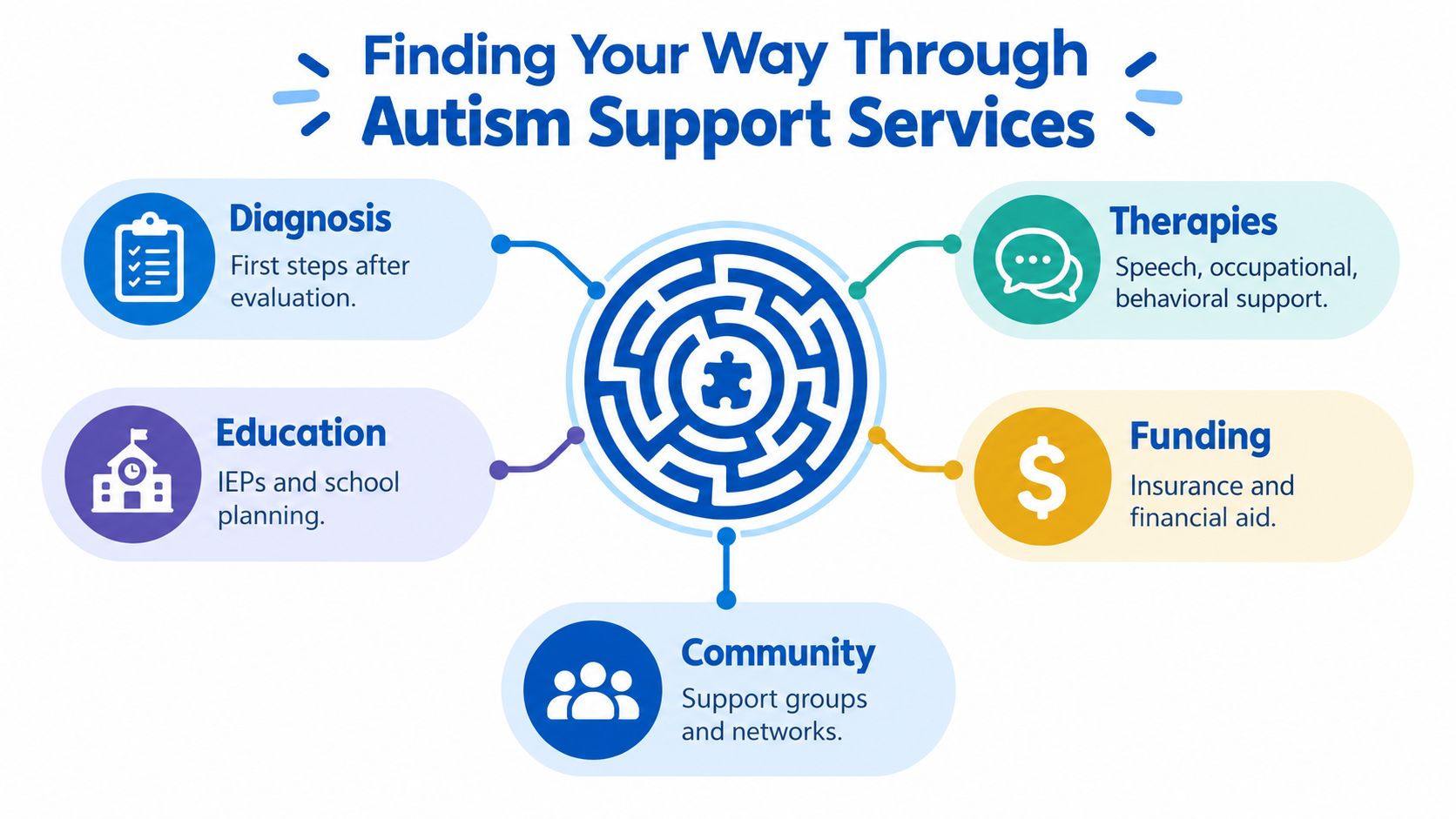
The first days after diagnosis often feel like standing in front of a maze with too many exits. One parent may be told to call the insurer, another hears about school evaluations, and a third is handed a stack of therapy names with no explanation of what comes first. That mix of urgency and uncertainty is normal.
Think of autism support services as a connected system, not a single appointment. A child might need evaluation, therapy, school accommodations, family support, and later transition planning, and those pieces rarely arrive in a neat order. What matters most is getting enough structure to move forward without assuming you have to understand the whole system at once.
Start with the next practical step
A helpful way to begin is to ask, “What is the next action that opens the next door?” For one family, that may be an evaluation. For another, it may be a call to a school district or an insurer. The point is to break the journey into pieces small enough to handle.
Practical rule: if a service can't start yet, ask what document, approval, or referral is missing. That question usually reveals the real bottleneck.
Families also benefit from keeping a simple folder, physical or digital, with reports, school notes, insurance letters, and provider names. When people are stressed, they forget details quickly. A shared folder cuts down on repeat phone calls and helps you tell the same story clearly to each office.
The Four Main Types of Support Services
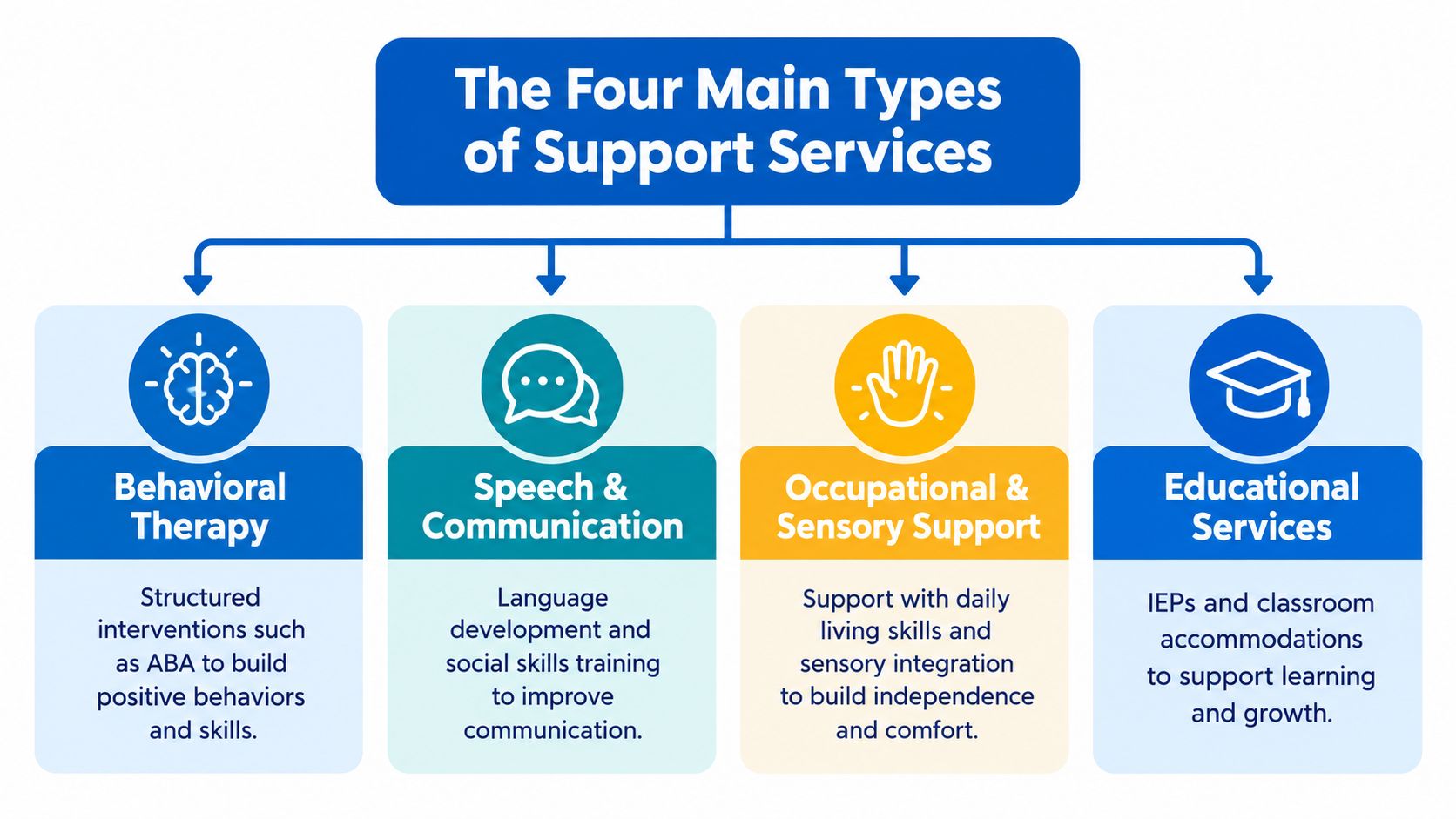
The hard part for many parents is not finding a service name, it's understanding what each one does. A therapy service, a school accommodation, a respite option, and a care coordinator can all support the same child, but they play very different roles. Knowing the difference helps you ask smarter questions and avoid paying for the wrong kind of help.
Therapy, school, relief, and coordination
Behavioral therapy, including ABA, usually focuses on building skills through structured practice. In plain language, it's a teaching plan built around small, repeated steps. That can be useful when a child needs support with communication, routines, or behavior patterns that make daily life harder.
Educational services are a separate lane. Schools may provide classroom supports, planning through an IEP, or other accommodations that help a child learn in that setting. Those supports don't replace therapy, and therapy doesn't replace school planning. They work like different members of the same team.
Respite care gives caregivers a break. That break can matter just as much as therapy because families need time to rest, work, and care for other children. Case management or care coordination helps connect the dots, especially when one office wants records from another or when families don't know which door to knock on next.
A service can be helpful and still not be the right fit for your child's current season. Ask what problem it solves, then decide whether that problem is the one that matters most right now.
Navigating Insurance and Payment Options
Paying for care is where many families hit the steepest wall. Private plans, Medicaid, and CHIP can all play a role, but none of them are simple, and none should be assumed to work the same way. The safest approach is to treat coverage like a set of rules that have to be checked line by line for your child and your plan.
Private insurance mandates have expanded a lot over time, and that changed the picture for many families. By 2015, 40 states and Washington, DC had passed laws requiring many private health plans to cover autism diagnostic and treatment services, and some of those mandates set annual caps ranging from US$12,000 to US$50,000 depending on the state and the child's age, according to a review of U.S. policy history at PMC. By May 2018, 47 states, the District of Columbia, and the U.S. Virgin Islands had laws requiring health insurance companies to offer or cover behavior-analytic services for people diagnosed with autism spectrum disorder, as described in the same policy review.
What in-network and out-of-network really mean
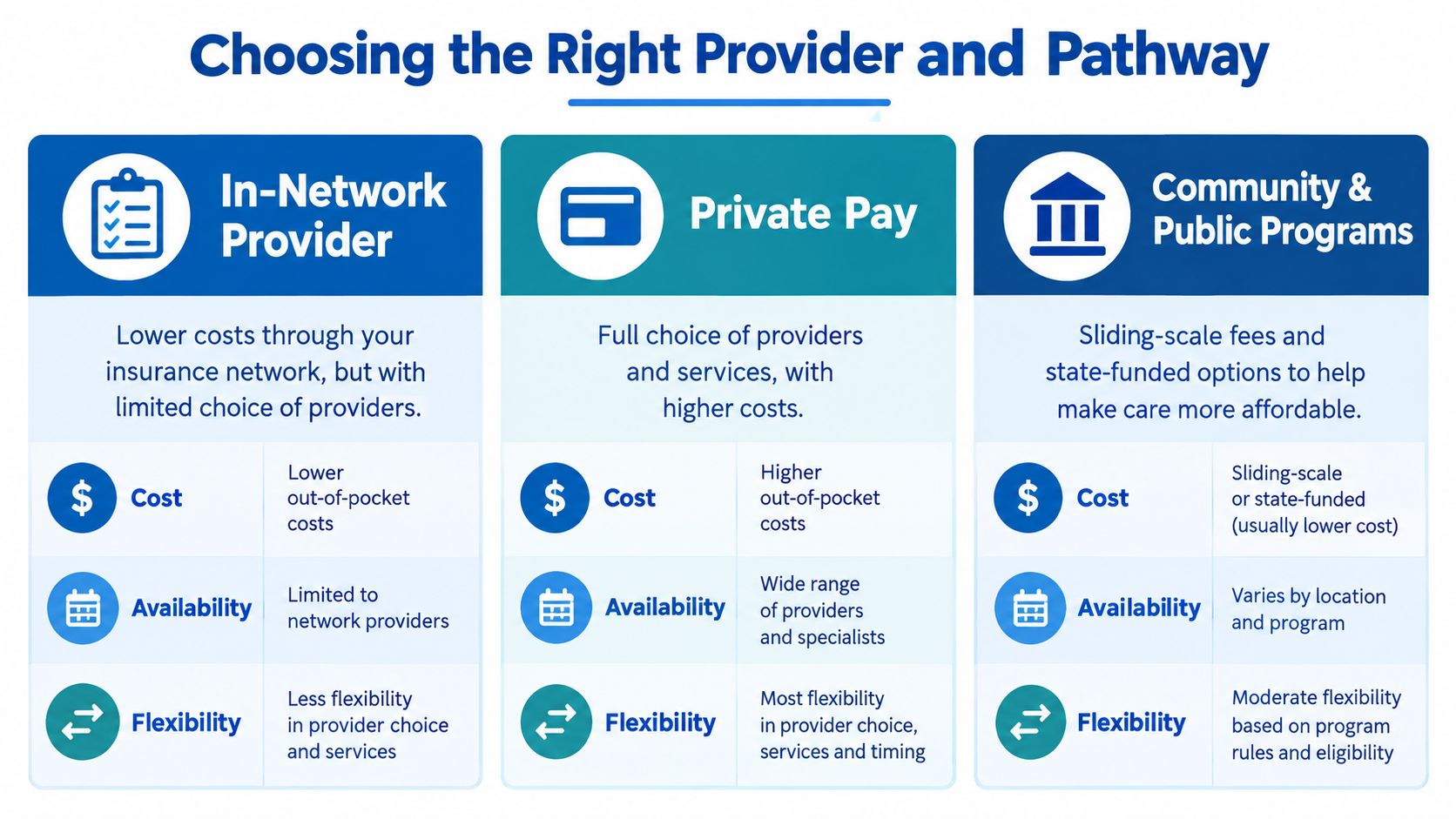
An in-network provider has a contract with your insurance company. That often means lower out-of-pocket costs, but it can also mean longer waitlists or fewer choices. An out-of-network provider doesn't have that contract, so your plan may cover less, or you may need to pay first and seek partial reimbursement later, depending on the benefits.
That's why coverage questions need to go beyond “Is ABA covered?” and move into “How is it covered, by whom, and under what rules?” The ABA therapy cost per hour guide can help you think through the payment side before you commit to a provider conversation.
Practical rule: always ask the insurer whether the plan covers the service, whether prior authorization is required, and whether out-of-network claims can be submitted. Those three answers often matter more than the headline benefit.
Medicaid and CHIP can work differently from private insurance. CMS says ABA is one treatment option for autism, but states decide what's medically necessary, and Medicaid must follow EPSDT rules for children under 21 when a service is medically necessary to treat ASD. That means the same service can be available in one situation and delayed or denied in another, depending on state policy and medical necessity review.
Questions to ask before you assume the answer
- Is this provider in network with my specific plan? A clinic may accept some plans and not others.
- Does my child need a referral or prior authorization? Missing paperwork can stall a claim.
- If the nearest in-network options are full, can I use out-of-network care? Some plans may allow partial payment or exceptions.
- Does my child qualify for Medicaid or CHIP support in our state? Eligibility and covered services vary.
- What records should I keep for reimbursement? Bills, session notes, and denial letters can matter later.
Choosing the Right Provider and Pathway
A family may find the “right” provider on paper and still hit a wall in practice. The true test is whether care can start, how billing is handled, and whether the provider fits your child's needs and your family's schedule. Some families can wait for a preferred clinic. Others need the first opening they can get, even if that means starting with telehealth, private pay, or a public program.
Comparing the main routes
In-network care can lower the bill, but the waiting list may be long and the provider list narrow. Private pay gives you more choice, yet the cost can be hard to carry. Community and public programs may offer sliding-scale or state-supported options, though they often come with intake rules and slower starts.
The AACAP policy statement on expanding access to care for autism notes that state mandates do not always apply to every plan or every treatment option, and it recommends broader coverage, timely evidence-based care, and telehealth to improve access. That matters because a provider may look available on a website while still being out of reach for your actual plan.
What to look for beyond credentials
A good provider should explain what happens after intake, who handles prior authorization, and how family input shapes the plan. Compare local options in our guide to autism service providers to see in-network, private-pay, and community pathways side by side. Then ask a few plain questions: What is the average wait time for intake? Who coordinates paperwork? How are progress reports shared with schools?
Those answers tell you more than a long list of credentials. You want someone who speaks clearly, listens carefully, and treats your questions as part of care, not as a nuisance. If the office cannot explain its own billing or referral steps in plain language, that is a warning sign.
ABA Finder is one option families may use to look for ABA providers and review payment pathways, including insurance and out-of-network routes. It still helps to check fit, current availability, and your own coverage terms before you decide.
Support Beyond Early Intervention
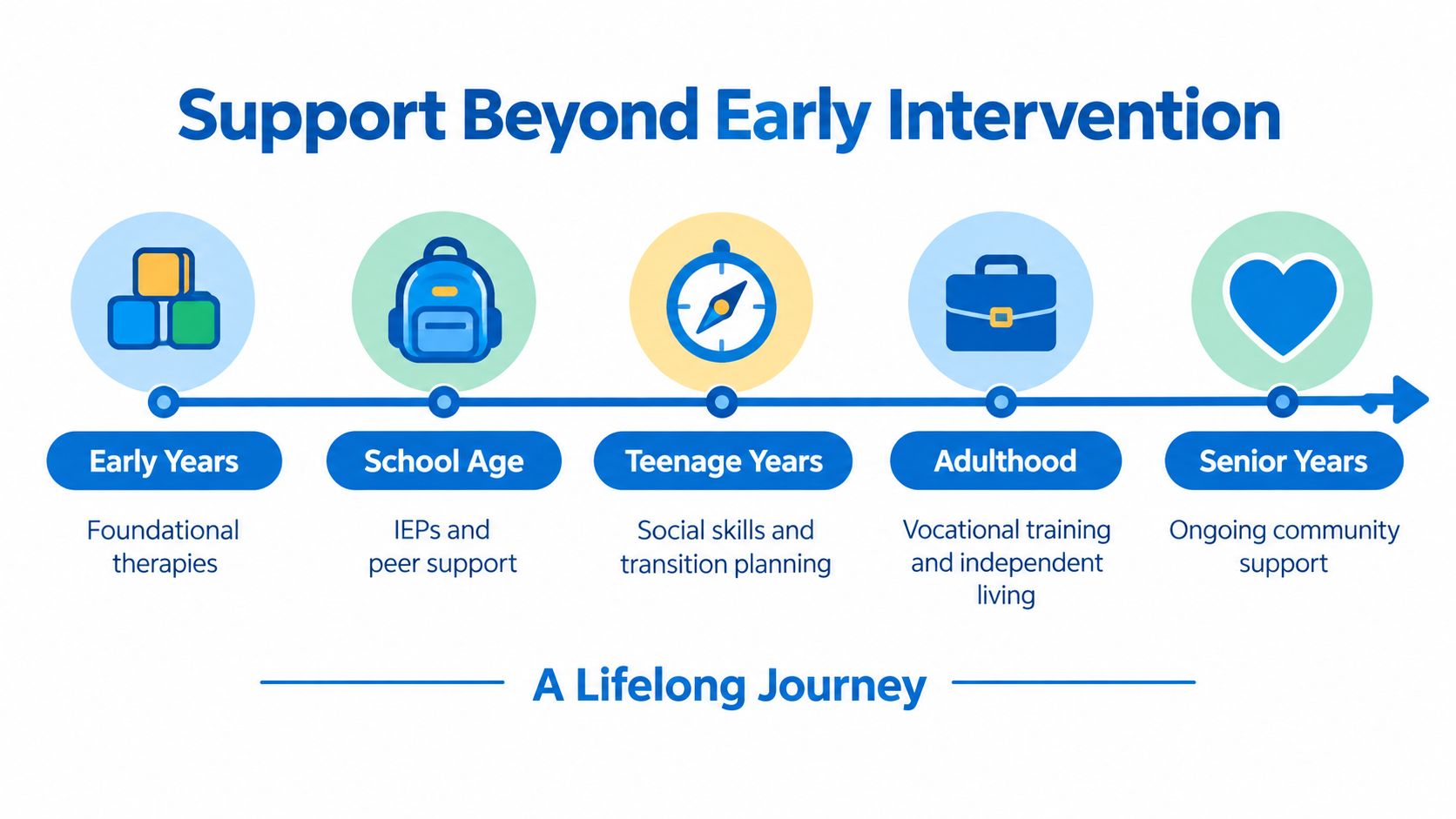
Support doesn't stop when a child leaves early intervention. It changes shape. The needs of a toddler, a school-aged child, a teen, and an adult can look very different, but the central problem is the same, families need a steady path instead of a hard drop-off when one program ends.
That gap after diagnosis can be especially frustrating. Families often expect a clear roadmap, then discover that services thin out, referrals get scattered, and the adult system looks nothing like the child system. Evidence from the 2025 AsIAm report shows how serious those gaps can be in practice, with 84% of children in the cited report waiting more than one year for support through disability teams and 69% not receiving any support from their local children's disability network team at all, according to that report. The same report says autistic adults often face no clear public pathway for assessment or follow-up support.
Why long-term planning matters
A child who gets therapy now may still need help later with school transitions, social communication, daily living, or work readiness. That means families do better when they think in phases instead of hoping one program will solve everything. Early services can build a foundation, but school-based help and transition planning keep that foundation from cracking later.
The 2025 National Autism Strategy for Australia also highlights unmet demand and service gaps, with a call for better access across disability and mainstream services. That matters because transition planning is not just about adulthood, it's about making sure support doesn't disappear when a child outgrows a category.
A simple way to think about the timeline
- Early years: focus on foundational support and learning routines.
- School age: coordinate with school services and classroom supports.
- Teen years: start asking about social skills, independence, and future planning.
- Adulthood: look for vocational, community, and daily-living supports.
- Later years: keep community connection and practical support in place.
A short video can also help families picture how support changes over time.
Common Misconceptions About Access and Care
One of the biggest myths is that insurance coverage means immediate care. It doesn't. A plan may say a service is covered, but the family still has to find a provider, clear authorization steps, and wait for an opening. The bottleneck is often capacity, not just paperwork.
A Medicaid.gov ABA toolkit notes that some families wait up to two years between ASD screening and diagnosis, and because evaluation is usually needed before treatment starts, that delay can push back ABA and related services. That's a painful gap because families often want action right away, but the system may move much more slowly. Workforce scarcity also means waitlists and closed intakes are common in many markets, so the core problem is often availability.
Coverage and access are not the same thing
Another common misunderstanding is that all autism therapies are interchangeable. They're not. A school support, a behavioral program, and a community group can all help, but they do different jobs. If parents treat them as identical, they may chase the wrong option and lose time.
State and local data show the same pattern. A Kansas Health Institute analysis found average ABA wait times of 22.3 months for KanCare and 19.4 months for private insurance, and a Nevada legislative audit estimated provider capacity was enough for only about two-thirds of children who would most benefit from ABA, with only about one-third of licensed ABA providers serving Medicaid in fiscal year 2020. Those numbers point to a simple truth, paper coverage doesn't automatically create a real appointment.
The smartest expectation is not “covered equals available.” It's “covered may help, but I still need to check timing, network fit, and backup options.”
Your Next Steps Toward Accessing Services
Start with the records you already have. Gather the diagnosis paperwork, screening notes, insurance cards, school reports, and any referral letters into one place. That small act makes every future call easier because you're not searching for documents while someone waits on hold.
Next, call your insurer and ask plain questions about coverage, authorization, and network options. If the first in-network choice has a long waitlist, ask whether out-of-network claims, exceptions, or telehealth options are available. Families sometimes assume a “no” is final when it's really just the first answer from the first person they reached.
A simple checklist for today
- Make one document folder. Keep every report and letter together.
- List three providers. One in-network, one out-of-network, and one community or public option.
- Write down your coverage questions. Ask about authorization, network status, and claim submission.
- Track every call. Note the date, name, and next step.
- Check local options. The after autism diagnosis guide can help you think through the first moves after diagnosis.
If your family is stuck between diagnosis and actual care, that doesn't mean you're doing it wrong. It usually means the system is hard to get around, and you need a clearer route, not more pressure.
ABA Finder helps families sort through ABA provider options and payment pathways, including insurance review and out-of-network benefits, so the next step feels more manageable. If you're trying to find a provider or make sense of coverage for your child's needs, visit ABA Finder to explore your options and get help thinking through the road ahead.
Our Latest Insights










Every Child Deserves Access To Quality ABA Therapy
Whether you're searching for providers, exploring financial assistance, or trying to better understand your insurance options, we're here to help you take the next step with confidence.