



10 Autism Parent Resources to Find Support in 2026
Explore 10 autism parent resources for insurance, ABA access, school support, grants, Medicaid, IEPs, and practical next steps for your family.


If you're staring at an insurance card, a therapy waitlist, and a school email all at once, you're not overreacting. This is often how the process starts. One parent is trying to figure out whether ABA therapy is covered, another is calling providers who aren't taking new families, and many are also wondering what to do about school supports, Medicaid forms, or rising out-of-pocket costs.
A good list of autism parent resources should separate those jobs. Some resources explain official coverage rules. Some help you find actual providers. Some help with school services, financial strain, or long-term planning. That's what this guide does.
It also helps to say one thing clearly up front. Coverage, eligibility, and provider participation can vary by state, insurance plan, managed care company, school district, and your child's specific needs. A directory, website, or helpline can point you in the right direction, but you'll still want to confirm details with the insurer, Medicaid agency, provider, school team, tax professional, or attorney involved in your case.
You'll notice this article uses person-first language, such as "child with autism." Many families prefer that wording. Some people prefer identity-first language, such as "autistic child." If your family uses that language, that's valid too.
Table of Contents
1. Autism Speaks Resource Hub and Family Services Directory
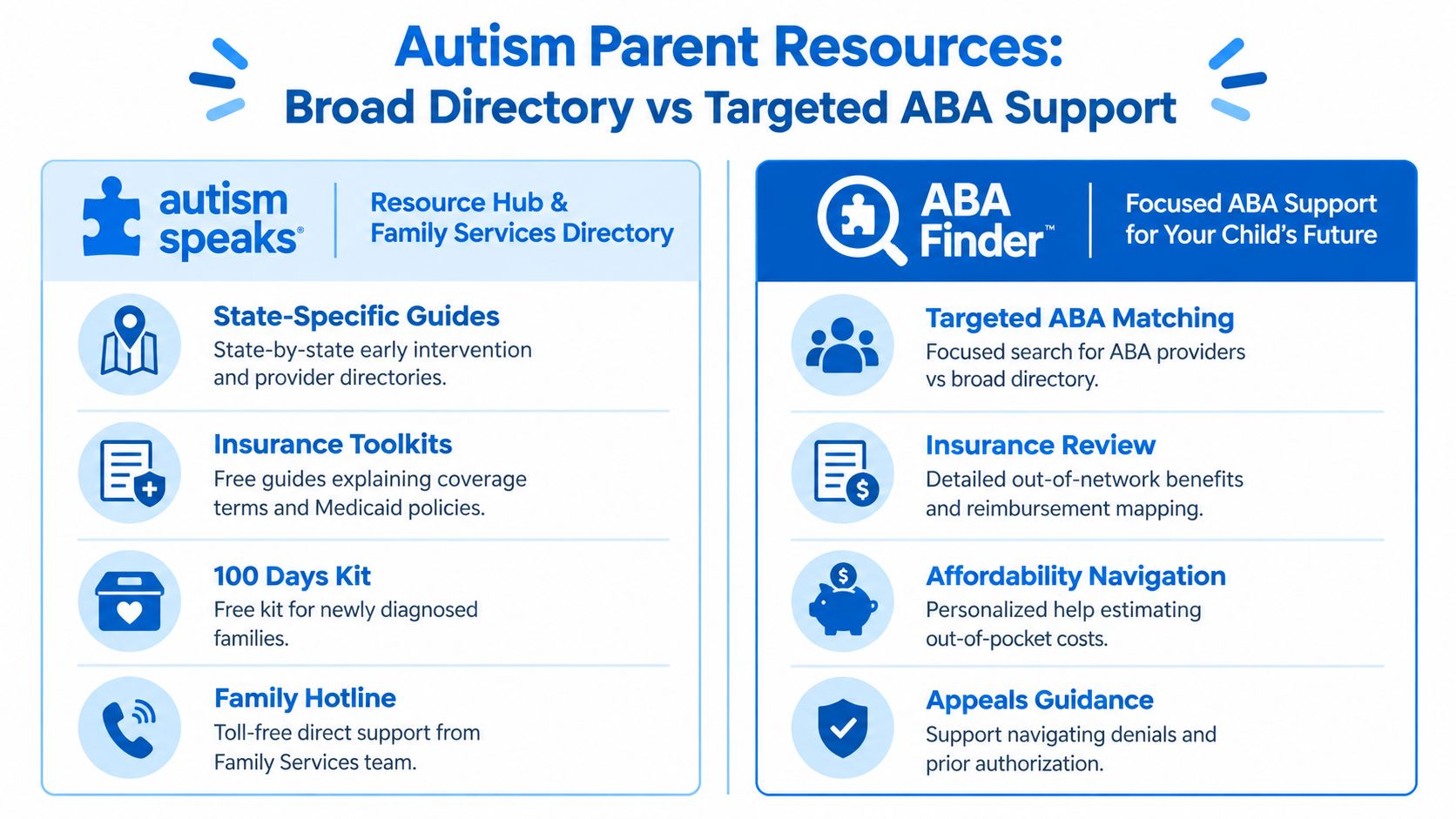
When you don't even know where to begin, a large directory can be useful. Autism Speaks offers state-by-state resource pages, service listings, and family guidance that can help you build a first draft of your plan. That can be especially helpful if you're trying to sort through therapy, early intervention, school supports, and insurance questions at the same time.
This kind of hub is best for orientation, not final decisions. A listing may help you discover options you didn't know existed, but it doesn't replace checking whether a provider is in network, taking referrals, or experienced with your child's needs.
What it can do well
If your child was recently diagnosed, you might use Autism Speaks to identify local therapy categories, find state contacts, and learn basic insurance terms before calling your health plan. Families who are also comparing approaches may want a broad overview of therapy options before narrowing the list, including guides like this overview of autism therapy options for families.
A practical example: a parent in a new state might use the directory to identify early intervention contacts, local autism support groups, and nearby therapy providers, then cross-check every name against their insurance portal.
Practical rule: Use a major directory to make your shortlist. Use your insurer and the provider's office to verify the shortlist.
What to ask before you rely on it
- Is this listing current: Ask whether the provider is accepting new patients, which insurance plans they work with, and whether they offer a waitlist.
- Does this fit my child's needs: Ask about age range, session setting, parent training, and whether the provider coordinates with school or speech services.
- Who can explain the terms: If a guide mentions prior authorization or Medicaid, write those terms down and ask for plain-language explanations before you submit anything.
A good next step is simple. Pick one state guide, one therapy category, and one insurance question. Don't try to solve the whole system in one afternoon.
2. State Medicaid Programs, EPSDT, and CMS Guidance
You get off the phone with one office thinking your child's services should be covered. Then the managed care plan says it needs prior authorization, and the clinic says it does not take that version of Medicaid. Families run into this mismatch all the time.
Medicaid can help with more than many caregivers expect, especially for children. The hard part is that "Medicaid" is not one single door. It works more like a set of connected doors: federal rules, your state's program, and sometimes a managed care plan inside that program. The CMS autism services and ABA toolkit explains that ABA is one possible autism treatment, not the only one, and that coverage decisions still turn on medical necessity, state rules, and plan requirements.
That distinction matters for real-life decisions. If you are trying to figure out whether Medicaid can help your family now, focus on three questions first. What service are you asking for. Who has to approve it. Which providers can bill your child's plan.
A useful way to sort this resource is by what it can and cannot do.
What Medicaid, EPSDT, and CMS guidance can do:
They can show you whether your child may have a pathway to covered care, what categories of services your state recognizes, and what rights or review processes may apply if a request is denied.
What they cannot do:
They cannot guarantee that a nearby provider has openings, accepts your specific plan, or will receive approval without more records.
That gap is where many families get stuck. A caregiver study on ABA access found that coverage type by itself did not predict whether a child had received ABA, which is a useful reminder that a benefit on paper still has to pass through authorizations, provider participation, and scheduling barriers, as described in this caregiver study on ABA access.
If EPSDT is new to you, the plain-language version is simple. For children, Medicaid may have to cover medically necessary services to correct or improve a condition, even when parents assume the state only pays for a short list. That does not mean every autism service is automatically approved. It means you have a stronger reason to ask specific questions instead of stopping at a vague "we don't cover that."
Start the call like a case builder, not like someone asking for a favor. Have the diagnosis, recent evaluations, referral notes, and the name of the recommended service in front of you.
Ask these questions in order:
Is this service a covered benefit for my child's age and plan?
Use the exact service name if you have it. If the representative uses unfamiliar terms, ask them to spell them and explain them in plain language.What documents are required before review?
Ask whether the plan needs prior authorization, a physician order, updated testing, or a treatment plan from the provider.Who makes the decision?
Some approvals sit with the managed care plan, while others depend on a state Medicaid office or a contracted reviewer.Which in-network providers can bill for this service right now?
Ask for names, phone numbers, and whether the list is current.If no provider is available, what is the next option?
Ask whether the plan considers single-case agreements, out-of-network exceptions, or other access steps.
If the answer is no, ask for the denial in writing and ask how to appeal. If the answer is yes, ask what would still prevent scheduling, because approval and access are not the same thing.
A practical next step is small and concrete. Make one Medicaid call with your records beside you, write down every requirement you hear, and turn that information into a checklist you can use with the provider's office.
3. Private Insurance Out-of-Network Benefits and Reimbursement Mapping
A lot of families hit the same wall. Their plan appears to cover autism services, but there isn't a nearby in-network ABA provider with space available. That's where out-of-network benefits enter the conversation.
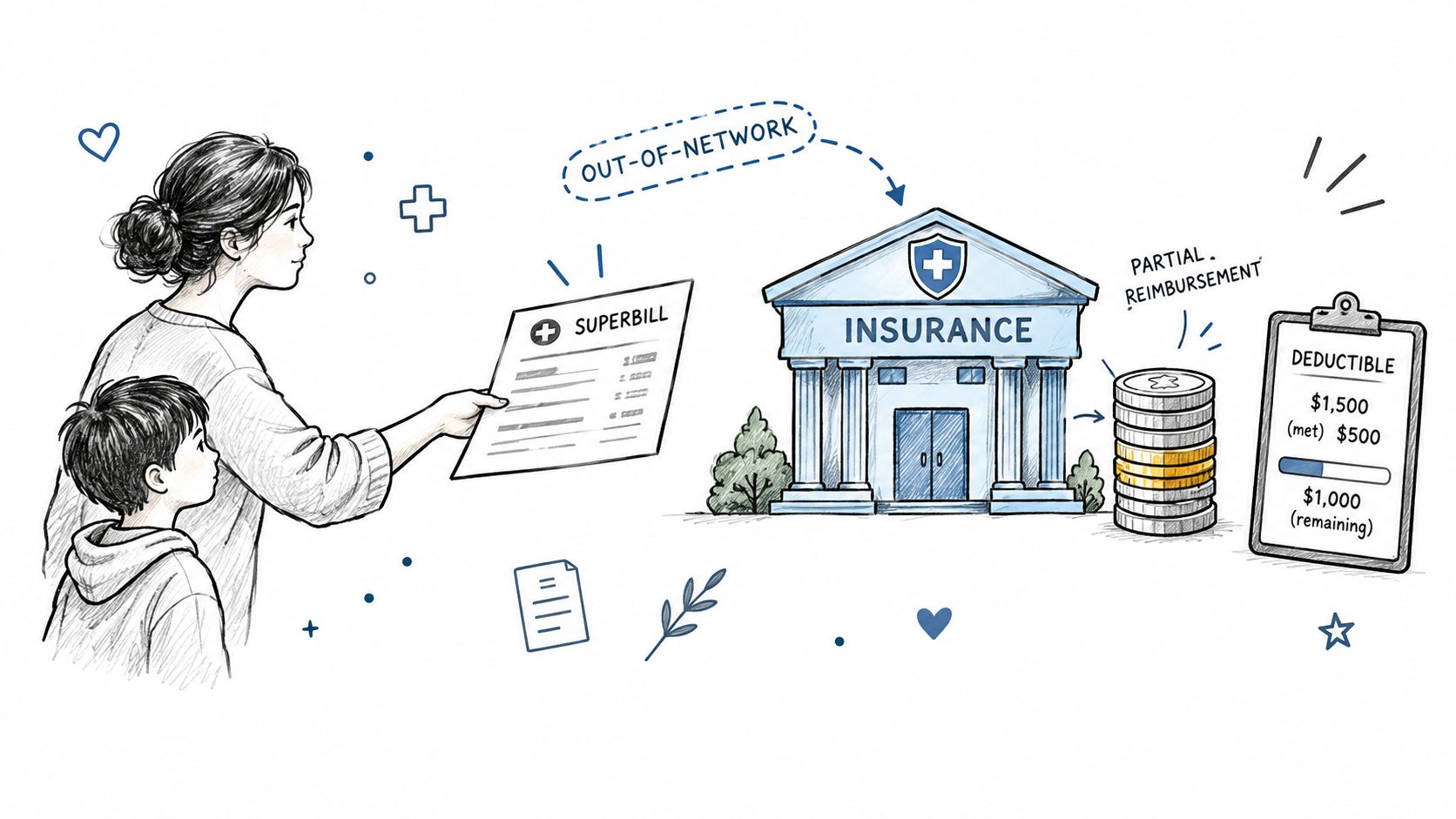
"Out of network" means the provider doesn't have a contract with your insurance company. Depending on your plan, you may still be able to submit claims for partial reimbursement. That usually involves paperwork, different cost-sharing rules, and more follow-up than families expect.
What to look for in your plan
Ask your insurer for the Summary of Benefits and Coverage and, if possible, a plain-language explanation of autism-related services. Then ask about your out-of-network deductible, coinsurance, prior authorization rules, and whether the plan requires a referral.
The hardest part is often not understanding whether out-of-network care exists, but understanding whether it is financially realistic for your family.
When no nearby in-network ABA provider is available, families are increasingly being told to ask insurers about out-of-network treatment at in-network rates through a gap exception or network adequacy request, a pathway discussed in the Autism Society Helpline FAQ.
A realistic example
A rural family may find one provider within driving distance, only to learn that provider is out of network. The clinic may offer a superbill, which is an itemized receipt used to submit claims to insurance. That doesn't guarantee reimbursement, but it gives the family something concrete to work with.
- Ask the provider's billing team: Do they prepare superbills, help with claim forms, or know whether other families with your plan have received reimbursement?
- Ask the insurer: Is prior authorization required before out-of-network claims can be considered?
- Ask yourself: If reimbursement is delayed or lower than expected, can we manage the temporary cash flow?
Your next step is to request written benefit details before you commit to a therapy schedule.
4. The Arc and State or Local Disability Organization Networks
A parent can spend all morning calling insurers and providers, then get more useful local information from one 15 minute conversation with a disability organization. That happens because chapter-based groups often know the local system the way a good librarian knows the shelves. They may not provide the service itself, but they can point you to the office, person, or program that families in your area use.
The Arc is one of the best-known examples. State and local disability organizations can also help. Their value is practical: they may know which county office handles respite, whether a recreation program is autism-friendly, which waiting lists move slowly, and where parents go for school advocacy support. Services differ by chapter, so it helps to treat these groups as local guides, not as a single national program with identical offerings everywhere.
That difference matters.
A website can give you names. A local chapter may tell you which names are worth calling first.
Caregiver strain is part of the reason this resource matters. A 2023 study found high levels of burden among caregivers of children with autism, according to this peer-reviewed caregiver burden study. For a tired parent, a warm handoff to the right county contact can be more useful than a long general resource list.
Here is the tradeoff to keep in mind. These organizations can shorten the search and help you understand the system around your child. They usually cannot approve Medicaid, force a school district to act, or guarantee that a grant or service slot will open soon. Some chapters are highly active. Others are small and may rely on volunteers, which can affect how quickly they respond.
If you call, keep the conversation focused on decisions you need to make now.
Ask:
- Which local programs help with respite, transportation, or short-term family support?
- Who in this area helps parents prepare for IEP meetings or school disputes?
- Is there a benefits planner, waiver case manager, or legal aid contact families use often?
- Which services have long waitlists, and which ones are realistic to pursue this month?
One more question helps avoid confusion: "Do you provide this service directly, or are you referring us to another agency?" That can save time and set expectations early.
A useful next step is to search for The Arc plus your city, county, or state, then request three names only: one for benefits help, one for school support, and one for parent or caregiver support. That gives you a small, workable starting point instead of another long list.
5. Internal Revenue Service Medical Expense Deductions and Dependent Care Accounts
A lot of families discover this resource late. They pay for evaluations, co-pays, mileage, summer care, or specialist visits for months, then realize tax rules might have helped them plan those costs differently.
This resource works best as a record-keeping and budgeting tool. It may help you keep more of your own money, but it does not create new services, speed up an insurance approval, or lower a clinic bill today. That difference matters. If Medicaid, school services, and insurance are the main doors to care, tax rules are closer to a receipt basket under those doors. The basket will not open the door, but it can help you recover part of what already went through.
Families usually look at two buckets here. One bucket is medical expense deductions, which may matter if eligible costs add up and you meet IRS rules. The other is employer benefits such as a health FSA, HSA, or dependent care account, which can sometimes let you pay certain expenses with tax advantages. The hard part is that autism-related expenses do not all fit neatly into one bucket.
A simple example shows where confusion starts. An evaluation may count differently from child care. Travel to a specialist may be treated differently from tuition or a camp. A dependent care account may help with care that lets a parent work, while a medical expense deduction focuses on qualifying medical costs. Same family budget. Different rulebook.
Before you assume an expense qualifies, ask a tax professional three direct questions:
- Which autism-related expenses in our records are most likely to be treated as medical expenses?
- Which expenses belong in an HSA or FSA, and which do not?
- Does our dependent care account apply to any care costs tied to work, or are we mixing up two separate rules?
One limitation is easy to miss. Good records matter as much as the expense itself. An itemized invoice, proof of payment, an Explanation of Benefits, and a mileage log can make the difference between a usable record and a stack of papers that does not answer the tax preparer's questions.
Start small. Open one folder, paper or digital, and drop in every therapy invoice, evaluation bill, insurance statement, and mileage note from this year. Then book a short call with your tax preparer or employee benefits office and ask them to sort those expenses into three columns: likely medical, likely dependent care, and unlikely to qualify. That gives you a clearer decision point than trying to guess from memory at tax time.
6. Nonprofit Grants and Charitable Organizations
A therapy spot opens, the deposit is due this week, and insurance still has not answered. That is often the moment families start looking at charitable help.
Nonprofit grants can cover part of a cost that no other system picks up, but they rarely function like ongoing insurance or school services. They are closer to a pressure-release valve. Helpful in the right moment, limited in amount, and often competitive.
Two examples show how different these programs can be. The UnitedHealthcare Children's Foundation gives medical grants to help families pay for health care services or equipment for children when those needs are not fully covered by insurance. Awards can be up to a few thousand dollars, depending on the case and program rules. Autism Care Today's Quarterly Assistance Program may help with items such as therapy, assistive technology, safety equipment, camps, or social skills programs, but families need to check current eligibility and application periods before counting on it.
That difference matters. One program may focus on medical expenses tied to insurance gaps. Another may allow a wider set of autism-related supports. A family trying to fund speech therapy, a communication device, or fencing for elopement risk could get very different answers from different nonprofits.
Before you spend hours on applications, sort the organization into one of three buckets: medical bill help, autism-specific family support, or local emergency assistance. That quick sorting step works like labeling folders before you start filing papers. It helps you avoid applying to a program that never covers the expense you have.
Questions to ask each group:
- What exact expenses do you fund: therapy sessions, evaluations, adaptive equipment, safety items, travel, camp, or respite?
- Do you pay the family or the provider: some grants reimburse after payment, while others send funds directly to a clinic or vendor.
- Is there an income limit or insurance requirement: some programs require proof that insurance denied or only partly covered the service.
- How often can a family apply: one-time awards and annual assistance programs work very differently.
- What is the decision timeline: a 6 to 10 week review period may be too slow for an immediate opening.
The main limitation is reliability. Grant programs can pause, run out of funds, or close their application window with little notice. Local charities also vary widely. A church fund, civic group, or community foundation may be flexible, but may know little about autism services and ask for simpler requests such as a specific invoice rather than a broad appeal for "therapy help."
A useful next step is to pick one immediate expense, one that has a bill, estimate, or written quote attached to it, and build one application packet around that single need. Include the diagnosis page, the invoice or cost estimate, any insurance denial or EOB you have, and two sentences that explain why the item matters now. Then apply to two or three programs whose rules match that expense, instead of sending the same general request everywhere.
7. Your Child's School District and Special Education Services
School support and medical coverage are different systems, but they often overlap in practical ways. A school district may not pay for private ABA in most situations, yet it can still be one of the most important autism parent resources because it can provide evaluations, classroom supports, therapies, and records that help you explain your child's needs elsewhere.
For many families, school is also where daily problems show up first. Trouble with transitions, communication, behavior, sensory overload, or peer interaction often becomes easier to document once the school team is involved.

What schools can often help with
If your child may qualify for special education, the district can evaluate and, if eligible, create an IEP. That can include supports such as speech services, behavior supports, classroom accommodations, or related services based on the child's educational needs.
Families looking for school-home coordination may also want examples of school support services for children receiving ABA-related help. Even when school and medical systems operate separately, sharing consistent goals can reduce confusion.
Limits to keep in mind
School services are based on educational access, not the same rules used by private insurance or Medicaid. So an evaluation that helps at school may still not answer every question an insurer asks.
Research on caregiver satisfaction also suggests that quality matters as much as availability. In Ontario, 1,810 primary caregivers completed a service-satisfaction survey, and related research linked service satisfaction with caregiver well-being while unmet needs remained common, as described in this autism service satisfaction study.
- Ask for evaluations in writing: Written requests usually create a clearer paper trail.
- Bring outside records: Diagnosis reports and therapy recommendations can help the team understand the bigger picture.
- Share school documents carefully: Ask providers and insurers which records are useful before sending large packets.
Your next step is to request the right contact person at school, often the special education office or school psychologist.
8. Online Insurance and Benefits Planning Tools
Sometimes the fastest useful answer is in your online portal, not on hold with customer service. Insurance company websites, Healthcare.gov, and state marketplaces can help you compare plan structures, check provider directories, and download key documents during open enrollment or after enrollment.
This doesn't make the system easy, but it does make it more visible. You can usually find terms that affect autism care costs, such as deductible, coinsurance, out-of-pocket maximum, and referral requirements.
Best use of these tools
Use portals to gather documents before making calls. If you already have the Summary of Benefits and Coverage, current provider directory, and any behavioral health policy language in front of you, your phone call with the insurer tends to go better.
A common scenario: one parent logs into the portal and sees that "behavioral health" is listed but can't tell whether that includes ABA, parent training, or autism evaluations. That's the moment to call and ask for a written explanation in plain language.
What these tools can't tell you well
Directories may lag behind real provider availability. A clinic can appear in network online and still have a closed waitlist, limited age range, or no current evaluator on staff.
A provider directory answers "who is listed." It doesn't always answer "who can actually see my child soon."
Your next step is to compare the online directory with at least one live call to a provider and one live call to the insurer. If those answers don't match, ask for the discrepancy to be noted in writing.
9. Medicaid Waiver Programs and Home and Community-Based Services
Waiver programs can be powerful, but they can also be slow and confusing. Home and Community-Based Services, often called HCBS waivers, are state-specific programs that may help fund supports outside a standard Medicaid package. Depending on the state, that could include respite, parent training, care coordination, or other disability-related services.
The key word is "may." Waiver rules, eligibility, and waitlists differ widely.
Why families should check early
A family may not qualify right away, or a waitlist may be long, but that still doesn't mean the program should be ignored. Early application can matter because some states process services through long queues or separate developmental disability systems.
This is especially important because broad insurance rules don't look the same across the country. A widely cited summary notes that all 50 states and Washington, D.C. have enacted autism insurance mandates that may require ABA coverage, but the rules can differ significantly by state, including age limits, benefit caps, and whether self-funded employer plans are included, according to this state-by-state autism insurance summary.
How parents use waivers in real life
A family might use standard insurance for one set of services while also applying for waiver-based supports that address respite or long-term community needs. Families seeking in-home options may also explore home-based ABA support pathways when available in their area.
- Ask which agency runs the waiver: In some states, it's not the same office as standard Medicaid.
- Ask about the waitlist and required paperwork: You don't want to discover missing records months later.
- Ask how providers get paid: Even if your child qualifies, not every provider may accept that funding route.
Your next step is to call both the Medicaid office and the developmental disabilities agency if your state separates them.
10. State Disabilities Planning and Benefit Specialists
It is 9:30 p.m. You are finally looking at the stack of papers on the kitchen table, and one question keeps coming up: if we save money for our child, change jobs, or plan for adulthood too late, could that create problems with benefits later?
State disabilities planning and benefit specialists help with that kind of question. They do not replace your insurer, your school team, or a lawyer. They help you sort out how public benefits, work income, savings tools, and longer-term disability planning may fit together so one decision today does not create a surprise later.
A useful way to place this resource in the larger list is to see it as a map for later-stage decisions. Insurance can tell you whether a therapy claim may be covered. A waiver office can tell you whether your child may qualify for a service. A benefits planner helps you ask a different question: how do all these pieces affect each other over time?
That question shows up earlier than many families expect. A 2021 policy brief from the Heller School at Brandeis found that many families raising a child with autism reported meaningful out-of-pocket health care costs, including expenses that took a noticeable share of household income, according to the Brandeis autism family financial burden brief.
Here is what these specialists can usually help you do:
- Compare benefit-related choices, such as whether savings in an ABLE account are handled differently from money kept in a standard account.
- Explain how work, earned income, or a future job for your child could affect SSI, Medicaid, or related programs.
- Point out when a planning question has crossed into legal territory and should go to a special needs planning attorney.
Here is what they usually cannot do. They often cannot approve benefits, speed up a waitlist, write legal documents, or guarantee that a future rule will stay the same. Rules also differ by state, and some programs focus more on adult disability benefits than on the daily concerns of parents with younger children.
That limitation matters. If you call expecting direct financial aid, you may leave frustrated. If you call with one focused question, the conversation is often more useful.
Try questions like these:
- We are thinking about saving for future support. What options should we learn about first, and what tradeoffs should we understand?
- If one parent changes work hours or income, which benefits should we recheck before making the change?
- At what point do we need a lawyer, accountant, or estate planning professional instead of a benefits counselor?
Your next step is simple: find your state's WIPA program or disability benefits planning contact, then book one conversation around your biggest decision, not your whole future plan. One clear question is enough to start.
Side-by-Side Comparison of 10 Autism Parent Resources
| Resource / Service | Core features | Experience & Quality (★) | Cost / Financial support (💰) | Primary audience (👥) | Unique value / USP (✨🏆) |
|---|---|---|---|---|---|
| Autism Speaks Resource Hub & Family Services Directory | State-specific guides, provider directories, hotline, insurance toolkits | ★★★★ Trusted, broad state coverage | 💰 Free guides + grant listings | 👥 Families seeking comprehensive state resources | ✨ State-by-state breadth; 🏆 national credibility |
| State Medicaid Programs (EPSDT & CMS) | Medicaid/EPSDT coverage pathways, prior auth, appeals processes | ★★★★ Authoritative but state-variable | 💰 Often low/no copay; can cover substantial hours | 👥 Medicaid-eligible/low-income families | ✨ Potential for broad coverage; 🏆 most affordable if eligible |
| Private Insurance Out-of-Network Benefits & Reimbursement Mapping | Superbills, reimbursement rates, deductible/coinsurance mapping | ★★–★★★ Variable accuracy; admin burden | 💰 Upfront payment then partial reimbursement | 👥 Families with private plans lacking in-network ABA | ✨ Expands provider choice; faster access vs waitlists |
| The Arc & State/Local Disability Networks | Local chapters, referrals, advocacy, respite listings | ★★★ Community-rooted, locally knowledgeable | 💰 Mostly free local support; grant referrals | 👥 Families seeking local advocacy & supports | ✨ Deep local ties; 🏆 strong community advocacy |
| IRS Medical Expense Deductions & Dependent Care Accounts | Tax deductions (7.5% AGI), FSA/HSA, travel deductions | ★★ Depends on tax situation & record-keeping | 💰 Potential tax savings; FSA/HSA pre-tax benefits | 👥 Families with sizable medical expenses/tax liability | ✨ Reduces net cost via tax strategy (consult pro) |
| Nonprofit Grants & Charitable Organizations | One-time grants, need/merit-based awards, local funds | ★★ Competitive; variable turnaround | 💰 Non-repayable $500–$5,000 (typically one-time) | 👥 Under/uninsured families needing startup funds | ✨ Free direct funding to start therapy |
| School District & Special Education (IEP, evaluations) | Free evaluations, IEPs, school-based therapies, documentation | ★★★ Variable by district; legally mandated services | 💰 No-cost school services during school hours | 👥 School-aged children needing educational supports | ✨ Free evaluations + documentation to support insurance/appeals |
| Online Insurance & Benefits Tools (Insurer sites, Healthcare.gov) | Plan comparisons, provider directories, SBCs, enrolment filters | ★★ Convenient but often outdated directories | 💰 Free self-service; helps compare plan cost impacts | 👥 Families shopping plans during open enrollment | ✨ Fast side-by-side plan comparison; filter behavioral benefits |
| Medicaid Waiver Programs & HCBS | Waiver funding for ABA, respite, care coordination, flexible services | ★★★ Variable by state; often long waitlists | 💰 Potentially generous funding; waitlist delays | 👥 Families seeking comprehensive/state-funded supports | ✨ Can fund extensive ABA services; 🏆 comprehensive when active |
| State Benefit Specialists (WIPA, ABLE, planning) | WIPA consultations, ABLE account guidance, benefit preservation | ★★★★ Free expert planning; tailored advice | 💰 Low/no-cost planning; ABLE tax-advantaged savings | 👥 Families planning long-term benefits & savings | ✨ Preserves benefits while saving; expert benefit strategies |
Turn a Long Resource List Into One Next Step
When everything feels urgent, the best move is usually smaller than you think. Don't try to solve insurance, therapy, school, taxes, grants, and long-term planning in one week. Pick the most immediate problem.
If your child needs care now, start with coverage and provider access. If school is the daily crisis, start with evaluations and support requests. If cost is stopping you from moving forward, start with the official payer, then ask about out-of-network paths, grants, and local disability organizations.
Keep your paperwork simple. Gather the diagnosis report, any developmental or psychological evaluations, your insurance card, plan documents, and notes from provider calls. Put them in one folder. If a provider or agency asks for something you don't have, add that to a short follow-up list instead of trying to memorize it.
Then track every contact. Write down the date, name of the person you spoke with, reference number if given, what they said, and what they told you to send next. If an answer matters, ask for it in writing. Families often save time later by building that paper trail early.
One more point matters here. Waitlists and system delays are not just a family-level problem. Recent family guidance continues to highlight long waitlists, referral bottlenecks, and uneven local support, which is why parents often need location-specific and availability-aware help, not just general information, as reflected in the AACAP Autism Resource Center.
It's also okay to ask for help translating the system into plain language. Autism parent resources are most useful when they don't just hand you a list, but help you decide what to do with that list.
Nothing in this process is one-size-fits-all. Medicaid rules vary by state. Private insurance terms vary by plan. Grant decisions, provider acceptance, tax treatment, and waiver eligibility all depend on individual circumstances. It's worth confirming each major step with the organization responsible for that benefit or with a qualified professional who can advise on your situation.
If you're in one of ABA Finder's service areas and you want help narrowing the next step, it's reasonable to ask for support. A short conversation about providers, insurance, out-of-network possibilities, or affordability questions can sometimes bring order to a process that feels scattered.
ABA Finder helps families sort through provider options, insurance questions, out-of-network possibilities, and affordability concerns in select service areas, without pushing you into a commitment. If you want a clearer starting point for finding ABA care or understanding what options may fit your situation, visit ABA Finder.
Our Latest Insights








Every Child Deserves Access To Quality ABA Therapy
Whether you're searching for providers, exploring financial assistance, or trying to better understand your insurance options, we're here to help you take the next step with confidence.