



After Autism Diagnosis What to Do Next for Your Child
Feeling overwhelmed after autism diagnosis? Get clear next steps for support, insurance, and early intervention to help your child thrive.


You may be sitting in your car with a stapled report on the passenger seat, searching your phone with one hand and trying not to cry with the other. Or maybe you already suspected autism for months, and now that it's finally written down, the next problem has hit you harder than the diagnosis itself. How do I get help? Who do I call first? What does insurance even cover?
That reaction makes sense. The days after a diagnosis often feel less like clarity and more like paperwork, waitlists, phone calls, and unfamiliar terms. Parents usually aren't asking abstract questions. They're asking practical ones. Can my child start therapy soon? Do I need another referral? Does Medicaid count? What if the only provider with an opening is out of network?
The good news is this. A diagnosis is not the end of the story. It's the point where support can start to become more concrete. Autism can often be identified very early, and the CDC reports that autism prevalence among 8-year-olds reached 1 in 31 children (3.2%) in its 2022 surveillance data, with related U.S. survey data showing a median age of diagnosis of 47 months, and about half of children with autism evaluated by age 3, according to the CDC autism data table. That matters because many families begin this process after a long stretch of concerns, screenings, and delays. You are not late because you are doing this now.
I'm using person-first language here, such as “child with autism,” because many families search that way and many professionals still use it. Some autistic people prefer identity-first language, such as “autistic child.” Both are used in real life. If your family has a preference, use the one that feels respectful and right to you.
Table of Contents
- Week one needs a paper trail
- Share the diagnosis on a need-to-know basis
- Make three calls, not thirty
- Find support that lowers panic, not raises it
- What families are usually asked to provide
- What happens after the form is submitted
- Provider matching depends on location and capacity
- Documents to have ready before the first call
- Private insurance, Medicaid, and out-of-network are different lanes
- Common Ways Families May Access ABA Coverage
- State rules can change the answer
- Ask these questions before you choose a provider
- Don't chase labels. Track progress.
- What to ask a provider about goals and intensity
- The evidence is useful, but not magic
- Make home feel simpler, not stricter
- Help other adults work from the same playbook
- Protect your own bandwidth
Introduction After Autism Diagnosis and What Comes Next
The hardest part after autism diagnosis usually isn't accepting the report. It's turning a diagnosis into a care plan that works in real life.
A lot of families expect one clear next step. They don't get one. They get a binder of papers, maybe a recommendation list, maybe a referral, maybe a vague suggestion to “look into ABA, speech, OT, school services, and insurance.” That's too much at once.
Start with order, not urgency
You do not need to solve your child's entire future this week. You do need to get organized fast enough that the system doesn't outrun you.
Here's the order I recommend:
- Secure the documents. Keep the diagnostic report, referral notes, prior evaluations, and insurance cards together.
- Loop in the people who matter. Your child's pediatrician, daycare or school if needed, and any early intervention or therapy contacts.
- Clarify what kind of help you're seeking. Not every family needs the same path.
- Check coverage before you commit. This step saves a lot of grief.
- Track every call and promise. Names, dates, and reference numbers matter.
Parents often lose time because they move straight into provider searches without knowing whether they need a referral, prior authorization, or proof of medical necessity. That creates avoidable delays.
Practical rule: Don't start by searching for “best autism therapy near me.” Start by figuring out what paperwork and coverage rules your child's next provider is likely to ask for.
The first goal is access
After autism diagnosis, your first goal isn't perfection. It's access. Access to an intake call. Access to a benefits check. Access to a provider who serves your area. Access to school supports and medical supports that can work together instead of leaving gaps.
That matters because the support system is patchy. Autism diagnosis still depends on developmental history, observation, and clinician expertise rather than a biomarker, and families often get uneven guidance on what to do next, as discussed in this policy review on post-diagnosis pathways and coverage barriers. In plain English, families are often told what the diagnosis is, but not how to get through the next month.
That's why a simple plan beats a perfect one.
Your First Weeks After Diagnosis Made Manageable
In the first two weeks, your job is not to become an autism expert. Your job is to create enough structure that you can make good decisions under stress.
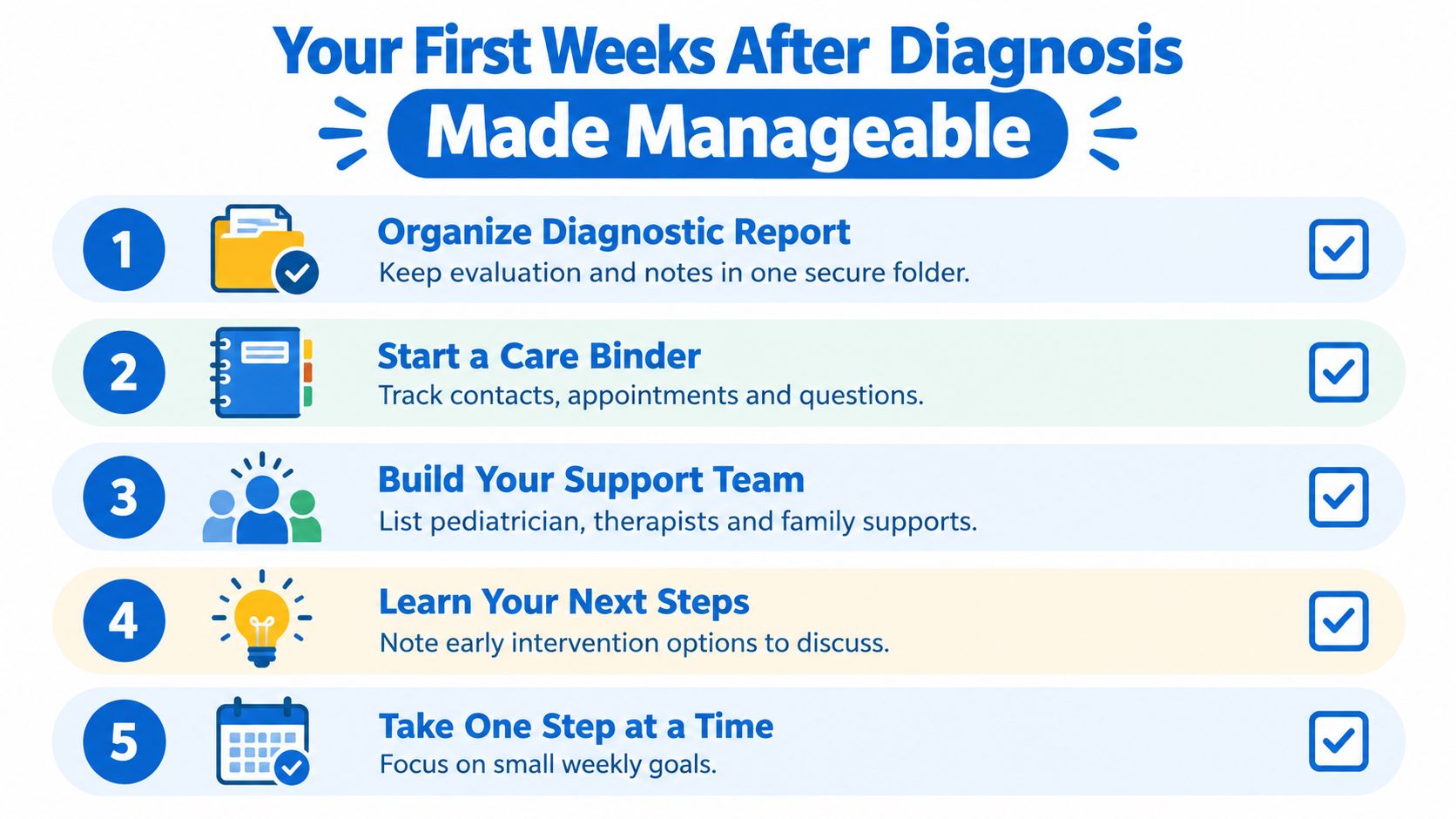
Week one needs a paper trail
Start with the report. Save a digital copy in a secure folder. Print one paper copy. If the evaluator gave you scoring pages, recommendations, or referral notes, keep those attached.
Then build a simple care binder or notes app with these sections:
Diagnosis documents
Include the full evaluation, referral notes, and any developmental history forms.Insurance details
Add the front and back of insurance cards, member ID, and customer service numbers.Contact log
Write down the name of every provider, insurer representative, school contact, and intake coordinator you speak with.Questions list
Keep a running page for things you don't want to forget during calls.
This sounds basic because it is. Basic systems save families every day.
Share the diagnosis on a need-to-know basis
You don't owe everyone a polished explanation. Tell the people who need the information to support your child well.
That may include:
Your child's pediatrician
Ask that the report be added to the medical chart and ask whether referrals are needed for therapy.Daycare, preschool, or school staff
Share what helps your child, not just the label.Close family members
Give them one or two practical ways to help. Childcare during appointments counts as help. So does listening without giving advice.
Keep your update simple: “Our child was diagnosed with autism. We're taking this one step at a time and starting to look at services. What helps most right now is patience and practical support.”
Make three calls, not thirty
The fastest way to melt down is to call everyone at once. Pick your first three contacts.
A smart starting set is:
- Pediatrician or diagnosing provider
- Insurance company or Medicaid plan
- One therapy intake line or early intervention program
That creates momentum without chaos.
If your child is very young, ask about early intervention services in your area. If your child is school-age, ask both medical and school-based contacts what support can begin now. Those are different systems. Don't assume one replaces the other.
Find support that lowers panic, not raises it
Some online groups help. Some just spread fear. Be choosy.
Look for resources that answer practical questions, explain acronyms, and respect your child. Avoid spaces that promise miracle outcomes, push expensive treatments with no clear rationale, or make you feel like you're already failing.
The best early support is often boring. A good report, a clear referral, a copied insurance card, and one helpful phone call can do more for your family this week than hours of frantic searching.
How the Intake and Assessment Process Typically Works
Once you reach out for ABA support, families usually feel better when they know what the process looks like. Not the marketing version. The version.
Most reputable programs start with an intake, which is the first information-gathering step. You share basic details so the provider or referral team can figure out whether they serve your area, whether they work with your child's age and needs, and what documents they'll need to move forward.
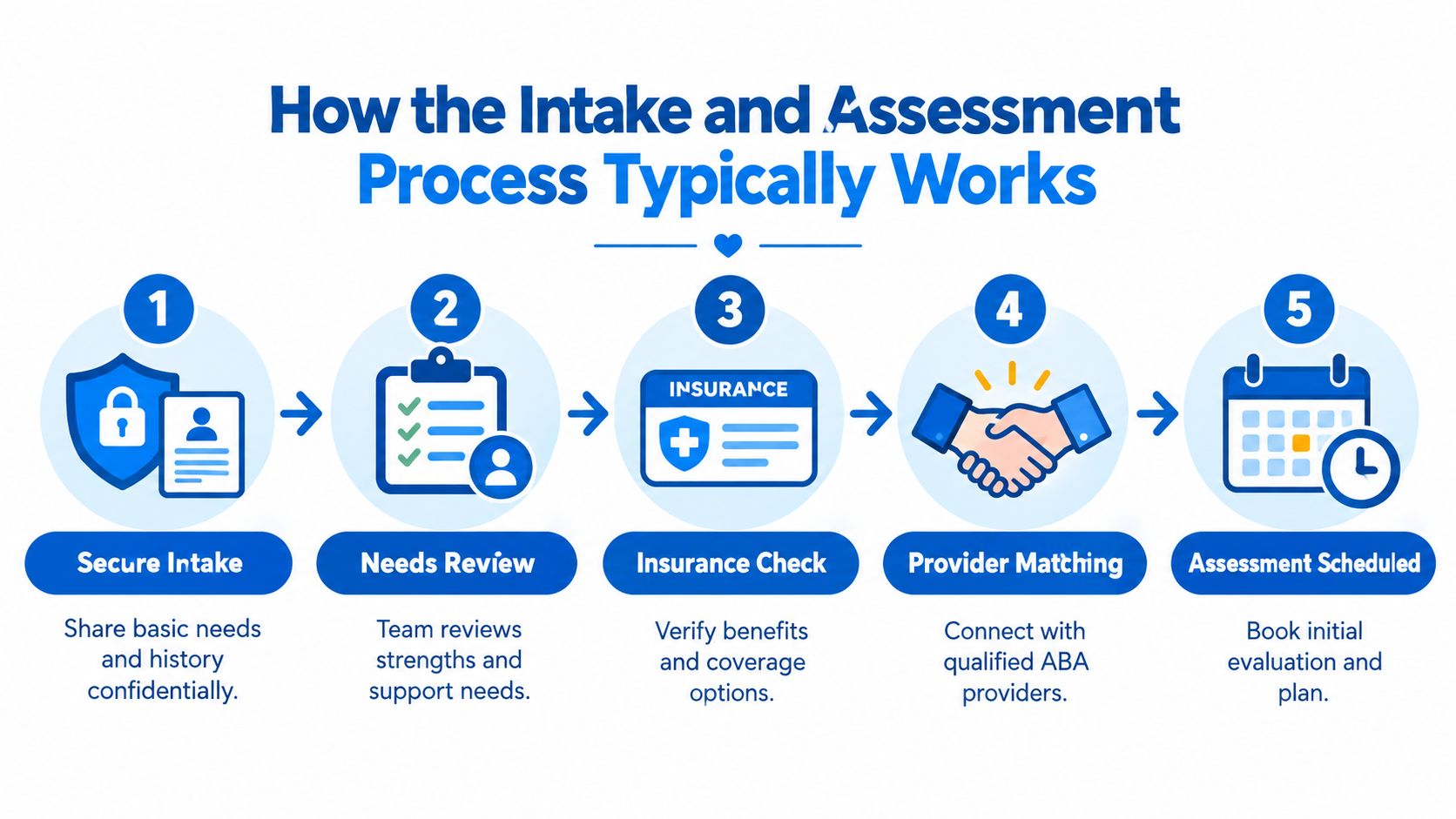
What families are usually asked to provide
Expect a provider or support service to ask for a short list of basics first.
Child and caregiver information
Name, age, address, and the best contact details.Diagnosis and referral documents
The autism evaluation, and sometimes a pediatrician referral depending on plan rules.Insurance information
Private insurance, Medicaid details, or both if your child has secondary coverage.Service preferences
Home-based, clinic-based, school collaboration, schedule needs, or language preferences.Current concerns and strengths
Communication, routines, behavior challenges, safety concerns, toileting, feeding, or daily living skills.
This isn't busywork. It helps the provider decide whether they can realistically serve your family.
What happens after the form is submitted
A good intake process should feel orderly. First comes a review of your child's information and the service area. Then someone usually checks whether there appears to be a possible coverage path, available openings, or a waitlist.
If there's a potential fit, the next step is often a conversation about an initial assessment. That assessment helps the clinical team understand your child's current skills and support needs before making treatment recommendations. If you want a helpful overview of that part, this guide on what to expect during your first ABA assessment is a strong starting point.
Provider matching depends on location and capacity
Many parents get frustrated. A provider may look ideal online and still not work out. Maybe they don't serve your zip code. Maybe they only see younger children. Maybe they're full. Maybe they take your insurance in one county but not another.
That's normal. It's not a sign you've done anything wrong.
If you're using a service that helps with matching, expect them to look at practical filters first:
| Matching Factor | Why It Matters |
|---|---|
| Location | Some providers only serve specific counties or commuting areas |
| Insurance path | In-network, Medicaid participation, or possible out-of-network route |
| Age and support needs | Not every provider serves every profile |
| Scheduling | A provider with one after-school slot may not fit your child's needs |
| Current capacity | Openings change quickly |
Documents to have ready before the first call
Keep these in one folder before any intake call:
- Full diagnostic report
- Insurance card images
- Referral if one exists
- List of current therapies or evaluations
- School or daycare schedule
- Your top three goals for help right now
If you feel lost, lead with one sentence: “My child was just diagnosed with autism, and I need help understanding what services may be available and what documents you need from me.”
That sentence gets you much farther than trying to sound like you already know the system.
Understanding Insurance and Ways to Help Make Care Affordable
Money and coverage are where families often get stuck after autism diagnosis. This is also where bad assumptions cost time.
Don't assume your insurance covers ABA just because autism treatment is mentioned in the plan. Don't assume Medicaid works the same in every state. Don't assume an out-of-network provider means you have no path at all. Check the details.
Private insurance, Medicaid, and out-of-network are different lanes
With private insurance, families often run into terms like deductible, prior authorization, medical necessity, and in-network provider. In plain language, a deductible is the amount you may need to pay before your plan starts sharing costs, and prior authorization means the insurer may require approval before treatment begins.
With Medicaid, rules can be broader for children, but they still vary by state. The Centers for Medicare & Medicaid Services says children from birth to age 21 are protected by EPSDT, and that Medicaid does not require one single autism treatment model, including ABA. States decide what is medically necessary for an eligible child, so coverage can vary even though EPSDT obligations apply, according to CMS guidance on autism treatment coverage and state discretion.
A separate CMS toolkit says that if a child had a screening or diagnostic evaluation before Medicaid enrollment, that earlier evaluation can still help trigger EPSDT follow-up diagnostic services and medically necessary treatment after enrollment, depending on eligibility and state rules, as explained in the CMS autism services and ABA toolkit.
Common Ways Families May Access ABA Coverage
| Coverage Path | How It Typically Works | Questions to Ask |
|---|---|---|
| Private insurance in network | The provider bills your insurer directly if they participate with your plan. You may still have cost-sharing, and prior authorization may be required. | “Are you in network with my exact plan?” “Do you obtain authorization?” “What costs may still be my responsibility?” |
| Medicaid | Coverage may depend on your state's rules, your child's eligibility, diagnosis documentation, referral requirements, and medical necessity review. | “Does my child's Medicaid plan cover ABA or related autism treatment?” “Do we need a recent diagnosis or referral?” |
| Out-of-network reimbursement | The family may pay the provider at the time of service, receive a superbill with diagnosis and provider details, and then submit it to the insurer. Reimbursement may be subject to the deductible and out-of-network rate, and some plans may offer no out-of-network benefits at all, based on this explanation of how ABA superbills and out-of-network reimbursement typically work. | “Do I have out-of-network benefits?” “Do I need preapproval?” “What paperwork do you need with a superbill?” |
State rules can change the answer
State-specific Medicaid rules matter more than parents expect. A clear example comes from Texas. Autism Speaks says the Texas Medicaid ABA benefit became effective February 1, 2022, and that a child must be under 21, have an ASD diagnosis within the last 3 years, have a diagnosis level of 1, 2, or 3, and receive a referral from an enrolled Medicaid provider, according to this Texas Medicaid ABA benefit summary. That doesn't mean every state follows Texas. It means families need to verify rules where they live.
Autism Speaks also summarizes CDC-related findings showing that 67.3% of children with autism were identified through special education eligibility, and nearly 18% were identified on that basis alone without a documented medical diagnosis, which can create problems when school-based support ends and families need medically based care, as explained in the Autism Speaks CDC prevalence update FAQ.
Ask these questions before you choose a provider
Use this script when you call your insurer:
- “Does my child's plan cover ABA or other autism treatment?”
- “Do we need prior authorization before starting?”
- “Is a referral required from the pediatrician?”
- “Do you have out-of-network benefits for this service?”
- “What documentation do you need for reimbursement?”
- “Is there a deadline for claim submission?”
Use this script when you call a provider:
- “Do you accept my specific insurance plan?”
- “Do you work with Medicaid in my state?”
- “If you're out of network, do you provide a superbill?”
- “Can you explain what families usually pay upfront, if anything?”
- “Who handles authorization and reauthorization?”
A lot of parents need broader help than one phone call can provide. This roundup of autism parent resources can help you build a more complete support list.
Ask for the exact plan rules in writing if possible. Families often remember the general answer and miss the detail that changes everything.
Starting Early Intervention and Exploring ABA Options
Once you've begun sorting out access and coverage, the next question is treatment. Families often hear “start early” and then panic. Don't panic. Start thoughtfully.
Research supports the idea that early intensive behavioral intervention is often most effective when started as soon as the family is ready. One evidence-based benchmark recommends about 20 hours per week of active early intervention focused on social communication, followed by a formal progress review after the first 12 months, or sooner if the child isn't progressing or is advancing rapidly, according to this NDIS evidence summary on early intervention and the Early Start Denver Model.
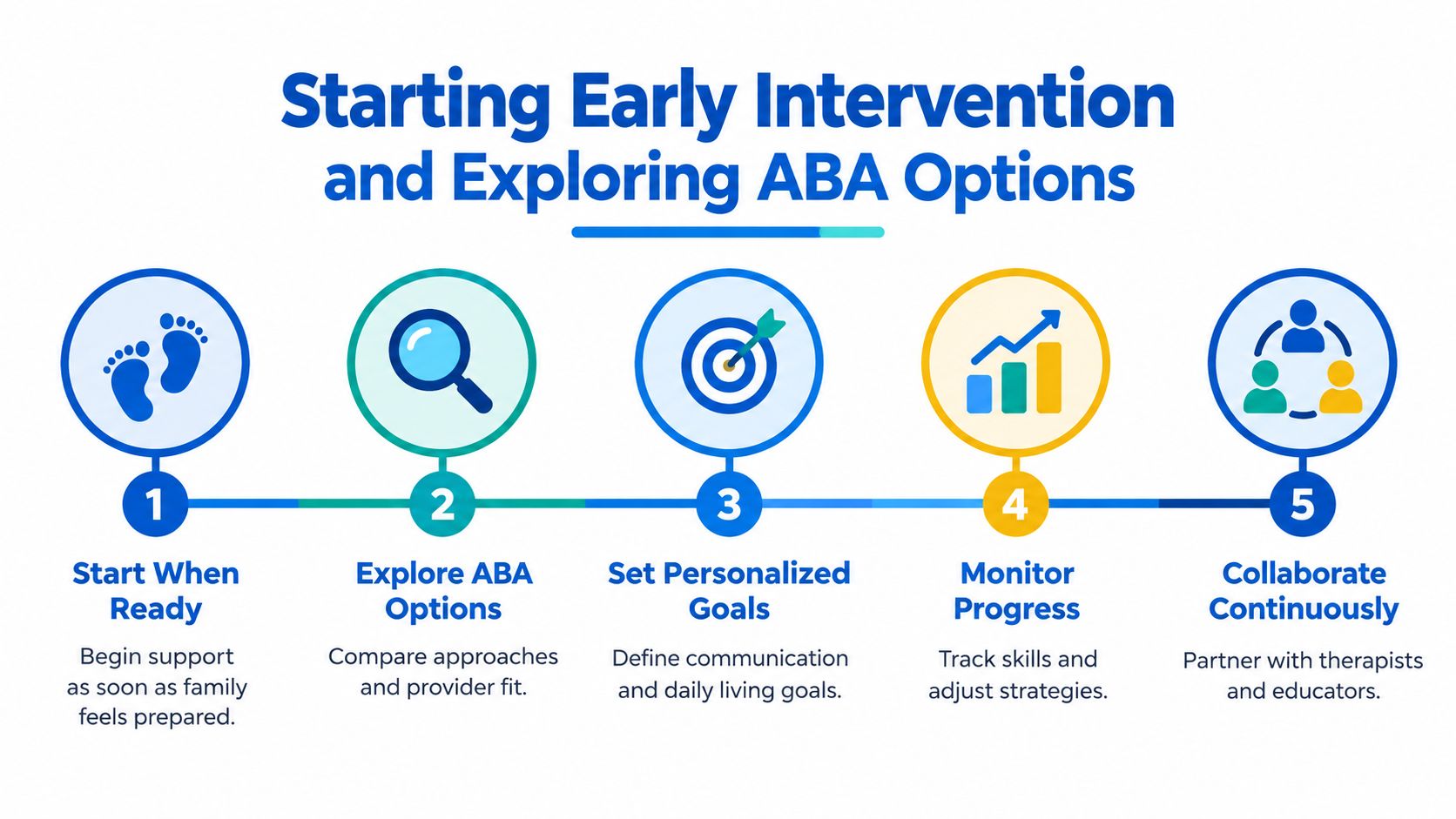
Don't chase labels. Track progress.
Families get overwhelmed by therapy names. ABA. Naturalistic ABA. ESDM. Parent coaching. Social communication support. The label matters less than whether your child's goals are clear and progress is being measured.
A major lesson from the evidence is that outcomes vary. In the long-term randomized ESDM study, children maintained developmental gains over a 2-year follow-up in intellectual ability, adaptive behavior, symptom severity, and challenging behavior, and compared with community intervention later showed improved core autism symptoms and adaptive behavior. But a naturalistic study also found high variability, and intervention type alone did not predict global or adaptive outcomes. That means families should not lock into a fixed plan and assume the name of the therapy guarantees the outcome.
What to ask a provider about goals and intensity
Use questions that force specifics:
“What skills will you measure first?”
Ask for a baseline, not general impressions.“How will you know this plan is helping?”
You want frequent review of communication, daily living, and behavior goals.“How often will goals be updated?”
If the answer is vague, keep asking.“How do you change the plan if progress stalls?”
Good providers can explain how they adapt.
For a broader look at therapy approaches, this overview of the best autism therapy options can help you compare what different supports may look like in practice.
Here's a short visual explanation many families find useful before provider calls:
The evidence is useful, but not magic
A meta-analysis found modest but measurable average effects from early intervention, including improvement in cognitive ability (g=0.32), daily living skills (g=0.35), and motor skills (g=0.39), while effects on expressive language, receptive language, communication, socialization, and adaptive behavior were not consistently better than comparison care, according to this systematic review and meta-analysis of early autism interventions. The same review also noted that very early support programs may show little to no difference in autism symptom outcomes by age 3.
That's why I'm opinionated about this. Do not judge a therapy by its brochure. Judge it by whether your child's day-to-day functioning is improving in ways that matter to your family.
Better care is matched care. A strong provider sets goals your child can actually use, tracks them often, and changes course when the data or daily life says the plan isn't working.
Practical Caregiving Tips and Your Next Step With ABA Finder
The systems work matters. Daily life matters just as much.

Make home feel simpler, not stricter
Children with autism often do better when home feels predictable. That doesn't mean rigid. It means clear.
Try these basics:
Use visual routines
A simple picture schedule for morning, meals, bath, and bedtime can reduce stress.Keep directions short
One step at a time usually works better than long explanations.Notice sensory patterns
If certain sounds, clothes, lights, or transitions trigger distress, write it down and tell your providers.Build in recovery time
School, daycare, errands, and therapy can be a lot. Some children need quiet time after demanding parts of the day.
Help other adults work from the same playbook
Consistency matters more than perfection. If grandparents, teachers, babysitters, or therapists all respond differently, your child may get mixed messages and more stress.
A short cheat sheet helps. Include:
| What to Share | Example |
|---|---|
| Communication tips | “Give one direction at a time” |
| Known triggers | “Loud hand dryers are hard” |
| Helpful supports | “Visual countdowns help with transitions” |
| Comfort tools | “Headphones and favorite toy help during waiting” |
Protect your own bandwidth
Parents often spend every ounce of energy chasing services and then wonder why they're snapping at everyone by Friday. You need a system that is sustainable.
Pick one admin day each week for calls and forms. Keep one master note on your phone. Ask one trusted person to help with logistics if they can. You do not have to carry every task alone.
Your child needs a steady parent more than a parent who answers every question immediately.
If you're unsure what therapy path, provider fit, or coverage route may make sense for your family, it's okay to ask for help sorting through the options.
ABA Finder helps families make sense of what happens after autism diagnosis by reviewing provider options, insurance questions, out-of-network possibilities, and affordability pathways in select states. If you want a calmer starting point, you can visit ABA Finder to learn more and request no-obligation help understanding what options may be available for your child.
Our Latest Insights





Every Child Deserves Access To Quality ABA Therapy
Whether you're searching for providers, exploring financial assistance, or trying to better understand your insurance options, we're here to help you take the next step with confidence.