



Best Autism Therapy Options for Your Child
Explore the best autism therapy options for your child, including ABA, speech, occupational, and developmental models, with practical guidance for families.

You're sitting in the car after an appointment, staring at a phone crowded with therapy names. ABA, speech therapy, occupational therapy, developmental programs, insurance forms, waitlists. You're relieved to have a clearer explanation for what your child has been experiencing, but you may also feel grief, fear, and pressure to make the perfect decision immediately.
There isn't one universal best autism therapy. The better question is: What therapy package can help this child, fit this family, and continue long enough to matter? Evidence matters, but so do access, cost, trust, transportation, school schedules, and your child's comfort.
The recommendations below are designed to help you build a practical, evidence-informed plan without chasing every option at once. Take a breath. You don't have to solve your child's entire future in one afternoon.
Table of Contents
- When the Therapy Question Feels Overwhelming
- Applied Behavior Analysis
- Speech-language therapy
- Occupational therapy
- Developmental and relationship-based models
When the Therapy Question Feels Overwhelming
A parent once described the first few weeks after an autism evaluation as “trying to build a map while standing in fog.” Every conversation seemed to add another road. One person emphasized ABA, another mentioned speech therapy, and a school team focused on classroom support. Meanwhile, the family still had to manage meals, sleep, siblings, work, and the ordinary demands of the day.
That confusion is understandable. Autism affects children differently, and therapy goals can range from requesting a favorite toy to tolerating toothbrushing, joining classroom activities, communicating pain, or becoming more independent at home. A program that makes sense for one child may be exhausting or poorly matched for another.
The right plan is the one your child can engage with and your family can keep going.
I'm opinionated about this because families are often pushed toward a single label. ABA may be appropriate and valuable, but it isn't automatically the complete answer. Speech therapy may be essential for communication, while occupational therapy may make daily routines possible. A developmental model may help a child connect through play and relationships. These approaches can complement one another.
The strongest choice usually weighs four questions:
- What does your child need most right now? Communication, safety, independence, social connection, sensory regulation, or learning readiness may take priority at different times.
- What does the evidence support? Research can help you set realistic goals, but it doesn't replace individual observation.
- What can your family sustain? A theoretically excellent plan that repeatedly collapses because of travel, cost, or exhaustion isn't a workable plan.
- Can the team measure meaningful progress? You should be able to see how goals connect to home, school, and community life.
This article won't crown one winner. It will help you compare the main options, understand what research can and can't tell you, and choose a starting point you can revisit. Your first decision doesn't have to be permanent. It needs to be thoughtful, feasible, and kind to the people living it.
The Main Therapy Types Families Should Know
Families usually encounter four broad therapy groups. They overlap, and each contains different methods, settings, and levels of support.
Applied Behavior Analysis
Applied Behavior Analysis, or ABA, uses observation and structured teaching to build useful skills and reduce barriers to learning. A practitioner might teach communication, dressing, toileting, play, safety, waiting, or participation in routines. The work can happen at home, in a clinic, at school, or in the community.
Modern ABA should be individualized and focused on meaningful goals, not on making a child appear less autistic. Sessions may include play, practice in everyday routines, caregiver coaching, and careful review of progress data. The CDC's overview of autism and ABA-style approaches identifies ABA alongside approaches such as discrete trial training, early intensive behavioral intervention, response treatment, and verbal behavior intervention.
A 2023 meta-analysis of 11 studies involving 632 children with ASD found a medium improvement in intellectual functioning, with a standardized mean difference of 0.51, and a smaller gain in adaptive behavior, with an SMD of 0.37, compared with usual or minimal treatment. The same analysis found no clear added benefit for language abilities, symptom severity, or parental stress, which is an important reminder that results differ by outcome. Read the 2023 meta-analysis on PubMed.
Speech-language therapy
Speech-language therapy focuses on communication. That may include spoken language, gestures, picture systems, communication devices, understanding directions, conversation, or communicating wants and needs.
A session might involve play with motivating toys, practicing sounds, using an augmentative and alternative communication system, or helping a child understand and use language in daily situations. Speech therapy often works best when the therapist coordinates with caregivers, teachers, and other providers so communication practice continues outside the therapy room.
Occupational therapy
Occupational therapy, or OT, supports participation in everyday activities. Depending on the child, goals may involve fine-motor skills, dressing, feeding routines, handwriting, movement, sensory preferences, or managing transitions.
An OT session could include games, movement activities, practice with clothing fasteners, food exploration, or strategies for making a morning routine more manageable. OT usually fits alongside communication and learning support rather than replacing them.
Developmental and relationship-based models
Developmental approaches include DIR/Floortime, the Early Start Denver Model, and the Denver Model. These programs generally emphasize engagement, shared attention, social connection, play, and developmentally appropriate learning.
The guide to play-based learning and child development can help families understand why play may be used as a serious teaching context rather than treated as a break from therapy. The 2024 review of autism interventions found that ESDM enhanced receptive language, especially among preschool-aged children, while structured programs such as EIBI improved overall adaptive functioning. Review the 2024 systematic review of autism interventions.
How ABA, Speech, OT, and Developmental Models Compare
Families often want a simple ranking. A side-by-side view is more useful because each therapy answers a different need.
| Therapy | Primary Goal | Typical Intensity | Setting | Evidence Strength | Family Impact |
|---|---|---|---|---|---|
| ABA | Communication, independence, learning, behavior patterns, and daily-life skills | Can range from focused support to intensive programming | Home, clinic, school, or community | Broad and comparatively extensive, though quality and methods vary | May require regular caregiver participation, scheduling, and progress reviews |
| Speech therapy | Understanding and using communication | Usually focused sessions built around specific communication goals | Clinic, school, home, or telehealth | Strong for targeted speech and language goals | Families practice communication throughout ordinary routines |
| Occupational therapy | Sensory, motor, self-care, feeding, and participation skills | Usually targeted around specific functional needs | Clinic, school, home, or telehealth | Useful for functional goals, with evidence varying by target | Can change routines, environments, and daily expectations |
| Developmental models | Social engagement, play, joint attention, and early learning | Often integrated into play and caregiver-child interactions | Home, clinic, preschool, or telehealth | Growing evidence, but less uniform across models | Parents may carry strategies into play and everyday interaction |
ABA is often the broadest and most intensive option, but “ABA” doesn't describe one identical experience. A clinic using child-led play, functional communication, and caregiver coaching may feel very different from a rigid program that offers little explanation.
Speech therapy is narrower by design. That's a strength when communication is the immediate priority. OT can be the difference between knowing what a child should do and helping the child physically and sensory-wise participate in it.
Developmental models may suit families who want learning embedded in relationships and play. They're not automatically easier, however. Parents may need to practice frequently, and progress can be less obvious if goals aren't written clearly.
Compare the actual program, not only the therapy name.
Ask how goals are selected, how providers measure progress, whether services coordinate with school, and what happens when your child refuses or becomes overwhelmed. The parent-friendly explanation of ABA therapy offers useful background, but your provider should explain the specific model they use.
Reading the Evidence Without Getting Misled
Therapy headlines often turn a complicated study into a promise. A phrase such as “new therapy doubles progress” may leave out the number of children studied, the comparison group, the outcome measured, and whether the change was noticeable at home.
Start with the outcome. Effect size is a way to describe how different the therapy group was from a comparison group. A medium effect can matter, but it doesn't mean every child will show the same change or that every skill will improve. A confidence interval shows the range of results that remains plausible around the estimate. A wide range signals more uncertainty than a narrow one.
The 2025 meta-analysis of early intensive behavioral and naturalistic developmental behavioral interventions found significant gains in adaptive behavior, daily living skills, language, and joint attention. Its reported standardized mean differences were 0.31 for adaptive behavior, 0.36 for daily living skills, 0.42 for language, and 0.27 for joint attention. Language gains were larger in high-intensity delivery, with an SMD of 0.72, than in low-intensity delivery, with an SMD of 0.34. See the 2025 meta-analysis on PubMed.
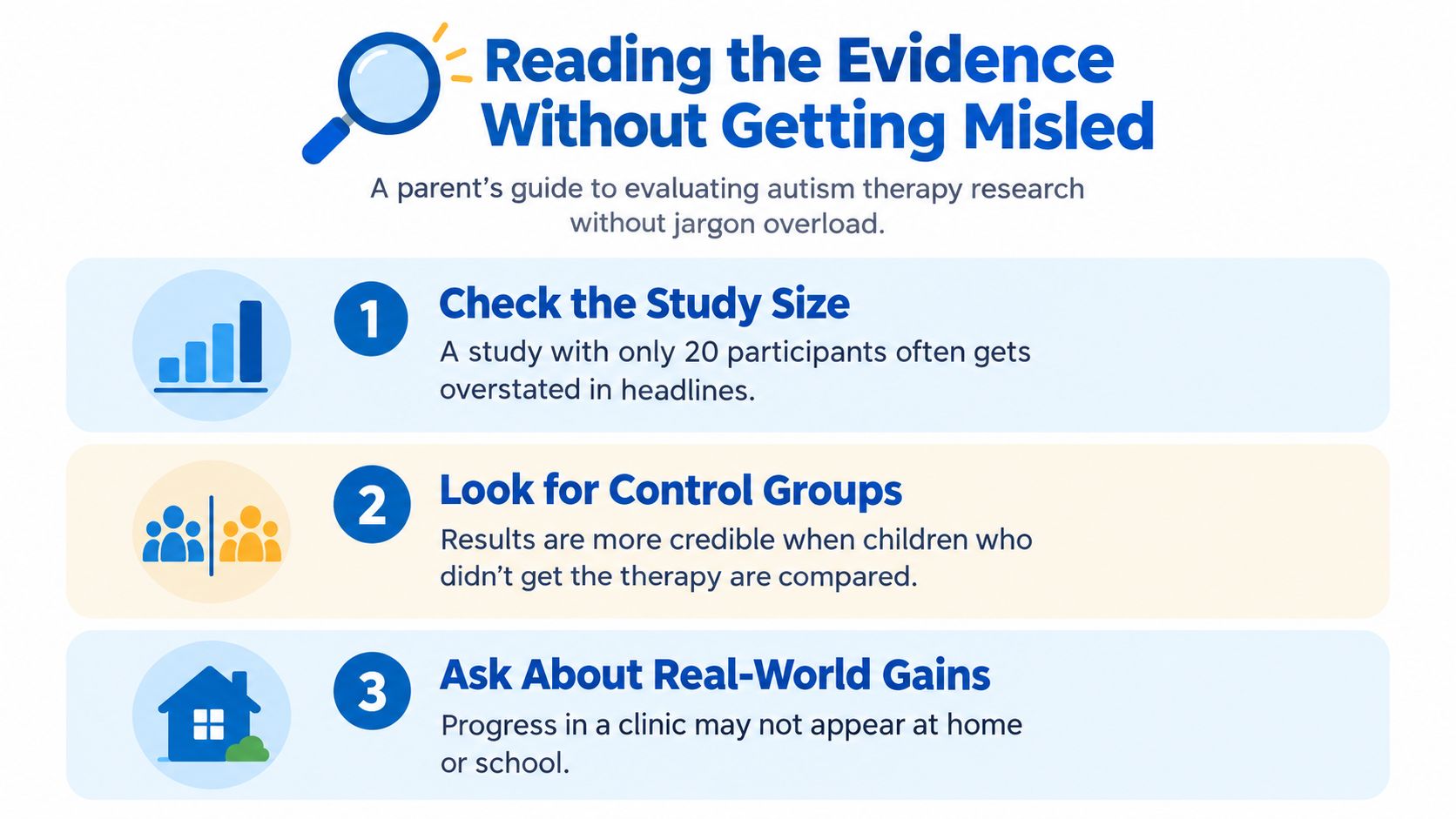
Use this parent-friendly checklist when someone presents a research claim:
- Check the study size: A small study may offer an interesting signal, but it can't answer every family's question.
- Look for a comparison group: Results are easier to interpret when researchers compare children receiving the intervention with children receiving another approach or usual care.
- Ask about real-world gains: A change measured in a clinic may not automatically appear at home, school, or the playground.
An individual participant data meta-analysis of early intensive ABA-based intervention reported average differences after 2 years of 7.00 Vineland adaptive behavior points and 14.13 IQ points compared with comparators. It also summarized earlier pooled effects across receptive language, expressive language, intellectual functioning, daily living skills, and social functioning. Read the full analysis in PMC.
The simple rule is this: ask what was measured, for whom, compared with what, and whether the result changed daily life. Strong evidence for one outcome doesn't make a therapy the right fit for every child.
Insurance, Medicaid, and Paying for Therapy
The word “covered” can create false reassurance. A plan may include autism services while still requiring prior authorization, deductibles, copays, visit limits, specific diagnoses, or an available in-network provider.
Private insurance rules vary by state and plan. State autism mandates can differ, and fully insured plans may follow different rules from self-funded employer plans. Confirm details through your insurer's member portal, the state insurance commissioner's office, and the provider's billing department. Review state-by-state ABA insurance considerations.
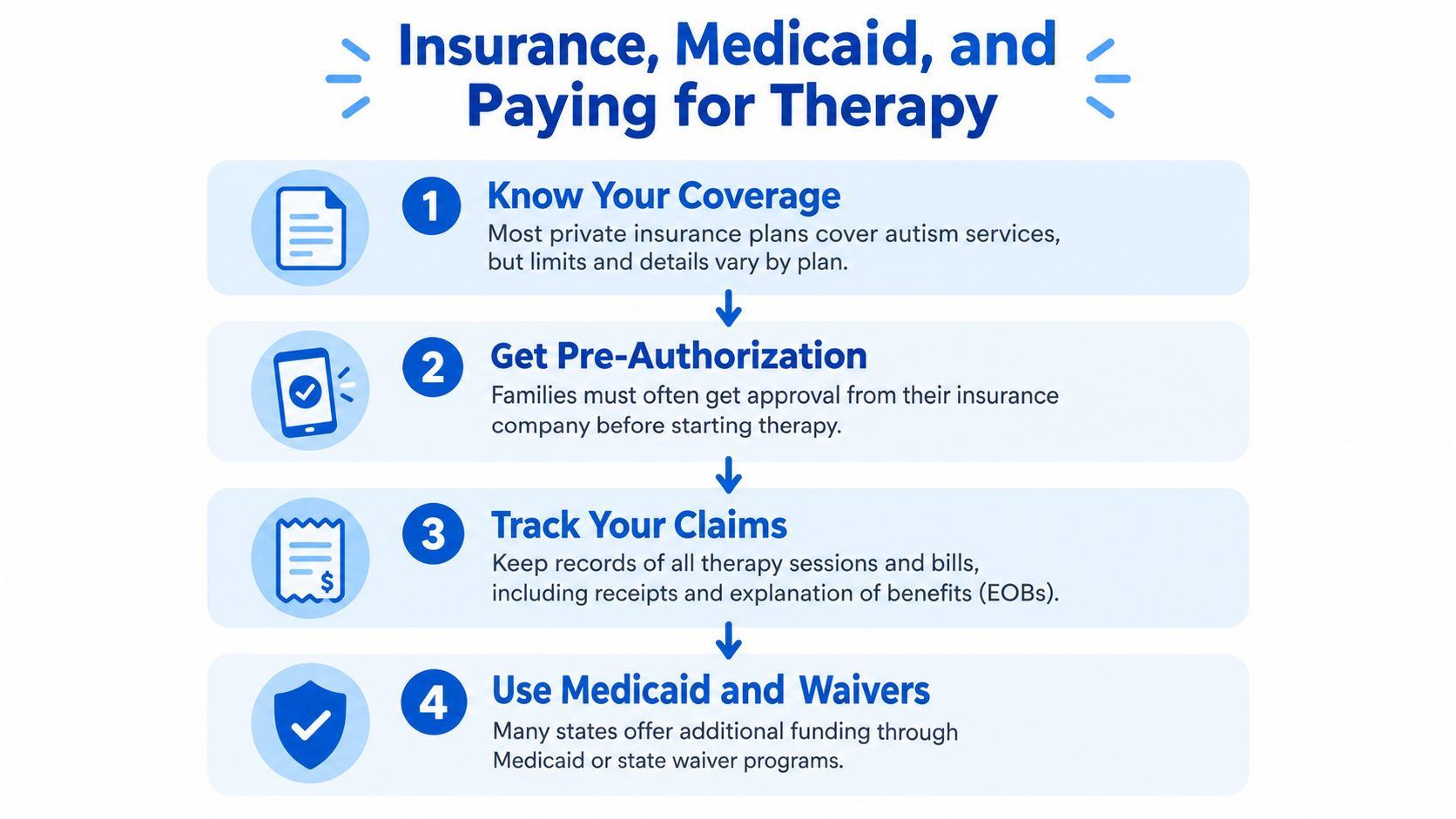
For children under 21, federal Medicaid EPSDT rules require state Medicaid programs to cover medically necessary services. That means ABA may be covered for an eligible child when the provider and state Medicaid program determine that it's medically necessary. Learn how Medicaid coverage may apply to ABA.
Out-of-network benefits are another possible route. With these benefits, a family may pay the provider first and submit a claim or superbill for partial reimbursement. The amount returned depends on the plan, deductible, and network rules. PPO and POS plans more often include out-of-network benefits, while HMO and EPO plans often restrict them. Understand out-of-network ABA reimbursement.
Keep a folder with authorizations, treatment plans, bills, claim decisions, and calls. Ask the billing team:
- What needs approval first? Find out whether the insurer requires an assessment, treatment plan, or recurring authorization.
- What counts toward limits? Ask whether limits apply to visits, hours, providers, or specific services.
- What happens if access is delayed? Request written explanations and ask about alternatives.
School-based services, sliding-scale clinics, and university teaching programs may reduce costs, depending on local availability. None of these options is automatic, so ask each organization about eligibility, capacity, and fees before planning around it.
Matching Therapy to Your Child and Family
A nonverbal toddler whose family can manage an intensive schedule may benefit from a coordinated package that includes ABA, speech-language therapy, and caregiver coaching. A developmental model can bring communication practice into play, while ABA may provide structured teaching for requesting, safety, and independence. The right balance depends on the child's response and the goals the care team sets.
A school-age child with sensory sensitivities and anxiety may need a different starting point. OT could address clothing, food, movement, or classroom participation, while speech therapy supports communication during stressful moments. A provider should also discuss emotional and mental health needs with the appropriate professional rather than treating every difficulty as a behavior problem.
| Child or Family Situation | Therapy Mix That Often Fits | Why This Mix |
|---|---|---|
| Young child with limited spoken communication | Speech therapy with AAC support, plus individualized ABA or a developmental model | Builds reliable communication across play, home, and learning routines |
| School-age child with sensory and daily-routine challenges | OT, speech therapy as needed, and focused behavioral or developmental support | Targets participation instead of treating every challenge as one category |
| Bilingual household concerned about skills carrying over | Speech therapy that respects both languages, caregiver coaching, and coordinated school support | Gives the child more chances to use communication with familiar people |
| Rural family with few local providers | The strongest locally available combination, with telehealth or caregiver training when appropriate | A sustainable service may help more than an ideal plan that can't continue |
The everyday communication strategies for families are useful because generalization happens during ordinary moments, not only during scheduled sessions. A bilingual family shouldn't have to abandon its home language to make therapy work. Ask the speech-language pathologist how the child's full communication environment will be supported.
Family capacity is part of clinical reality. Parent mental health, siblings, work schedules, commute time, transportation, and the child's tolerance for transitions all affect whether therapy continues. The best package is the one that survives a real week, including sick days, school holidays, and difficult mornings.
Choosing a Provider and Evaluating Fit
Credentials matter, but they're only the first filter. Look for the professional qualifications relevant to the service, such as a BCBA for behavior analysis, an SLP for speech-language therapy, or an OT for occupational therapy. Then ask whether the provider has experience with your child's age, communication style, support needs, and daily goals.
Questions to ask at intake
Bring a short list and write down the answers:
- How will you measure progress? Ask for examples of goals, data, and family updates.
- What does a typical session look like? The provider should describe activities in ordinary language.
- How involved should parents be? Clarify whether coaching happens during sessions or separately.
- How do you respond to distress or refusal? Look for respect, flexibility, and attention to safety.
- How are goals changed? Progress plans should be reviewed rather than left untouched.
- What are the cancellation and attendance policies? These details affect cost and continuity.
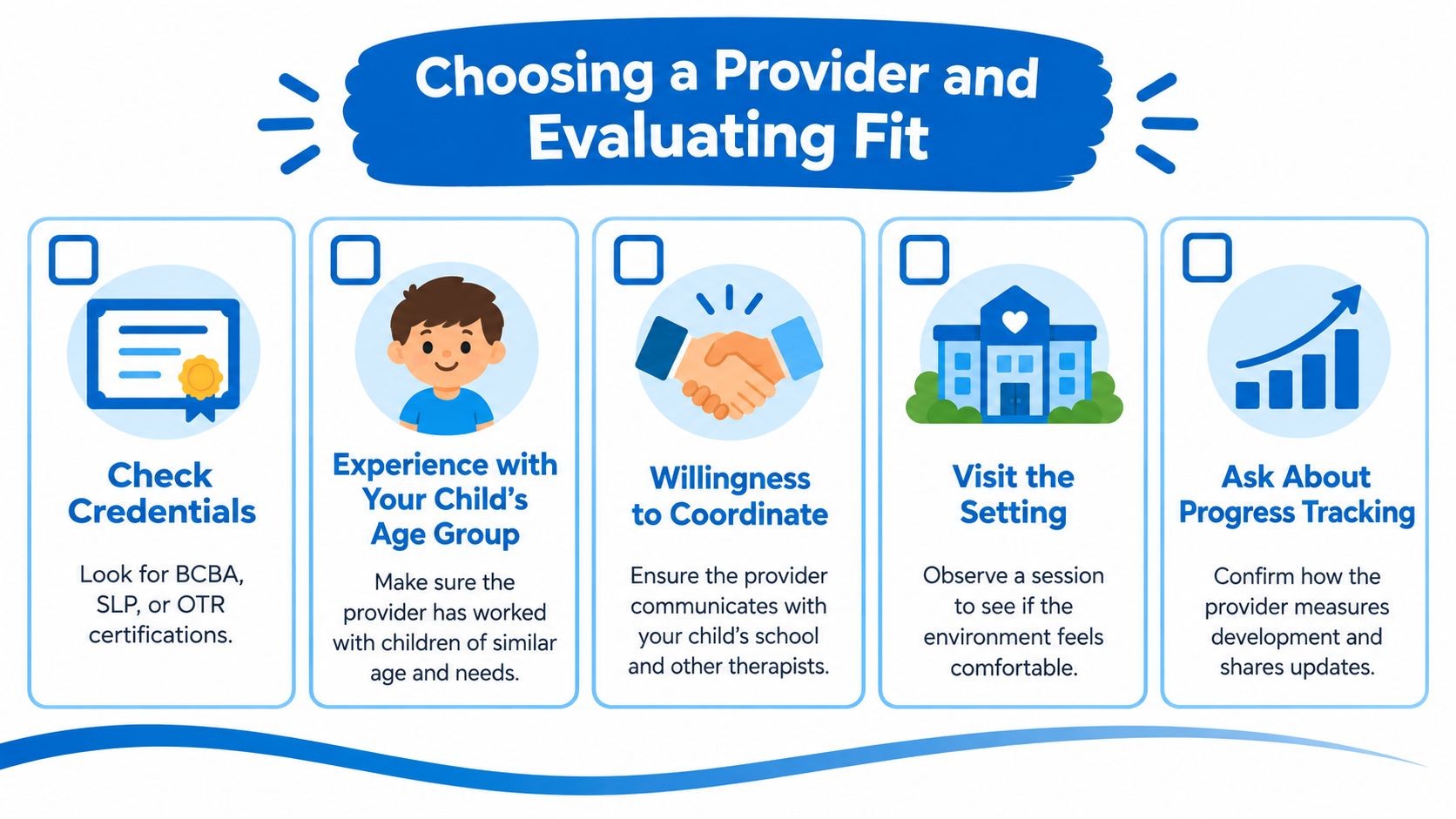
Give the relationship a genuine evaluation period, such as four to six weeks, while watching engagement, communication, comfort, and whether your child settles into the setting. Progress may be gradual, but you should still understand what the team is trying to teach and how they know whether it's helping.
Be cautious about rigid, one-size-fits-all programs, reluctance to share data, pressure to sign a long contract before you understand the service, or explanations that make you feel blamed. Credentials don't cancel out poor communication. If the fit remains wrong after a fair trial, asking about a transition or another provider is reasonable.
A Calm Path Forward for Your Family
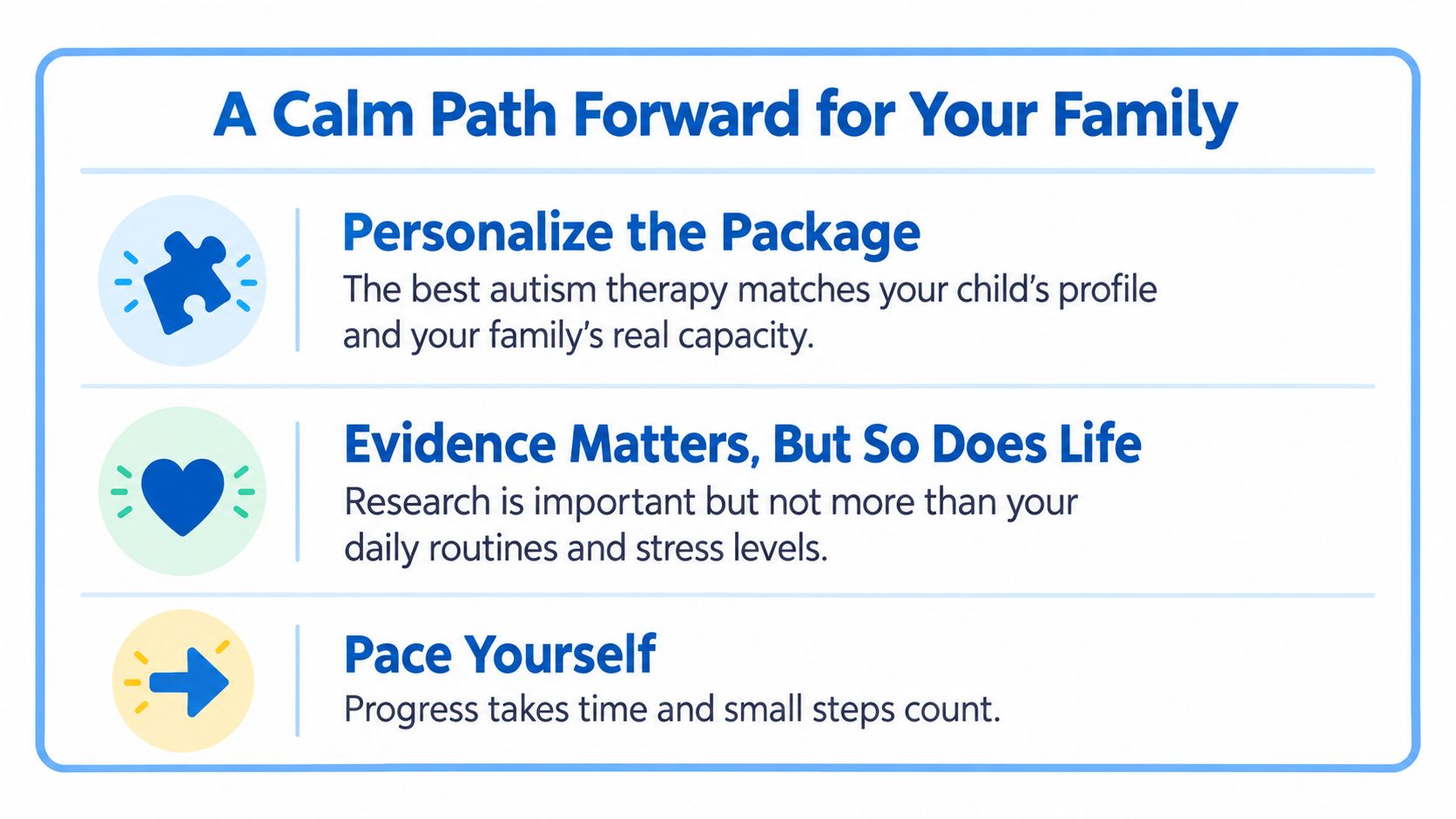
Three ideas can steady this decision.
First, personalize the package. Your child's communication, sensory profile, independence, safety, learning style, and interests should shape the goals. Don't choose a therapy because its label sounds impressive. Choose the services that address the barriers your child and family are facing now.
Second, respect both evidence and daily life. Research can show where an approach has measurable support, but continuity, rapport, affordability, and access determine whether your child receives it. Guidance from Abu Dhabi warns that unnecessary delays or gaps in intervention may increase costs and dependence on more intensive services, while NICE's review process indicates that its autism recommendations didn't need a substantive intervention update. Read the Abu Dhabi ABA guidance.
Third, pace yourself. Start with one or two well-supported priorities instead of collecting every possible therapy. Set a check-in for three months to review what's helping, what isn't fitting, and whether the goals still reflect your child's needs.
Families are also asking about probiotics, acupuncture, music therapy, neurofeedback, app-based anxiety tools, and telehealth caregiver training. A 2026 review reported that most complementary and alternative autism treatments lacked strong, reliable evidence, while a separate review described neurofeedback research as limited by small samples, varied protocols, and limited long-term follow-up. Read the summary of the 2026 review of complementary and alternative treatments. Promising tools may be worth discussing with a qualified professional, but they shouldn't displace established support when access is already limited.
Therapy is an ongoing conversation, not a verdict handed down once. Progress can look like a new request, a calmer transition, a safer meal, a better night routine, or a child finding a way to participate. Steady progress is enough. You're allowed to adjust the plan as your child grows.
ABA Finder can help families locate ABA provider options, understand possible insurance and out-of-network pathways, and review affordability resources in select U.S. locations. Visit ABA Finder to submit a no-obligation inquiry and get practical guidance on possible next steps.
Our Latest Insights




Every Child Deserves Access To Quality ABA Therapy
Whether you're searching for providers, exploring financial assistance, or trying to better understand your insurance options, we're here to help you take the next step with confidence.