



Out of Network Benefits for ABA Therapy
Understand out of network benefits for ABA therapy, how reimbursement typically works, and the practical steps families can take to use them without surprises.

You've called several ABA clinics, found that the nearest openings are months away, and finally located a provider who can see your child sooner. Then the billing coordinator asks, “Do you have out-of-network benefits?” Your insurer's website says the plan covers ABA, but that answer doesn't tell you whether the clinic's bills will be reimbursed, how much you'll owe first, or whether the provider can bill you for the difference.
Out-of-network benefits can create another path to care when an in-network waitlist is too long. They can also involve higher deductibles, upfront payment, claim forms, and confusing explanations of benefits. This guide breaks down how the process may work for ABA therapy, what the No Surprises Act does and doesn't cover, and which questions to ask before services begin.
Table of Contents
What Out of Network Benefits Actually Mean for ABA
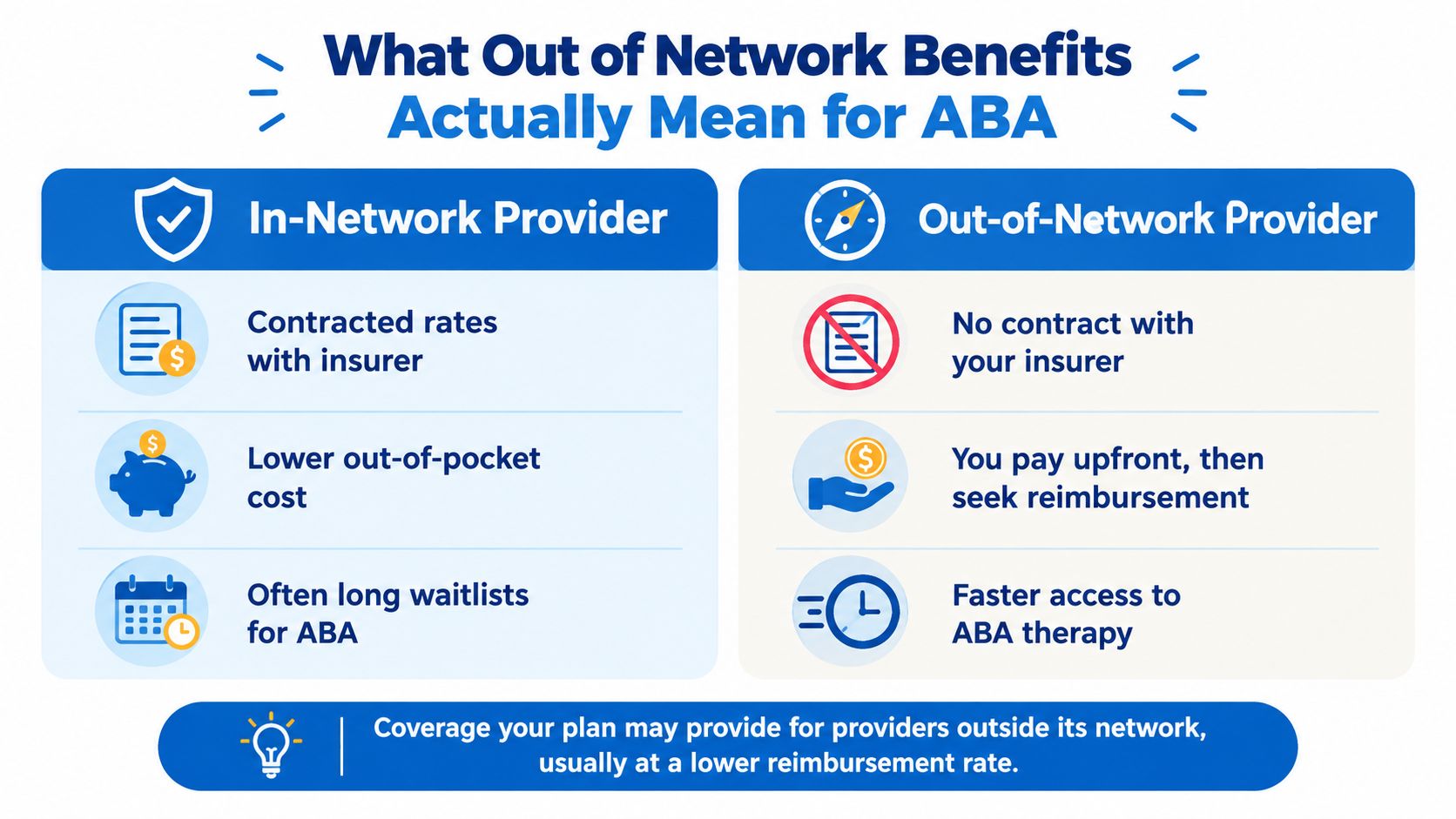
An out-of-network provider is a clinic or clinician that hasn't signed a contract with your health insurer. If your plan includes out-of-network benefits, the insurer may pay part of a covered ABA service even though the provider isn't in the plan's contracted network. Your share could be higher, and the plan may calculate reimbursement using its own allowed amount rather than the provider's full charge.
With an in-network provider, the insurer and provider have already agreed on rates. You'll usually have clearer cost sharing, and the provider generally submits claims under that agreement. An out-of-network clinic hasn't accepted those negotiated rates, so you may need to pay the provider first and request reimbursement later. UnitedHealthOne's explanation of out-of-network benefits notes that an allowed amount can be lower than the provider's bill, leaving the member responsible for cost sharing and possibly the remaining balance.
ABA access can be especially sensitive to network status. Families may find that a small local practice has relevant experience and availability but doesn't participate with their particular insurer. That can happen because of reimbursement terms, administrative workload, or the practical limits of a small practice. It doesn't automatically mean the service isn't covered, but it does mean you need the plan's specific rules in writing.
What the No Surprises Act changes
The federal No Surprises Act, enacted on December 27, 2020, was designed to reduce surprise billing when patients unknowingly receive care from out-of-network providers. For covered emergency services and certain non-emergency services at in-network facilities, out-of-network providers generally may not charge more than the patient's in-network cost-sharing amount. The law also removes prior-authorization barriers for emergency care. The U.S. Department of Health and Human Services summary reported that, in a 2017 national study, 18% of emergency room visits by people with large employer coverage produced at least one out-of-network bill.
That protection doesn't turn every scheduled ABA appointment into in-network care. Planned, non-emergency ABA generally depends on your plan's benefit design, authorization rules, provider agreement, and reimbursement formula. The law mainly addresses emergency care, certain services connected to an in-network facility, and air ambulance situations. As Department of Labor guidance on avoiding surprise healthcare expenses explains, families should review the EOB and use the internal appeal process when coverage appears incorrect.
How Out of Network Reimbursement Is Calculated
An out-of-network ABA claim usually turns on three numbers: the provider's bill, the insurer's allowed amount, and your cost-sharing rules. The allowed amount may also be described as a usual, customary, and reasonable amount. It's the figure the plan uses to decide what portion of a covered service is eligible for reimbursement.
Your deductible comes next. If you haven't met the separate out-of-network deductible, you may pay the allowed amount yourself. After that, the plan applies coinsurance, which is the percentage you share with the insurer. Your plan may also leave you responsible for the difference between the provider's charge and the allowed amount, depending on state law, the provider agreement, and the plan terms.
Practical rule: Never calculate your expected cost from the provider's hourly rate alone. Ask for the plan's allowed amount and the exact out-of-network cost-sharing rule for the relevant service code.
Here's a simplified example using hypothetical amounts. Suppose a provider bills $120 for an hour, while the insurer assigns an allowed amount of $90. If the out-of-network deductible is $2,000, the family may initially be responsible for the allowed amount, plus the $30 difference between the bill and allowed amount if balance billing applies. Once the deductible has been met, a plan with 60% coinsurance might pay 60% of the $90 allowed amount, while the family pays the remaining 40% and possibly the charge above the allowed amount.
| Line Item | Amount | What Happens |
|---|---|---|
| Provider's billed charge | $120 | This is what the provider charges for the hour. |
| Insurer's allowed amount | $90 | The plan uses this figure to calculate covered reimbursement. |
| Difference above allowed amount | $30 | You may owe this balance if the provider can balance bill. |
| Out-of-network deductible | $2,000 | You may pay eligible allowed amounts yourself until the deductible is met. |
| Coinsurance after deductible | 60% plan share | The plan may pay 60% of the allowed amount after the deductible, subject to the policy. |
The example is only a way to see the moving parts. Your policy may use a different allowed amount, deductible structure, coinsurance rate, or balance-billing rule. For additional context on what families may pay for ABA, review this explanation of ABA therapy cost per hour, then compare it with your insurer's written benefits.
Submitting an Out of Network ABA Claim Step by Step
Out-of-network claims are easier to manage when you treat them like a small records project. Keep one folder, digital or physical, for the plan document, authorization letters, invoices, claim forms, EOBs, payment records, and every phone-call note.
Start with coverage and authorization
First, ask whether ABA is covered under the plan's autism benefit, behavioral-health benefit, or another section of the policy. Confirm the diagnosis information the plan expects and ask which service codes it recognizes. ABA claims may involve codes from 97151 through 97158, but the insurer should confirm which codes apply to your child's services and provider.
Next, ask whether prior authorization is required. Request written approval before therapy begins whenever possible. A verbal statement from a representative may not protect you if the claim later denies for missing authorization, so record the authorization number, effective dates, approved services, units, and provider information.
Gather a complete claim packet
Ask the provider for a superbill, which is an itemized bill prepared for insurance submission. It should generally include:
- Provider details: NPI, tax ID, address, and billing contact.
- Service details: Dates of service, CPT codes, units, and billed charges.
- Clinical identifiers: The diagnosis code and any authorization number the plan requires.
- Payment record: Receipts or other proof of payment if the plan asks for it.
You may submit through the insurer's member portal, send a paper CMS-1500 claim form, or ask the provider to file on your behalf. Kaiser Permanente's out-of-area PPO claims guidance explains that members may need to pay the full bill first and submit an itemized bill for reimbursement, with payment affected by deductible and coinsurance status.
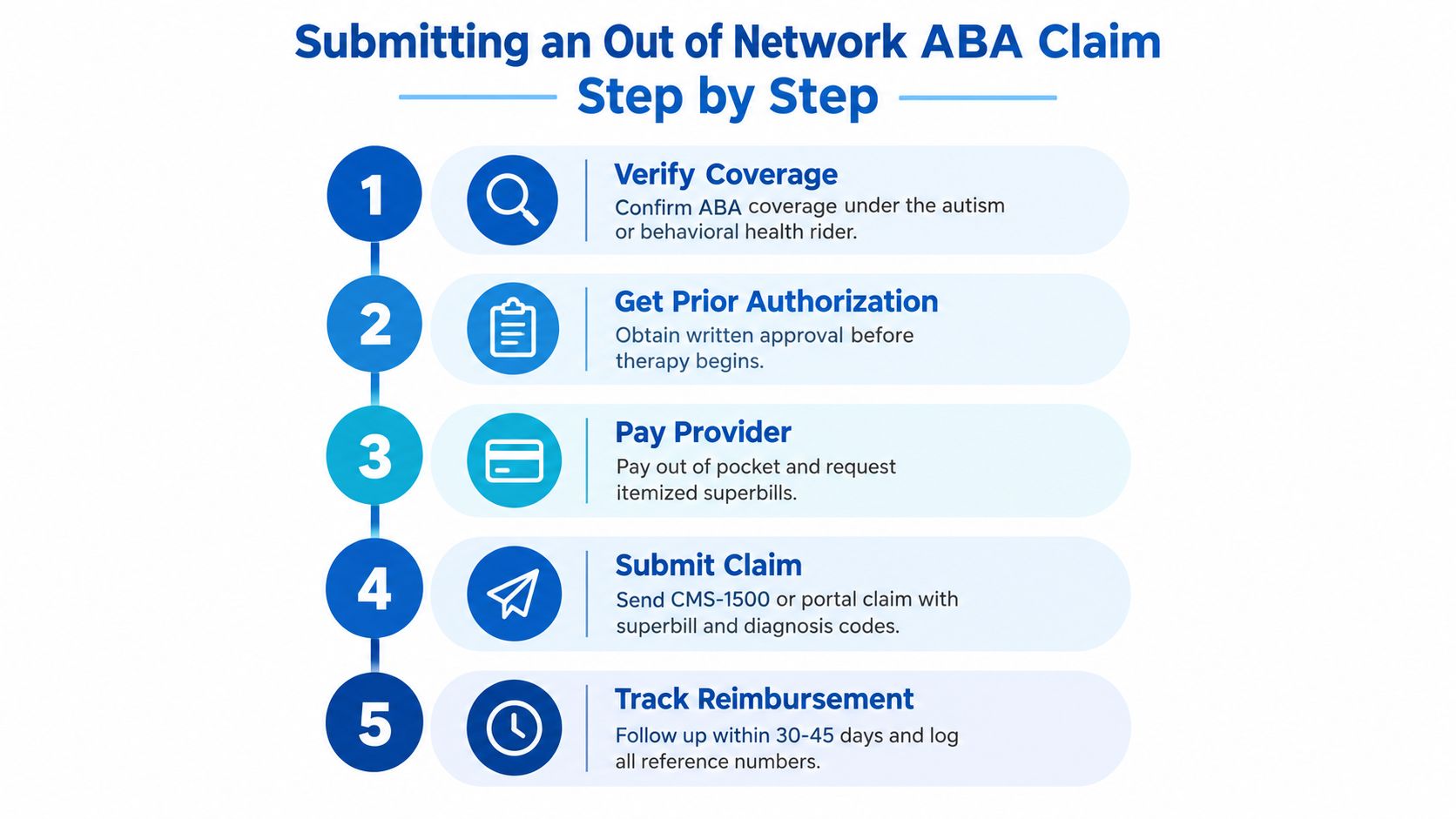
After submitting, save the claim confirmation and follow up if the EOB hasn't arrived within the plan's stated processing period. A 30 to 45 day follow-up window is a practical tracking point, but plan timelines vary. Ask for a reference number and write down the date, representative's name, and next action.
This short video may also help families visualize the claim process:
Plan Types, Medicaid, and EPSDT Pathways
Your plan type gives you a starting clue, but the certificate of coverage controls the answer. A PPO may offer an out-of-network path, while an HMO or EPO may limit non-emergency benefits to contracted providers. Even within one plan type, employer selections and state rules can change the result.
| Plan Type | Typical OON ABA Reimbursement | Deductible Expectation | Referral / Authorization |
|---|---|---|---|
| PPO | May reimburse covered ABA outside the network, often at a less favorable level | A separate or higher out-of-network deductible may apply | Prior authorization may be required; referral rules vary |
| HMO | Usually little or no non-emergency out-of-network reimbursement | You may face the full bill when no benefit applies | Primary-care referrals and authorization may be required |
| EPO | Generally focuses coverage on in-network providers | Non-network care may be excluded except for limited situations | Check for an employer-added out-of-network rider and authorization rules |
| Medicaid | Coverage may depend on state administration and medical necessity, rather than a standard commercial OON benefit | Ask whether a non-enrolled provider can be considered under a state pathway | State approval, provider qualification, and authorization requirements may apply |
Medicaid and the EPSDT route
For children under 21, Medicaid's Early and Periodic Screening, Diagnostic, and Treatment, or EPSDT, benefit can cover medically necessary services even when those services aren't listed in a state Medicaid plan. The federal Medicaid ABA toolkit explains that this may include services commonly delivered as part of ABA when they fit a covered benefit category and are provided by qualified providers.
That doesn't necessarily create a conventional out-of-network reimbursement benefit. Families may need to ask the state Medicaid agency or managed-care plan whether an out-of-state provider, non-enrolled provider, single-case arrangement, or network-gap exception is possible when qualified local care isn't available. Eligibility and procedures depend on the state.
For practical parent-focused information, the autism parent resources guide can help you organize questions before contacting Medicaid or a commercial insurer. Bring your member ID, plan name, provider details, and any written evidence of network limitations to the call.
Common Pitfalls and How Families Respond
A family finds a respected ABA clinic with an opening. Before the first session, the billing office checks the plan and says the clinic is out of network. The insurer confirms that the plan has an out-of-network ABA benefit, so the family starts care believing reimbursement is settled.
Then several problems appear at once. The insurer processes the claim using an allowed amount below the clinic's charge, and the family receives a balance bill. A later claim denies because prior authorization wasn't on file, even though a representative had verbally said authorization wasn't needed. The clinic's superbill arrives with a coding error, and the family learns that the out-of-network deductible accumulator reset under the new benefit period.
Each issue needs a different response:
- Balance above the allowed amount: Ask the provider to explain the charge and whether state law or a written agreement limits balance billing. Compare the bill with the EOB rather than paying automatically.
- Missing authorization: Request the denial reason and the plan's clinical or administrative criteria in writing. File an internal appeal within the deadline shown in the denial notice.
- Incorrect superbill: Ask the billing team to review the NPI, diagnosis code, CPT code, dates, and units, then submit a corrected claim or replacement document.
- Deductible confusion: Request the current out-of-network accumulator and ask which claims have been applied to it. Keep your own running log and compare it with each EOB.
KFF reported that HealthCare.gov insurers denied 37% of out-of-network claims in 2023, compared with 19% of in-network claims, and that out-of-network claims totaled 35 million that year. In a later analysis, KFF reported 44 million out-of-network claims and an overall denial rate of 37% for 2024. These figures concern Marketplace claims broadly, not ABA specifically, but they show why families shouldn't treat a denial as the final answer. KFF's claims denial and appeal analysis provides the broader context.
The No Surprises Act may protect patients in emergency or certain ancillary settings. It doesn't generally require a scheduled ABA clinic to accept the insurer's allowed amount as payment in full.
Questions to Ask Your Insurer and Provider
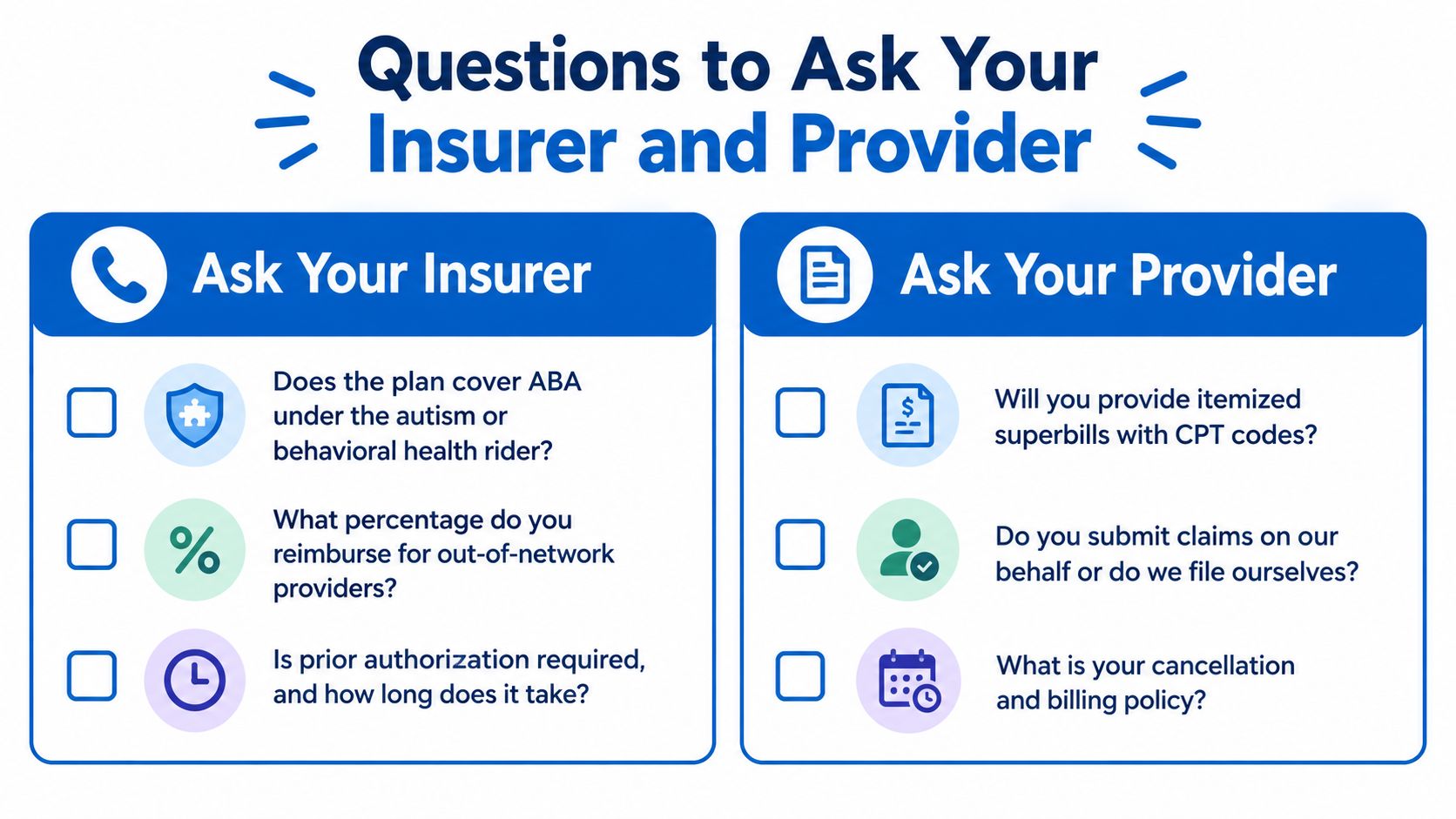
Use the following checklist as a script. Read the questions slowly, and ask the representative to distinguish between a general ABA benefit and the exact out-of-network benefit for your child's plan.
| Ask Your Insurer | Ask Your Provider |
|---|---|
| “Does this plan cover ABA under the autism or behavioral-health rider?” | “Are you in network or out of network for my exact plan and network name?” |
| “Does the diagnosis code on file match the child's evaluation and the code required for ABA claims?” | “Will you submit claims for us, or do we need to file them ourselves?” |
| “What is the separate out-of-network deductible, and how much has been met?” | “What documents will you provide after each session or billing period?” |
| “What coinsurance applies after the deductible?” | “Will the superbill include the NPI, tax ID, diagnosis code, CPT codes, units, dates, and charges?” |
| “What allowed amount applies to CPT codes 97151 through 97157?” | “How do you handle the amount above the insurer's allowed amount?” |
| “Is prior authorization required, and what services, units, and dates must it cover?” | “How long does it usually take to receive a corrected or itemized superbill?” |
| “What is the appeal deadline if a claim is denied?” | “What are your cancellation, attendance, payment, and collection policies?” |
| “Does the No Surprises Act apply to this scheduled ABA arrangement?” | “Can your billing team help identify a network-gap or single-case agreement request?” |
Ask the provider to confirm all billing terms before the first appointment. A clinic may accept your insurance card for identification without being contracted with the plan, so those are separate questions.
For help locating a nearby autism specialist, you can review autism specialist options near you. Whether you speak with a clinic, insurer, or resource service, keep a call log with the date, time, representative's name, reference number, and promised next step.
Key Takeaways and Next Steps
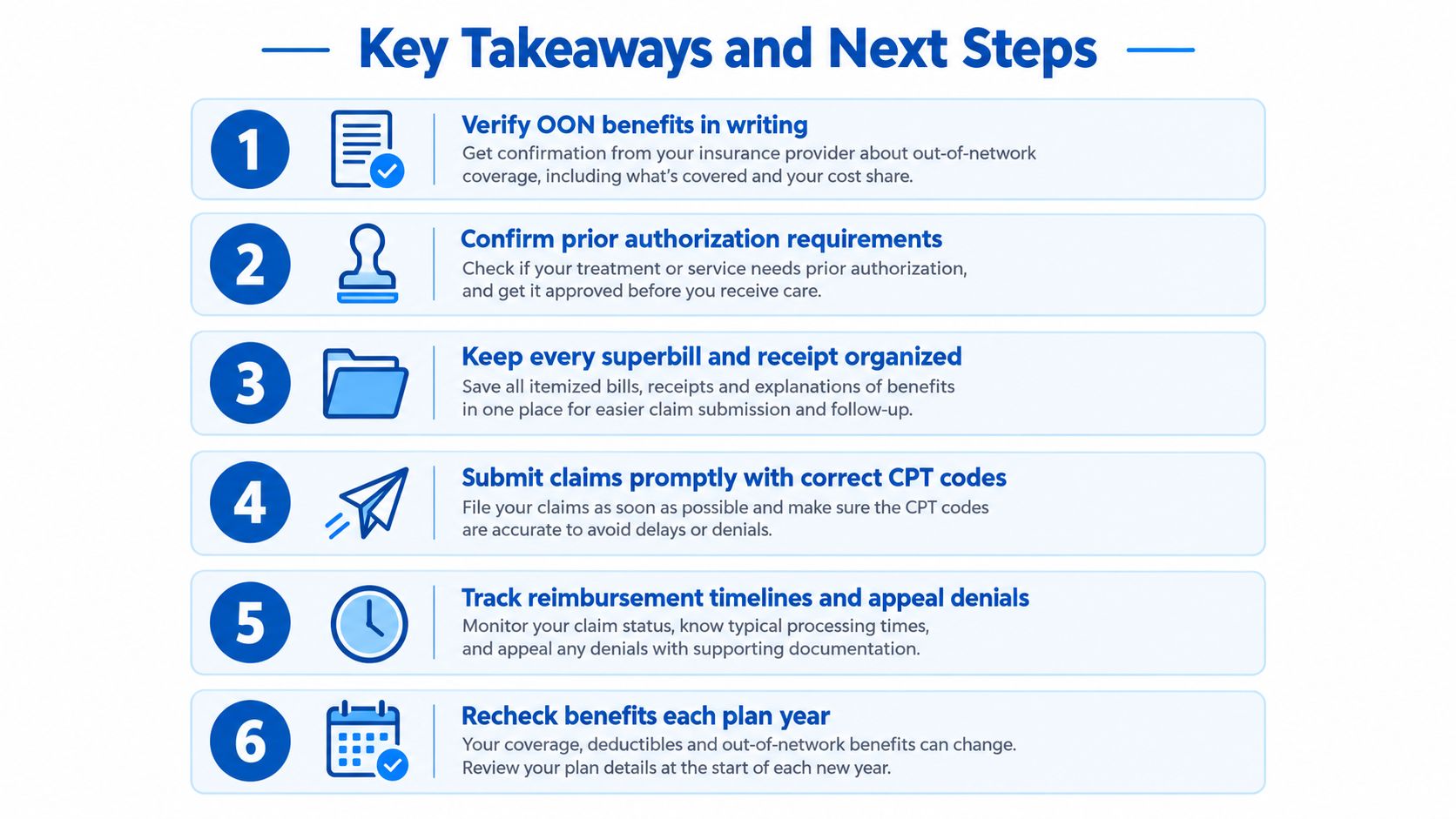
Out-of-network benefits can make a hard provider search more flexible, but they don't remove the need to verify details. Carry these six points into your next call:
- Verify benefits in writing. Ask for the exact ABA coverage language, network rules, deductible, coinsurance, and allowed-amount method.
- Confirm authorization before starting. Request an authorization number, approved dates, codes, units, and provider details.
- Understand the calculation. The provider's bill, plan allowed amount, deductible, coinsurance, and possible balance billing can all affect your share.
- Keep every document. Save superbills, receipts, authorization letters, session records, claim confirmations, and EOBs.
- Compare the EOB with the provider bill. Look for mismatched codes, units, dates, allowed amounts, and patient responsibility.
- Appeal when the record supports it. Follow the plan's internal appeal process, and consider contacting your state insurance department or a patient advocate when the dispute remains unresolved.
A manageable way to proceed is to spread the work across a week. Start by downloading the plan document and writing down the network name. Then call member services with the script above, ask the provider for billing terms, and create one claim folder. If the provider is otherwise unaffordable, ask whether a single-case agreement or network-gap exception exists. Families with complicated plans may also benefit from a patient advocate, autism-specific case manager, or state Medicaid contact.
Keep this sentence nearby: “Please send me the applicable benefit language and the reference number for this call.”
ABA Finder can help families compare provider options, review insurance and out-of-network pathways, and identify affordability resources where available. Eligibility, provider capacity, and reimbursement depend on the family's circumstances, plan, state, and provider, so a benefits review is a way to reduce uncertainty, not a promise of payment.
If you're trying to find an ABA provider or make sense of out-of-network benefits, visit ABA Finder to share your needs and explore provider and affordability options available in your area. Their team can help organize the insurance questions and possible next steps so you can approach the process with a clearer picture.
Our Latest Insights











Every Child Deserves Access To Quality ABA Therapy
Whether you're searching for providers, exploring financial assistance, or trying to better understand your insurance options, we're here to help you take the next step with confidence.