



ABA Therapy Cost Per Hour: What Families Need to Know
Understand ABA therapy cost per hour in 2026. Learn typical rates, insurance options, and what affects pricing for your child's treatment.

ABA therapy in the U.S. commonly costs $120 to $150 per hour for direct service, and BCBA-supervised time can run $120 to $200 per hour. The exact number depends on who is delivering care, where you live, and how much supervision your child's plan includes.
That's why the first phone call to an ABA clinic can feel like stepping into a billing maze. One office gives you a simple hourly quote, another talks about assessment time, supervision, and treatment planning, and both may be describing very different versions of care.
Table of Contents
Why ABA Therapy Costs Feel Confusing
A parent usually doesn't start with pricing spreadsheets. They start with a diagnosis, a referral, and a search bar, then run straight into a stack of numbers that don't seem to match. One site says ABA is expensive, another quotes a midrange hourly rate, and a third talks about insurance, authorizations, and out-of-network benefits like everyone already knows what those words mean.
That confusion is normal. ABA pricing is not just “the hourly rate.” It's also who is on the treatment team, how many hours the plan calls for, and whether insurance pays part of the bill or leaves the family responsible for most of it.
The first thing families usually need
The first question is rarely “What's the average price?” It's “What will we pay?” That answer depends on three things that matter more than the headline rate, provider credentials, weekly intensity, and insurance rules.
A family can get two quotes that look close on paper but land very differently in real life. One clinic may quote mostly technician-delivered care, while another includes more clinical oversight and planning time in the bill. If you're comparing options, the number alone won't tell you which quote is more complete.
Practical rule: don't compare only the hourly rate, compare what's inside that rate.
The most helpful next step is to ask for a plain-English breakdown. Ask who delivers the direct sessions, who supervises, and whether the quote includes assessment or treatment planning time. A clear provider should be able to explain the mix without making you decode billing jargon.
For families who want a simple background primer on ABA before they start calling clinics, this overview is a useful companion, Understanding ABA Therapy, What Every Parent Should Know.
How Provider Credentials Shape Hourly Rates
The biggest driver of ABA therapy cost per hour is usually the credential level of the person doing the work. A Registered Behavior Technician (RBT) typically delivers one-on-one therapy, while a Board Certified Behavior Analyst (BCBA) handles assessment, supervision, and treatment planning. Those roles are not interchangeable, so their prices are not either.
A 2013 commercial insurance claims analysis showed how widely reimbursement varied by credential, and modern pricing still follows that structure. The analysis found state reimbursement rates ranging from $24.64 to $160 per hour for a provider with a bachelor's degree or unspecified education level, and from $36.90 to $196.50 per hour for a provider with a master's degree or doctorate (TRICARE ABA benefit analysis). It also estimated a weighted national mean reimbursement rate of $65.16 per hour for therapeutic behavioral services from a BCaBA, behavior technician, or unspecified-level provider, and $94.72 per hour for master's- or doctoral-level providers.
What the market usually looks like now
Direct service from an RBT commonly falls around $50 to $85 per hour, while BCBA assessment, supervision, and treatment planning are often billed at $120 to $200 per hour (ABA therapy industry cost guide). Another U.S.-focused cost guide puts private-pay ABA in the broader $120 to $250 per hour range, which shows how quickly the blended rate can climb when supervisory time is included (therapy cost guide).
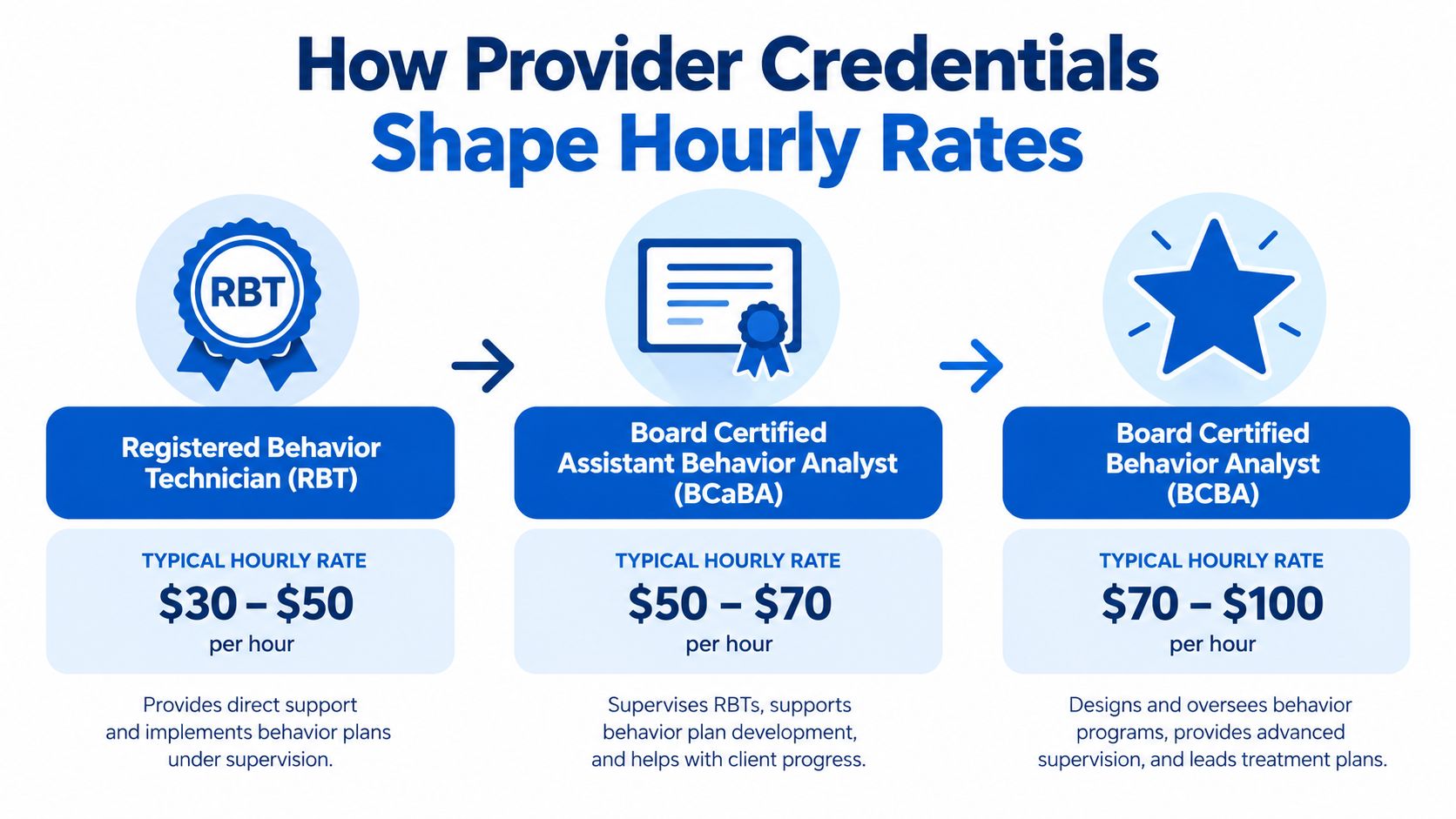
A quote that looks “higher” may be more transparent if it includes supervision, planning, and treatment oversight.
The simplest way to read a quote is to ask, “Who is billing this hour?” If most of the time is RBT-delivered, the price is usually lower. If the program includes more BCBA involvement, the effective hourly rate rises because you are paying for clinical oversight, not just direct play or skill-building time.
What Drives the Hourly Rate in Your Area
Location matters, but not in a simple zip-code way. Two clinics in the same metro area can still charge differently because one has higher overhead, more limited staffing, or a more complex service model. The family-facing question isn't “What's the exact local average?” It's “Why does this provider charge what it charges?”
A practical way to compare quotes
Start with the structure of the program, not the sticker price. A blended quote usually means the clinic is combining direct therapy, supervision, and planning into one effective hourly figure. An itemized quote may show those pieces separately, which can look cheaper at first and then rise once the full schedule is built out.
Here's the checklist parents can use when comparing providers:
- Ask who delivers each hour. If the session is mostly technician-led, the price may sit lower than a BCBA-heavy plan.
- Ask whether the quote is blended or itemized. Blended pricing can be easier to read, but itemized pricing helps you see where the money goes.
- Ask how many hours the plan assumes. A lower hourly rate can still cost more if the schedule is much heavier.
- Ask what your plan changes. Deductibles, copays, and network status can all affect the final bill.
- Ask whether supervision time is included. This is one of the easiest places for a quote to look simpler than the invoice.
Why the same price can feel different
A family with good in-network benefits may pay only a portion of a quoted rate, while another family with an out-of-network setup may be responsible for more. That's why the “expensive” clinic on paper can sometimes be the one that leaves the family with a clearer path to reimbursement.
Market competition, state Medicaid rules, and provider overhead also shape pricing. In a region with more ABA providers, quotes may look more competitive. In a place with fewer clinicians, longer waitlists and staffing strain can push prices upward or make access harder to secure.
From Hourly Rates to Total Program Costs
A quoted hourly rate only tells part of the story. Once therapy expands into a weekly schedule, the number on the page turns into a much larger family expense.
What the math looks like in real life
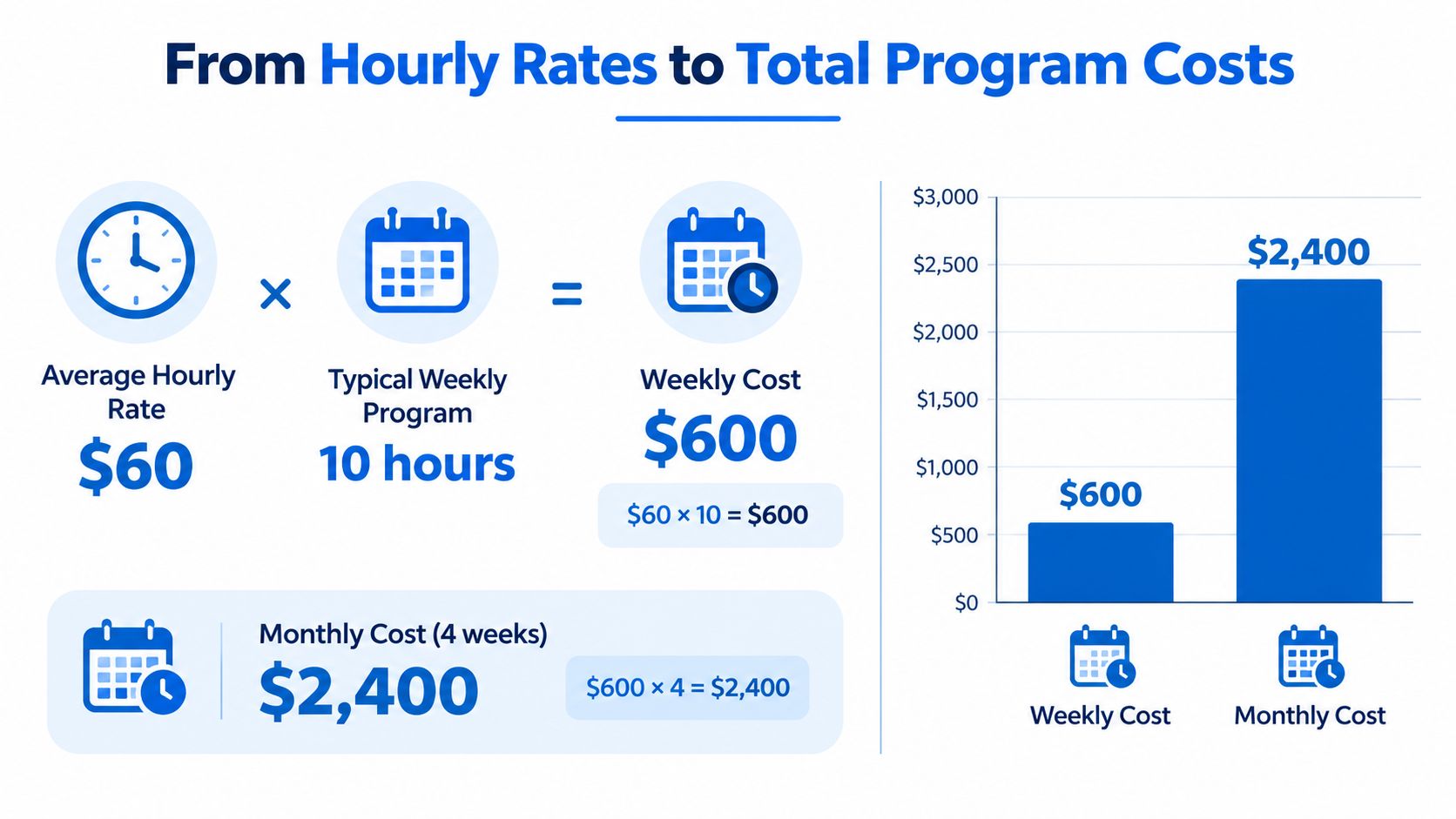
Using a midrange $120 to $150 per hour private-pay estimate, 10 hours a week can translate to roughly $1,200 to $1,500 weekly before any insurance offset (weekly cost planning benchmark). At the higher end of typical intensity, 30 to 40 hours a week can reach about $3,600 to $6,000 or more weekly before coverage adjustments.
That is the part many families miss at first. ABA plans for younger children often use more hours because the program is trying to build broad daily skills, not just work on one narrow goal. The service dosage matters just as much as the rate itself.
Why monthly planning matters
Families usually budget by the month, not by the hour. A quote can sound manageable in conversation and feel very different once it becomes a full weekly schedule. The question that matters is not only “What does one hour cost?” It's “How many hours is this plan asking me to fund?”
Insurance changes the math, but it does not change the provider's posted rate. It changes what the family pays at the end, which may mean copays, coinsurance, or post-deductible amounts instead of full private-pay charges. Two families can look at the same clinic and still come away with very different cost expectations.
Insurance, Out-of-Network, and Medicaid Pathways
Families usually want one thing from the billing conversation, a path that works. ABA therapy can be paid through private insurance, out-of-network reimbursement, or Medicaid, and each route comes with different rules, paperwork, and family costs.
Private insurance
Private insurance may cover ABA, but the details depend on the plan. Some families face copays, some face coinsurance, and some need prior authorization before therapy starts. The safest move is to check the policy directly, because coverage can vary by plan and state.
Out-of-network reimbursement
Out-of-network care can still leave room for reimbursement, but the process usually asks more from the family. One insurance guidance source explains that a provider may give a superbill with CPT codes, diagnosis codes, and the provider NPI number, which the family submits on a CMS-1500 form for partial reimbursement after paying upfront first (out-of-network insurance guidance). Reimbursement is not guaranteed, but it may be possible depending on the plan.
This route can also bring balance billing risk, where the provider charges more than the insurer's allowed amount. Deductibles and out-of-pocket maximums are often higher out of network too, so the family's real cost can look very different from the clinic's listed fee.
Medicaid
Medicaid works differently. A state-by-state guide says Medicaid covers ABA therapy for eligible children in all 50 states under the EPSDT mandate, which stands for Early and Periodic Screening, Diagnostic, and Treatment. The same guide says coverage is tied to medical necessity, not arbitrary caps (Medicaid coverage guide).
A broader coverage overview points to an analysis of rising Medicaid ABA spending, with CMS-linked reporting cited by one industry analysis showing steep growth in public spending on autism services (an analysis of rising Medicaid ABA spending). That trend does not tell any one family what they will pay, but it does show how quickly demand and public funding can move.
For families trying to understand the larger picture alongside insurance questions, this guide to autism early intervention can help frame the next step.
A Realistic Cost Story for Families
A family might get two ABA quotes and think the lower one is the smarter choice. Then they look closer and realize the cheaper hourly number doesn't include much supervision, while the higher quote bundles more clinical oversight and a cleaner service plan.
How that comparison can play out
One parent might be offered a program that looks affordable because the direct therapy hour is lower. But if the child needs a lot of BCBA planning time, the total bill can climb once the full weekly schedule is set. Another family might choose a provider with a higher billed rate because the team explains benefits clearly and the insurer allows some reimbursement after the family pays upfront.
A different family may decide to pursue Medicaid after confirming eligibility under their state's EPSDT pathway. That route can feel less confusing if the child qualifies, because the question shifts from “Can we cover the full sticker price?” to “What paperwork does the state need from us?”
What makes the story useful
The point isn't that one route is better for everyone. The point is that ABA pricing only makes sense when you compare the hourly rate, the weekly hours, and the payment path together. Without that full view, it's easy to pick the quote that sounds lower and still end up with the bigger bill.
Families often feel relieved when they realize they're not supposed to understand all of this on the first try. Billing rules are complicated, and that complexity is part of why asking direct questions matters.
Questions to Ask Before You Commit
A short list of questions can save a lot of stress later. You don't need perfect insurance language, you just need enough clarity to know whether a program fits your family's budget and coverage.
- Who provides the direct sessions? Ask whether most hours are with an RBT, a BCaBA, or a BCBA.
- What does your hourly quote include? Ask if supervision, assessment, and treatment planning are already built in.
- How many hours are you recommending each week? Ask why that level was chosen for your child's needs.
- Do you verify benefits before starting? Ask how the provider checks your coverage.
- Do you work with out-of-network benefits? Ask whether they can provide superbills or help with claim paperwork.
- Are there any extra administrative fees? Ask about intake, reassessment, or other charges that may not show up in the headline rate.
If you're comparing providers in a covered state or trying to sort out whether your plan leaves room for ABA, ABA Finder can help you review likely options and next steps. Their no-obligation consultation is meant to reduce guesswork, not pressure you into a decision.
If a provider can't explain the bill in plain language, keep asking until it makes sense.
How to Move Forward Without Feeling Overwhelmed
Start with the question that cuts through the billing fog: who will provide the sessions, how many hours does the plan call for, and what insurance path can help pay. Once you know those three pieces, the quote stops feeling like a mystery and starts looking like a plan.
If you want more support after diagnosis, this collection of autism parent resources covers the everyday questions families ask while they sort out care and coverage.
A useful next question for any provider call is simple. Ask what part of the bill you would still owe if coverage changes, so you can compare options with your eyes open.
If you're still sorting through options, you do not have to do it alone. For help understanding provider choices, insurance paths, and where to start next, visit ABA Finder and reach out when you are ready.
Our Latest Insights








Every Child Deserves Access To Quality ABA Therapy
Whether you're searching for providers, exploring financial assistance, or trying to better understand your insurance options, we're here to help you take the next step with confidence.