


Cost of ABA Therapy and Family Payment Options
Understand the true cost of ABA therapy, what drives the price, and how insurance, Medicaid, and out-of-network options may affect your family's budget.

You're staring at one estimate that seems to say everything and nothing at the same time. Maybe it's a clinic's hourly rate, maybe it's a benefit summary full of fine print, maybe it's a number that looks manageable until you multiply it by the hours your child needs. That first look can feel like a punch in the stomach, especially when you're trying to figure out how to get help without draining the household budget.
The hardest part is that the cost of ABA therapy is rarely one clean number. A peer-reviewed review of U.S. autism insurance mandates reported estimates from about $10,000 to $100,000 per child per year for intensive behavioral intervention, and a separate health-policy analysis cited an annual cost as high as $60,000 for intensive one-to-one autism therapy, both with important caveats about what those estimates include and exclude (review of U.S. autism insurance mandates). That wide range is exactly why a single headline price can mislead families.
Table of Contents
- Provider level changes the number on the page
- Hours and codes drive the total more than most parents expect
- Private insurance can still leave real costs behind
- Medicaid coverage depends on the state and the plan rules
- When the network exists on paper but not in practice
- Out-of-network can be expensive, but sometimes it's the usable option
Understanding the True Cost of ABA Therapy
A parent can see two families in the same city and assume they should face the same bill. That's usually not how ABA works. One child may need a few hours a week, another may need a much more intensive schedule, and the final bill changes again if the provider is in-network, out-of-network, supervised differently, or located in an area where labor and overhead run higher.
Why one estimate can be wildly off
The biggest reason families get confused is that hours, provider type, and location all affect the total. Historical estimates in the U.S. have spanned a huge range, from roughly $10,000 to $100,000 per child per year for intensive behavioral intervention, and those figures may leave out evaluations, parent training, care coordination, transportation, deductibles, copayments, coinsurance, and out-of-network balance billing (review of U.S. autism insurance mandates). A family comparing providers needs to know whether the quote reflects billed charges, allowed amounts, or the portion the household is expected to pay.
Practical rule: A quoted hourly rate is only one part of the bill. The more useful question is, “What will this cost my family over a month and over a full authorization period?”
The internal link below gives a simple starting point if you're trying to compare hourly estimates without getting lost in the jargon: ABA therapy cost per hour guide. Use it as a reference point, then ask how many hours are authorized and what your plan will really pay.
What families usually miss in the first conversation
People often focus on the therapist's hourly charge and miss the billing structure around it. A plan may cover part of the service but still leave you with deductibles, coinsurance, or an out-of-pocket balance if the provider is outside the network. A family can also be billed differently depending on whether time is spent on direct therapy, supervision, or a separate assessment.
A good estimate should answer three separate questions. What does the clinic bill? What does the insurer allow? What does your household owe after the plan's rules are applied? Once those are separated, the picture gets much clearer, even if the answer is still frustrating.
What Actually Drives the Price of ABA Services
Two children can receive ABA in the same neighborhood and still end up with very different bills. One may spend most of the week with a behavior technician, while another needs more time with a higher-level clinician. The billing code, the supervision model, and the payer's reimbursement rules all matter, and that's why a single “ABA hourly rate” can hide more than it reveals.
Provider level changes the number on the page
RAND reported a weighted national reimbursement mean of $65.16 per hour for therapeutic behavioral services delivered by a BCaBA, behavior technician, or unspecified-level provider, versus $94.72 per hour for master's- or doctoral-level providers such as BCBAs (RAND). That doesn't mean every family pays those exact amounts, but it does show why a plan can reimburse technician time very differently from clinician time.
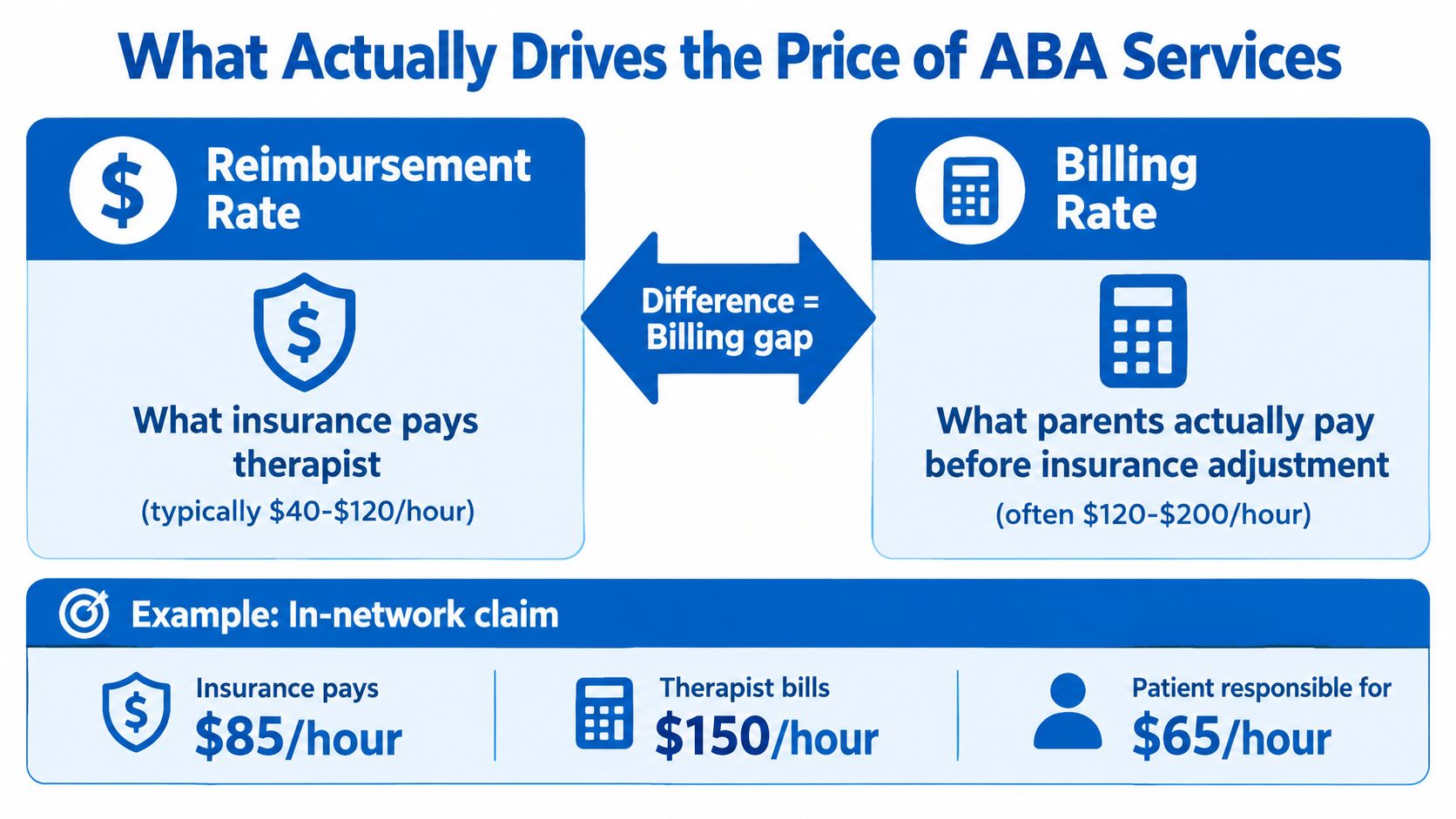
A clinic's sticker price can also look higher because it includes overhead, supervision, or a billing model that bundles multiple roles into one estimate. Imagine ordering a meal where the menu price, the tax, and the service charge are all listed in different places. If you only glance at one number, you won't know what you're really comparing.
Hours and codes drive the total more than most parents expect
Claims data show that ABA-related spending can rise quickly when utilization increases. In large-employer U.S. health plans, mean annual spending for children ages 3 to 7 with a current autism diagnosis increased from about $13,000 in 2011 to $20,000 in 2017, and spending tied to adaptive behavioral-intervention codes, including ABA, rose from $1,785 per child in 2015 to $5,498 in 2017 (CDC claims data). That growth wasn't just about price, it was also about more service being used.
Keep this in mind: The bill isn't just “rate times hours.” It's also who delivered the session, how much supervision was needed, and how the payer classifies each unit.
Families often ask why the same session can look cheaper or pricier on paper depending on the provider. The answer is that billing is built from separate pieces. A technician's direct time, a supervisor's review, and a parent-training session may all hit the claim differently. That's why asking for the rendering provider's credential and the billing code matters just as much as asking for the hourly rate.
How Insurance and Medicaid Shape Your Out-of-Pocket Costs
A parent may hear that ABA is “covered” and still face a monthly bill. The central question is not whether a plan mentions ABA, but how it pays for it, how much therapy it approves, and what portion of the cost stays with the family once care begins.
Private insurance can still leave real costs behind
State autism mandates changed access over time, but they did not erase cost-sharing. A 2015 review found that 40 states and Washington, D.C. had enacted autism-related mandates, with annual benefit caps commonly ranging from $12,000 to $50,000 depending on the child's age and the state (state mandate review). For families using intensive ABA, a cap like that can run out before the year is over.
The monthly pattern matters more than a single quoted rate. One plan may look affordable at first and then shift costs back to you through annual caps, prior authorization, medical necessity reviews, deductibles, copayments, and coinsurance. Another may approve ABA but only for certain providers or only after paperwork is complete. For a practical overview of those insurance terms, this guide to ABA therapy cost with insurance is a useful companion.
The part that often surprises families is how a claim is built. A session can include direct therapy time, supervision, parent training, and different billing codes, and each piece can affect the amount you owe. Two families can hear the same “covered” language and still have very different out-of-pocket totals because one plan authorizes fewer units or applies a higher deductible before coverage starts.
Medicaid coverage depends on the state and the plan rules
Medicaid works through state rules layered on top of federal requirements. For children, the Early and Periodic Screening, Diagnostic, and Treatment (EPSDT) benefit can cover medically necessary autism treatment, including ABA, for eligible beneficiaries under age 21, as CMS explained in its Medicaid FAQ (CMS Medicaid FAQ). That support can lower the monthly burden, but it does not guarantee the same number of hours, the same provider options, or the same approval process in every state.
Simple way to think about it: Medicaid can open the door, but it still asks which services are medically necessary and how they will be delivered.
State examples make the differences easier to see. Arkansas Medicaid describes ABA reimbursement on a per-unit basis and requires an eligible provider plus a prescription from the child's assigned primary-care provider (Arkansas Medicaid SPA). Wyoming's Medicaid plan describes ABA for children ages 0 through 20 with an autism-spectrum-disorder diagnosis, with prior authorization for medically necessary EPSDT services (Wyoming Medicaid SPA). Those examples show how Medicaid coverage can be real and still feel very different from one state to another.
Families who rely on Medicaid often end up planning around approvals, provider availability, and the timing of each month's services. That is why the out-of-pocket conversation has to include cash flow, not just coverage status.
Navigating Waitlists and Out-of-Network Options
A lot of parents assume the cheapest option is the in-network one their plan names. Then they call around and find a waitlist, a staffing shortage, or no one taking new clients. That's where the cost of ABA therapy often shifts, because delay itself can become expensive when a family has to patch together short-term care or keep paying out of pocket while waiting.
When the network exists on paper but not in practice
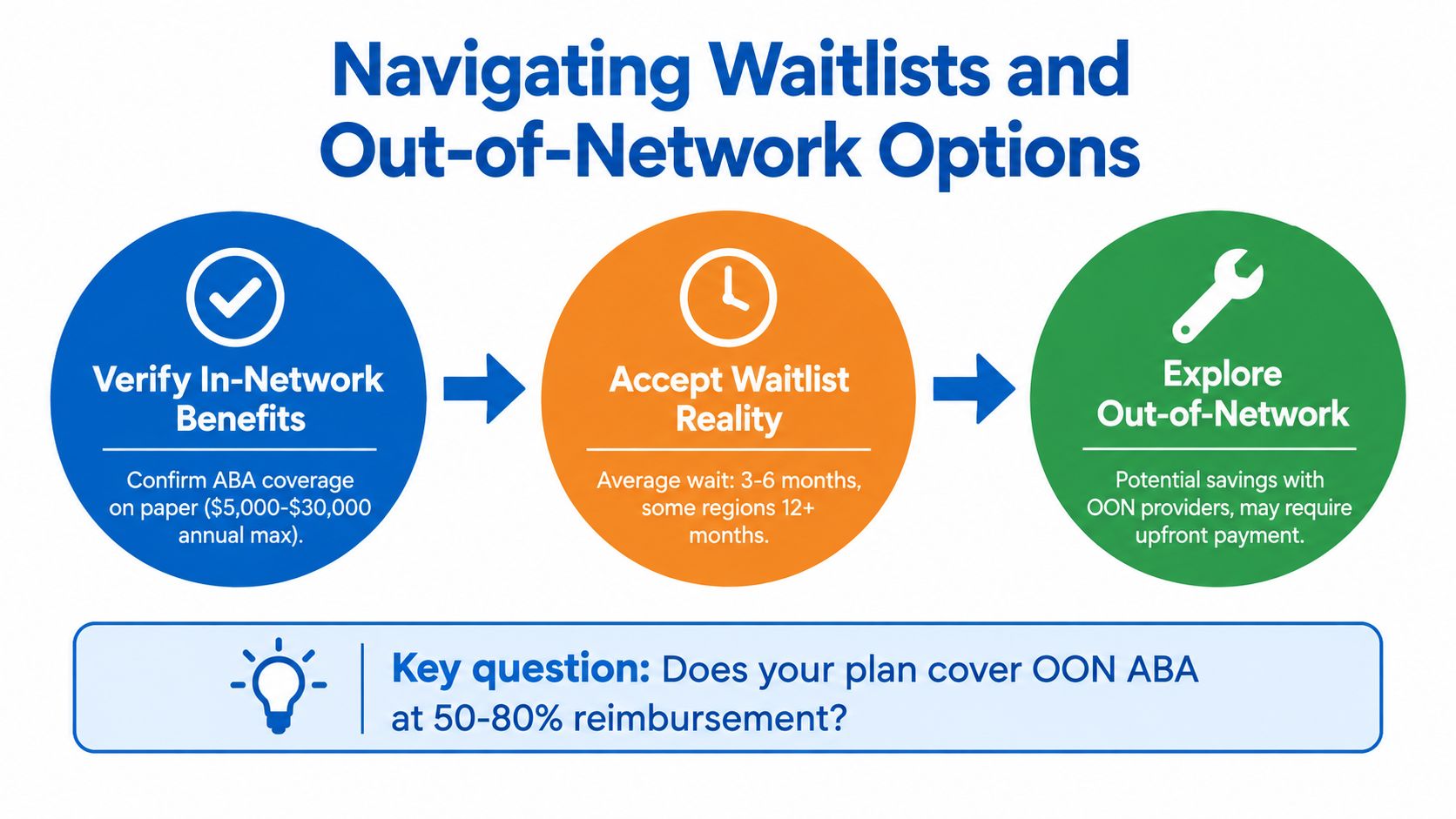
AACAP notes that state mandates may not apply to every plan or every autism treatment option, and families can still face long waitlists, workforce shortages, and restrictive insurance policies (AACAP policy statement). That's why an “in-network” label doesn't always solve the access problem. A provider can be listed and still have no openings, limited hours, or narrow scheduling that doesn't fit family life.
The practical response is to ask the insurer what happens when no usable in-network provider is available. Families can ask about out-of-network benefits, a gap exception, or a single-case agreement. If the answer is no, request the denial or network-shortage explanation in writing. That paper trail matters if you need to appeal later.
Out-of-network can be expensive, but sometimes it's the usable option
Out-of-network care often means paying more upfront, then seeking reimbursement later if the plan allows it. That can sound like the worst choice, but it isn't always. If the in-network option is months away, an out-of-network provider with coverage support may be the only path that starts care right away.
A strong question to ask is whether your plan reimburses out-of-network ABA at all, and if so, how it calculates payment. The answer may change whether you can bridge care now or have to wait for a vacancy. Families sometimes discover that a provider with a higher sticker price creates less immediate strain than a nominally cheaper provider with a long delay and heavy cost sharing.
Useful escalation path: Ask for the coverage rule in writing, save every denial, and document every waitlist. That record can support an exception request or appeal.
Hidden Costs and Financial Assistance Programs
The hourly rate is only part of the story. Families also run into assessments, parent-training sessions, care coordination, transportation, and cancellations that still affect the household budget. When ABA is paired with speech or occupational therapy, the family may also face separate deductibles, separate visit limits, or a different coverage rule for each service.
The bill often includes more than therapy hours
A child's first month can cost more than the months that follow because the evaluation and planning pieces happen first. Parent training may be billed separately, and care coordination can take time that doesn't feel like a therapy session but still ends up on the claim. Missed appointments can also matter if the clinic charges a no-show or late-cancellation fee.
That's why families need a view of the whole care package, not just the direct ABA hour. If speech therapy or occupational therapy is also part of the plan, those services can have separate benefit rules and separate out-of-pocket exposure. When budgets are tight, that combination can shape how many hours a child can realistically attend each week.
Help may exist, but eligibility varies
Some providers and community programs may offer grants, income-based payment options, or other assistance, but none of that is automatic. Families have to check eligibility, application timing, and whether the aid covers therapy directly or only helps with related expenses. The most important thing is not to assume the first “no” means no support exists elsewhere.
If you're looking at assistance options, this resource can help you sort through the application side without guessing: financial assistance program application guide. It's still smart to verify whether a program is open, what it covers, and whether it changes your remaining balance or just reduces part of it.
Practical rule: Ask every provider what else may be billed besides the therapy hour. The answer often changes the budget more than the base rate does.
Building a Month-by-Month Affordability Plan
A yearly total can feel impossible to process when you're already worried about school, routines, and your child's progress. Monthly planning feels more manageable because it matches the way families pay bills. It also shows how coverage, timing, and claim processing shape what leaves the checking account in any given month.
Start with the authorization letter, not the brochure
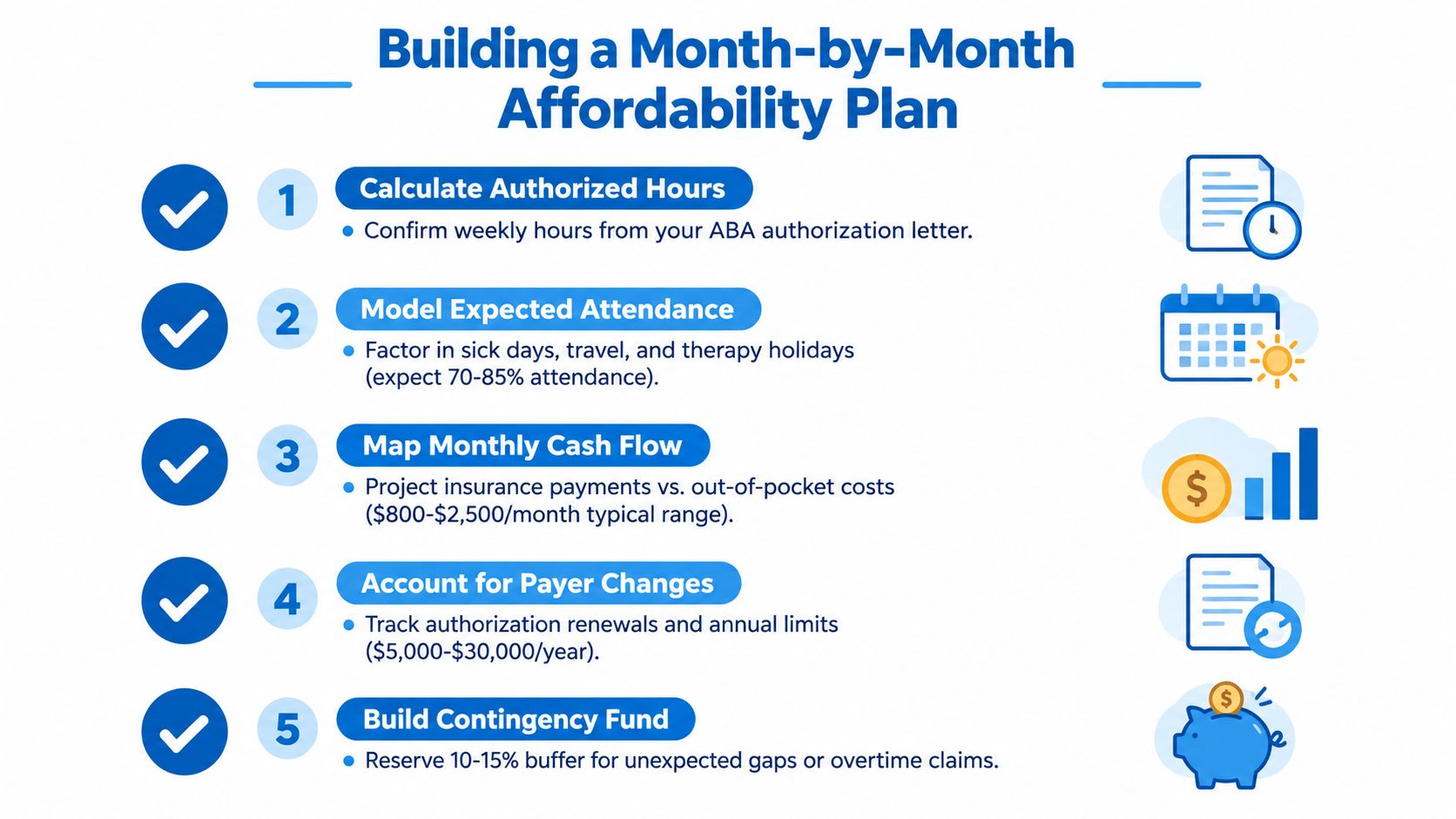
The authorization letter is the cleanest place to begin because it tells you how many hours the plan approved. From there, ask the provider to estimate the month using only those approved hours, not a hoped-for schedule. If the plan approves fewer hours than the clinician recommends, the gap becomes a family decision, not a surprise on the invoice.
The next step is to match those hours to likely attendance. Illness, travel, holidays, and school events all affect how many sessions really happen. A budget built around perfect attendance usually breaks fast, so a realistic estimate is more helpful than an optimistic one.
Track cash flow, not just total cost
A family can sometimes feel more strain from timing than from the final annual total. Claims may process slowly, deductible rules may reset, and some months may include a bigger out-of-pocket hit than others. That's why you want a month-by-month picture of what gets paid by the insurer and what gets billed to your household.
The CDC claims data show how fast spending can scale when service use rises, and the broader Medicaid discussion above shows how state rules and authorization limits shape what gets approved (CDC claims data, CMS Medicaid FAQ). That's why monthly modeling matters. It keeps you from mistaking a covered benefit for a low-cost benefit.
Budgeting habit that helps: Keep a simple folder for authorization letters, Explanation of Benefits forms, denial notices, and clinic invoices. When those records sit together, billing errors are easier to catch.
Finding the Right Support for Your Family
No parent should have to become a billing expert just to get a child help. The cost of ABA therapy changes with intensity, provider level, insurance design, and state policy, which means two families can have very different experiences even when they're both trying to do the same thing. What looks like a simple therapy quote can turn into a month-by-month planning problem once deductibles, supervision, and network rules are added in.
That's also why the same question keeps coming up from caregivers, what will this cost us, and where can we get care that's realistic for our budget? The answer usually isn't a single number. It's a careful look at your plan, your authorization, your local provider options, and whether out-of-network or assistance pathways can fill the gap when in-network care isn't available.
ABA Finder helps families review insurance, understand out-of-network benefits, and compare provider options in select states. If you want a calmer way to sort through the details, one no-obligation conversation can make the next step clearer.
If you're feeling stuck between a confusing benefit summary and a provider waitlist, ABA Finder can help you review your options in plain language. You don't have to sort out ABA coverage alone, and you don't need to commit before you understand the numbers.
Our Latest Insights



















Every Child Deserves Access To Quality ABA Therapy
Whether you're searching for providers, exploring financial assistance, or trying to better understand your insurance options, we're here to help you take the next step with confidence.