



Behavioral Autism Therapies: A Family Guide
Explore behavioral autism therapies, understand the evidence, and learn how to navigate insurance and waitlists to find the right support for your child.

You've just left an appointment with a diagnosis, a folder of referrals, and more questions than answers. One provider has a long waitlist, another doesn't accept your insurance, and the word “ABA” appears in paperwork without much explanation. You may be wondering what behavioral autism therapies involve, whether they're right for your child, and what you can do while you're waiting.
Those concerns are common and understandable. Behavioral care isn't one identical program for every child. It's a group of approaches that use careful observation, teaching, practice, and encouragement to support meaningful skills such as communication, daily living, social participation, safety, and independence.
Table of Contents
- Structured teaching
- Naturalistic and developmental-behavioral approaches
- Communication-focused support
- Parent-mediated programs
- Understanding challenging behavior
Understanding Behavioral Autism Therapies
Suppose your child throws a toy whenever you ask them to leave the playground. A behavioral therapist won't begin by labeling the behavior as “bad.” They'll ask what happened before it, what your child may be trying to communicate, and what happens afterward. Perhaps leaving is confusing, the transition feels overwhelming, or throwing the toy reliably delays the difficult moment. Once the team understands the pattern, it can teach a clearer way to request more time, use a visual transition cue, or move to a preferred activity.
That's the heart of behavioral autism therapies. They look at how a child learns and how the environment affects behavior, then use that information to teach useful skills. Goals may include requesting help, tolerating a routine change, dressing, eating, playing with others, communicating pain, or staying safe. The focus should be your child's quality of life, not making them appear less autistic.
Applied behavior analysis, or ABA, is one of the most widely used behavioral interventions for autistic people. Yet access remains uneven. A U.S. Centers for Disease Control and Prevention analysis found that approximately 40% of school-aged children with autism spectrum disorder and special health care needs received behavioral intervention or behavioral modification services for developmental needs. That figure describes reported utilization in a defined U.S. population and survey period. It doesn't measure eligibility, effectiveness, or what every child needs.
How the field has changed
Behavioral treatment developed through decades of applied learning research, including single-case studies and controlled evaluations of early intensive programs. Earlier services were often more rigid and adult-directed. Contemporary care can include structured teaching, naturalistic play, developmental-behavioral approaches, parent coaching, and support in home, school, or community settings.
Families also deserve room to ask difficult questions. A responsible provider should listen to autistic perspectives, explain the purpose of every goal, respect communication in all forms, and respond when a child shows distress or refusal. You're allowed to ask for goals centered on communication, comfort, safety, participation, and autonomy rather than automatic compliance.
The path can involve paperwork, phone calls, and waiting. It can still become more manageable when you separate the questions into three parts: what your child needs, which approach fits those needs, and how your family can access it.
Exploring the Main Types of Behavioral Interventions
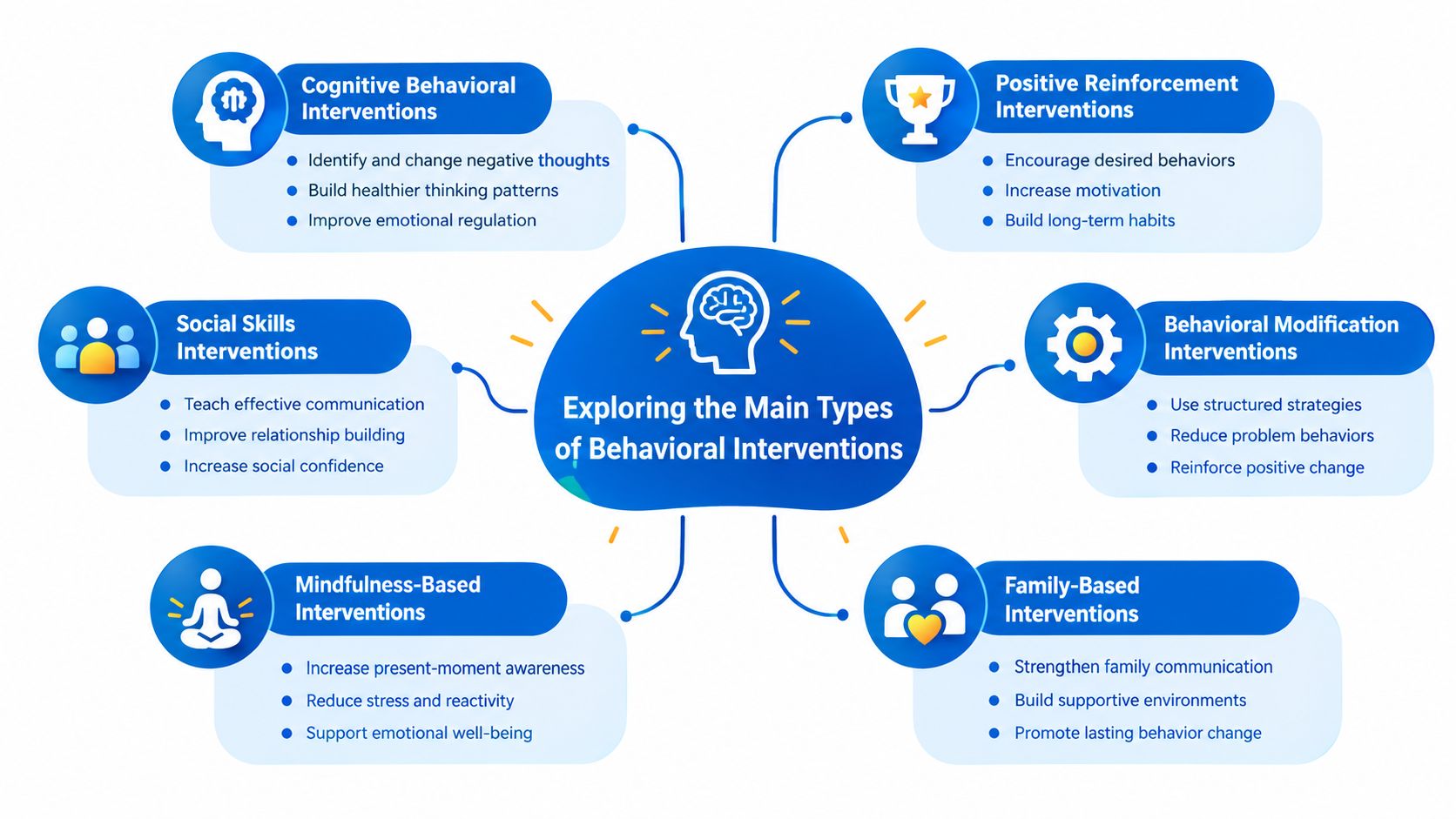
ABA is best understood as an umbrella term rather than a single therapy script. Two providers may both use ABA while offering very different schedules, teaching styles, goals, and levels of caregiver participation. Ask what the provider does each day, not only which label appears on the brochure.
Structured teaching
Structured ABA may break a skill into small steps and practice it repeatedly. Think of learning a new board game. First, someone explains the rules, then models a move, then helps you practice until you can play with less support. For a child, the skill might be matching pictures, requesting a preferred item, following a dressing routine, or responding to a safety instruction.
This format can be useful when a child needs predictable repetition or when a team is teaching a complex skill systematically. It should still include breaks, choice, reinforcement that matters to the child, and regular review of whether the goal remains useful.
Naturalistic and developmental-behavioral approaches
Naturalistic interventions teach during activities that already matter to the child. A therapist might practice requesting while playing with bubbles, turn-taking during a favorite game, or communication during snack preparation. The teaching follows the child's interests and uses ordinary routines so skills have a better chance of appearing outside therapy.
You can read more about this approach in this guide to naturalistic ABA therapy. Ask whether the provider practices skills in more than one setting and plans how your child can use them with family members, teachers, and peers.
Communication-focused support
Some behavioral programs place special emphasis on functional communication. That may include spoken words, signs, picture systems, gestures, speech-generating devices, or other reliable ways to express wants, refusal, discomfort, and ideas. A child shouldn't have to speak in order to communicate successfully.
The important question is whether communication helps your child participate and feel understood. A plan that teaches requesting a break can be more meaningful than one that only measures whether a child repeats a phrase on command.
Parent-mediated programs
Caregiver coaching helps parents use consistent strategies during routines such as getting dressed, leaving home, eating, playing, and bedtime. It doesn't mean you're expected to become your child's full-time therapist. A good coach demonstrates, watches what happens, adjusts the plan, and respects what your family can realistically sustain.
Understanding challenging behavior
A functional behavior assessment, or FBA, examines why a behavior may be happening. The team looks at antecedents, meaning triggers or events before the behavior, the recurring pattern, the child's possible need, and consequences, meaning what follows the behavior. NICE guidance on autism care recommends psychosocial intervention informed by FBA when an untreated mental-health, physical, or environmental trigger hasn't been identified.
For example, if a child hits when asked to stop an activity, the team might teach “more time,” “help,” or “break,” change the transition warning, and ensure that communication receives a useful response. If behavior involves injury, sudden change, sleep disruption, pain, or serious distress, speak with a qualified medical or mental-health professional rather than assuming the cause is purely behavioral.
What the Evidence Says About Treatment Outcomes
Parents often hear two extreme messages. One says behavioral therapy can solve everything. The other dismisses the entire field. The evidence calls for a more careful position: behavioral services have empirical support for some outcomes, but results vary, goals matter, and no intervention guarantees a particular response.
A 2025 National Academies review concluded that a substantial body of literature and multiple meta-analyses support the efficacy and effectiveness of ABA services. The review reported that approximately 10 to 20 hours of ABA service per week may produce positive outcomes for many autistic individuals, while emphasizing that treatment must be individualized. You can review the discussion in the National Academies evidence review.
That range shouldn't become a target that families pursue at any cost. The right schedule depends on goals, developmental fit, the child's tolerance, therapist availability, caregiver capacity, school responsibilities, and funding. More hours aren't automatically better if the program causes exhaustion, limits meaningful family life, or focuses on goals that don't matter to the child.
Choose outcomes that matter at home
A treatment plan should define what progress looks like in everyday life. Useful goals might include:
- Functional communication: Your child can request help, refuse, report pain, or express a preference through a reliable method.
- Daily participation: Your child becomes more independent with dressing, eating, toileting, sleep routines, or moving between activities.
- Safety and regulation: Your child gains safer ways to respond to distress, seek support, and handle changes.
- Connection: Your child can participate in play, family routines, school activities, or community experiences in ways that feel comfortable.
- Reduced distress: The plan addresses the conditions causing overwhelm rather than suppressing visible behavior.
Eye contact, quiet sitting, or stopping harmless self-stimulatory movements shouldn't automatically count as success. Ask whether a goal improves communication, comfort, access, autonomy, or relationships. Ask how your child can indicate “no,” request a pause, or show that an activity is too difficult.
Treat evidence as guidance, not a promise
Research findings describe patterns across groups. They don't predict exactly what will happen for your child. A qualified provider should collect baseline information, review progress regularly, explain limitations, and change goals when the current plan isn't helping.
The strongest partnership is honest in both directions. You can appreciate evidence for behavioral teaching while still asking whether the treatment respects your child's sensory needs, identity, preferences, and emotional well-being.
Managing the Waitlist and Supporting Your Child Now
The diagnosis-to-treatment gap can feel like a second crisis. A provider may say your child is accepted but offer no start date, or place your family on a list without explaining where you are in the queue. A 2025 study of parents of autistic children identified long waiting lists as the most significant access barrier, with a weighted mean of 4.88 on the study's challenge scale. Parents also reported that logistical difficulties interfered substantially with sustaining ABA services.
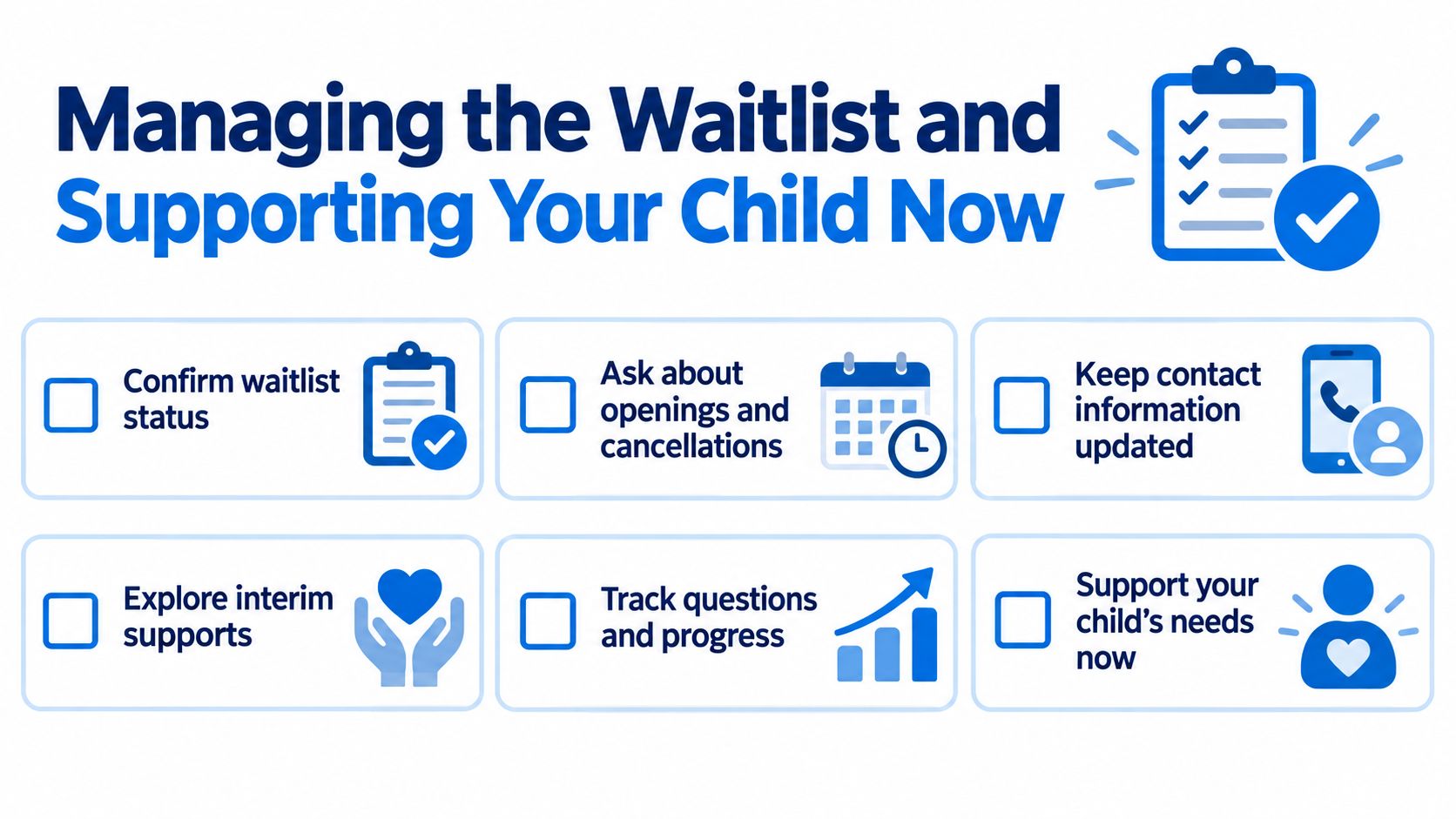
Waiting doesn't have to mean doing nothing. It means choosing safe, practical actions that preserve information, reduce confusion, and support communication without attempting to recreate a clinical program at home.
Build a waiting-period file
Keep one folder, digital or paper, with the diagnosis report, referrals, insurance correspondence, provider names, call dates, waitlist updates, school notes, and questions for the next appointment. Add brief observations rather than long narratives. Record what happened before a difficult event, what your child did, what helped, and whether sleep, illness, pain, hunger, noise, or a routine change may have played a role.
Call more than one provider and ask to be added to each appropriate waitlist. Ask whether the provider offers parent coaching, telehealth, part-time services, home-based care, center-based care, or a cancellation list. Confirm the provider's service area, age range, insurance participation, assessment process, and expected next contact.
Use interim supports carefully
While waiting, caregivers may be able to work on predictable routines, visual schedules, functional communication, choice-making, and sensory-friendly transitions. A speech-language pathologist, occupational therapist, school team, pediatrician, or qualified behavior professional may help you choose strategies that fit your child.
Avoid copying a complex intervention from a video and treating it as a substitute for assessment. A strategy that works for one child may be ineffective or unsafe for another, particularly when behavior involves aggression, self-injury, elopement, feeding concerns, medication changes, or sudden regression.
Safety comes first: If behavior escalates to immediate danger, or you suspect pain, illness, a mental-health emergency, or another urgent concern, contact an appropriate medical or emergency service rather than waiting for an ABA opening.
Use the waiting period to clarify priorities. Which communication would make the biggest difference this week? Which routine creates the most distress? What would help your child participate more comfortably at home or school? Those answers can give a future provider a practical starting point.
Navigating Insurance and Affordability Options
Insurance language can make a simple question feel impossible. Start by identifying who regulates the plan and what the plan requires before treatment begins. “ABA is covered” doesn't necessarily mean your chosen provider is in network, every requested hour is authorized, or your family has no out-of-pocket responsibility.
Private autism mandates generally apply to state-regulated, fully insured plans. They may not apply in the same way to self-funded employer plans, which are primarily governed by federal rules. A state legislative document citing Autism Speaks reported that 39 states had taken affirmative action to clarify ABA coverage for children with autism when medically necessary, including Connecticut, Florida, Georgia, Maryland, Massachusetts, North Carolina, South Carolina, Virginia, and Washington. Review the state legislative document on autism coverage, then confirm your own policy rather than relying only on the state's general rule.
Medicaid and EPSDT
For children enrolled in Medicaid, the federal Early and Periodic Screening, Diagnostic, and Treatment benefit, known as EPSDT, applies from birth through age 20. It requires state Medicaid programs to cover medically necessary care that corrects or improves physical or mental conditions, including autism-related care when the state determines the service is medically necessary. CMS doesn't require ABA specifically or endorse it over other approaches. States decide which services, providers, documentation, and authorization procedures meet their rules, as explained in the CMS autism services and ABA toolkit.
Ask your state Medicaid office or managed-care plan whether the requested service is covered, what treatment-plan documentation is needed, whether prior authorization applies, and which provider qualifications are accepted. Coverage remains dependent on the child's plan and medical-necessity decision.
Compare the main pathways
| Insurance Type | How It Generally Works | Key Questions to Ask Your Insurer |
|---|---|---|
| Fully insured private plan | State insurance rules may apply, subject to the policy's benefits and requirements. | Is the plan fully insured? Is ABA listed? Are there age, hour, network, review, or spending limits? |
| Self-funded employer plan | State mandates may not apply in the same way, and the employer plan documents control many details. | Is the plan self-funded? What autism-related behavioral services are included? Who handles authorization? |
| Medicaid | EPSDT may support medically necessary autism-related care, with state-specific service and provider rules. | Is the service covered under EPSDT? What diagnosis, treatment plan, provider, and prior-authorization requirements apply? |
| Out-of-network benefits | You may be able to use a nonparticipating provider and request reimbursement, depending on the plan. | Is out-of-network care covered? What deductible, coinsurance, reimbursement method, claim forms, and preauthorization rules apply? |
If in-network providers have long waits, ask whether out-of-network benefits could support another option. Reimbursement may be based on the insurer's allowed amount, and you may need to pay the provider first, meet a separate deductible, submit claims, or obtain authorization. Ask for the answer in writing before starting services.
For a plain-language overview of possible pricing factors, see this guide to ABA therapy cost per hour. It shouldn't replace a benefits determination from your insurer or Medicaid plan.
Finding the Right Provider and Taking the Next Step
A provider's first responsibility is to understand your child, not to sell you a preset schedule. During an introductory call, describe what your child communicates well, what causes distress, which routines are hardest, and what your family hopes will change. Then listen for whether the provider asks thoughtful follow-up questions.
Recent evidence reports improvements across language, social reciprocity, cognitive, emotional-expression, and behavioral domains after treatment. As the Frontiers in Pediatrics discussion of treatment outcomes makes clear, broad outcome categories don't show whether goals were chosen with the child and family or whether skills generalize to home, school, and community settings.
Questions worth asking
- How will my child and family help choose goals?
- How does my child show assent, refusal, discomfort, or a need for a break?
- Which communication methods will you support?
- How will you measure progress outside the therapy setting?
- How often will you review and revise the treatment plan?
- What training and supervision do direct-care staff receive?
- How do you address sensory needs, culture, language, and family routines?
- What happens if my child's distress increases or a goal no longer feels appropriate?
- How will you plan transitions, reduced services, or discharge?
You can also use this overview of autism service providers when building a list of questions and options. Compare answers, not just availability. A technically organized program can still be a poor fit if it ignores your child's communication, autonomy, or daily life.
ABA Finder connects families with recommended ABA providers in selected U.S. locations and offers information about insurance review, out-of-network pathways, and affordability resources. Eligibility, provider capacity, coverage, and assistance options vary, so ask for specific confirmation before making a decision.
ABA Finder can help you organize provider options, understand possible insurance and out-of-network pathways, and identify practical questions for your next call. Visit ABA Finder for a no-obligation conversation about finding care that fits your child, your location, and your family's circumstances.
Our Latest Insights








Every Child Deserves Access To Quality ABA Therapy
Whether you're searching for providers, exploring financial assistance, or trying to better understand your insurance options, we're here to help you take the next step with confidence.