



Autism Insurance Coverage Explained for Parents
Understand autism insurance coverage, state mandates, and out-of-network options. A plain-language guide to help parents navigate ABA therapy benefits.


You've just received your child's autism diagnosis. The report is in one hand, the insurance card is in the other, and the recommended next step may be Applied Behavior Analysis, often called ABA. Then the questions arrive: Is ABA covered? Which providers can you use? What happens if the only nearby provider is out of network?
Those questions are difficult because autism insurance coverage isn't a simple yes-or-no benefit. Coverage can depend on your state, your child's age, the way an employer plan is funded, the insurer's medical-necessity rules, and whether an available provider participates in the network. The system can feel impersonal, but it becomes more manageable when you separate those questions and check them one at a time.
Table of Contents
Navigating the Insurance Maze After an Autism Diagnosis
Maria sits at her kitchen table after her child's diagnostic appointment. Her provider recommended ABA, but the explanation of benefits uses unfamiliar terms such as deductible, coinsurance, prior authorization, and medical necessity. The insurer's website lists several behavioral health providers, yet the first two offices she calls have waitlists, and another doesn't serve her area.
Her confusion isn't unusual. A diagnosis may clarify why certain supports are needed, but it doesn't automatically explain how those supports are paid for. A useful starting point is to treat your insurance policy as a set of separate questions rather than one large decision.
ABA, or Applied Behavior Analysis, is a structured approach that may be recommended to support specific skills and behaviors. Whether a plan covers it, how many services it may authorize, and which providers families can use depends on the policy and applicable rules. General information about ABA therapy costs with insurance can help you learn the vocabulary, but your insurer and care team must confirm your child's actual benefits.
The words that matter first
- Covered service: A service the plan recognizes as a benefit. Coverage doesn't necessarily mean the plan pays the entire bill.
- In-network provider: A provider with a contract with the insurer. Using one may result in different cost-sharing than using an out-of-network provider.
- Deductible: The amount your plan may require you to pay before it begins sharing certain costs.
- Coinsurance: The portion of an allowed charge you may pay after the deductible, depending on the plan.
- Prior authorization: Approval the insurer may require before treatment begins.
- Medical necessity: The insurer's review of whether the requested service fits the child's documented needs under the plan's rules.
A practical rule: Ask the insurer to explain the benefit for your child's specific plan, not just the general autism policy shown on its website.
Your first goal isn't to understand every clause. It's to identify who makes the coverage decision, what paperwork they require, and what happens if no suitable in-network provider is available. Once you have those answers, you can compare realistic care options instead of relying on the word “covered.”
How State Mandates and Public Programs Shape Your Benefits
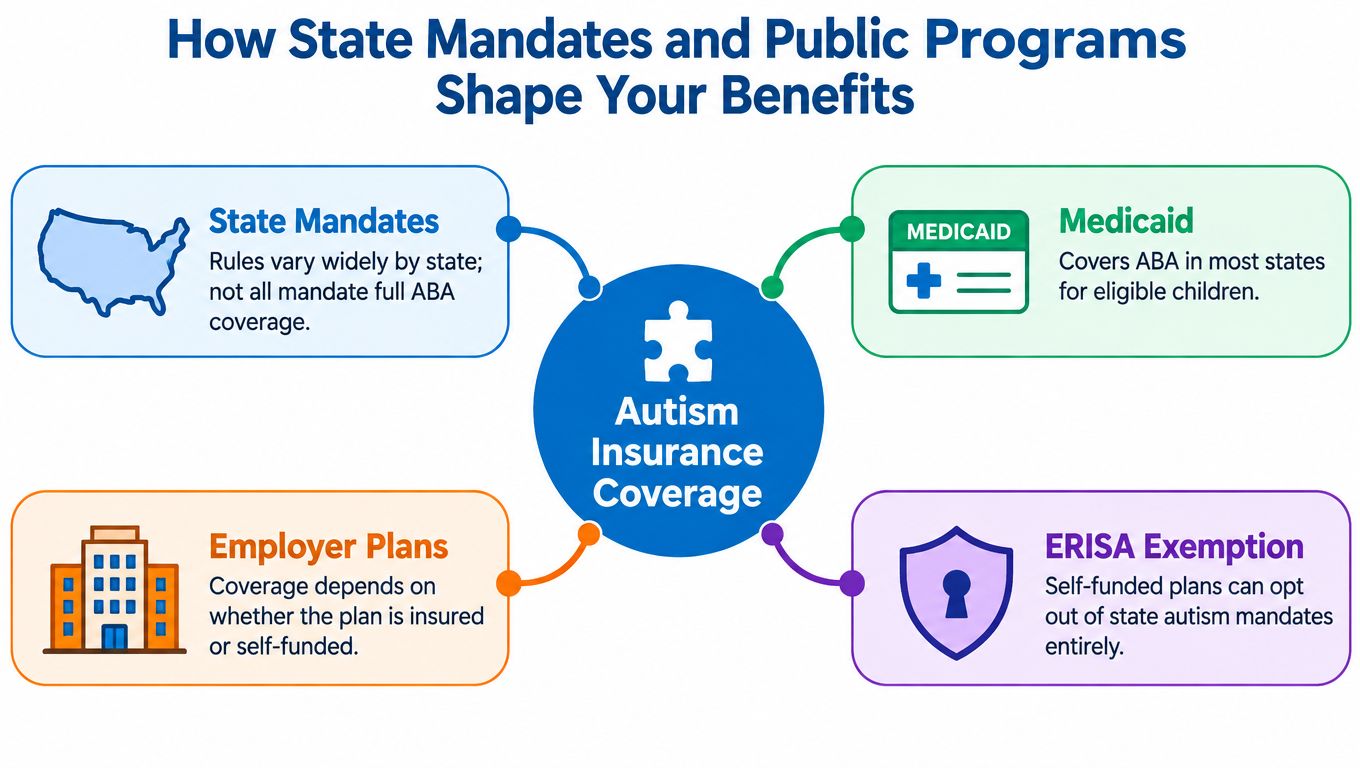
State autism mandates created a broad legal foundation for coverage, but they don't create one uniform benefit across the country. By 2017, a peer-reviewed review found that 46 states had enacted autism insurance mandates, while another review reported that all 50 states had some form of mandate requiring insurers to cover autism-related services. The findings are summarized in this peer-reviewed review of autism insurance mandates.
Those laws generally expanded commercial coverage for autism diagnosis and treatment. The details can still differ sharply. Common structures include coverage for provider-recommended autism services, age caps from 18 to 21 years, annual benefit limits often around $36,000, and no lifetime caps in many statutes. These figures come from the cited review, and they shouldn't be treated as a description of your own policy.
Why location changes the answer
A state mandate may specify which services must be included, who can provide them, or whether the benefit has age, hour, or spending limits. It may also apply only to certain types of insurance plans. That means a family shouldn't assume that a mandate guarantees unlimited ABA, applies to every employer plan, or removes deductibles and utilization review.
Start with your state insurance department or Medicaid agency. Search for the state's autism benefit rules, the plan type covered by the mandate, age limits, authorization requirements, and appeal process. Ask the insurer to identify the exact policy provision that describes autism services, rather than relying only on a customer-service summary.
Public coverage adds another pathway. A federal Medicaid and CHIP infographic reported that about 5% of children ages 3 to 17 with public insurance have autism or ASD. Drexel's National Autism Indicators Report found that 96% of children with autism had some type of health insurance coverage overall, including 54% with public coverage and 41% with private coverage. The same report found that poor children with autism were more likely to have insurance than poor children without autism, 95% versus 88%, and that 93% of insured children with autism were continuously insured over the prior 12 months. These figures appear in the federal Medicaid and CHIP autism infographic.
Those numbers describe whether children have insurance, not whether the plan is practical to use. A family may still face a high deductible, a provider shortage, a benefit limit, or a narrow network. For help organizing possible payment and assistance routes, families can review information about a financial assistance program application, then confirm eligibility directly with each program or provider.
The Hidden Divide Between Fully Insured and Self-Funded Plans
Two families can live in the same state, carry insurance cards with the same brand name, and receive very different answers about ABA. The reason may be how the employer plan is funded.
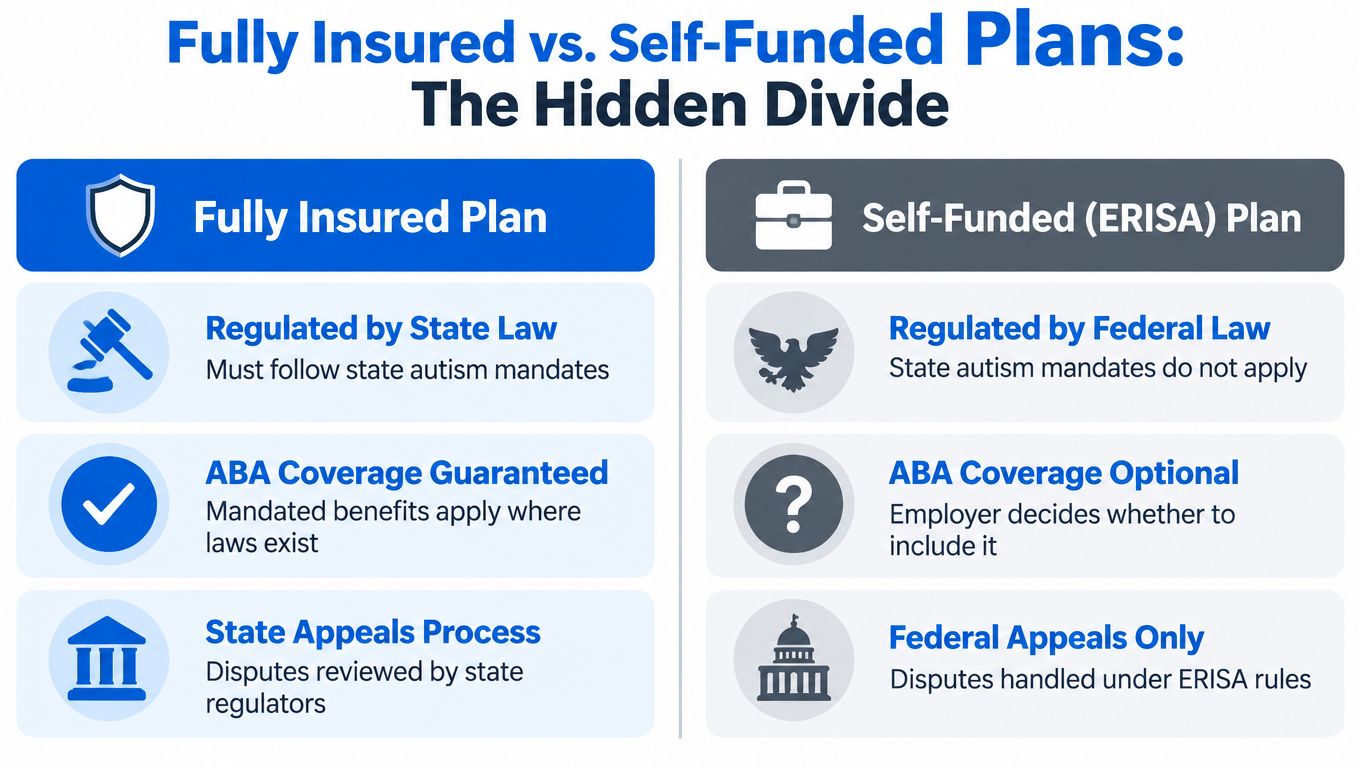
With a fully insured plan, an employer pays premiums to an insurance company, and the plan generally follows the state insurance rules that apply to it. With a self-funded plan, the employer takes on the financial responsibility for claims, often using an insurance company to process them. Self-funded employer plans are generally governed by federal ERISA rules, so state autism mandates may not apply.
A simple analogy helps. A state mandate is like a building code enforced by the state. A fully insured plan operating under that code must follow the applicable requirements. A self-funded plan may be operating under a different federal framework, so the state rule may not control the same benefit.
| Question | Fully insured plan | Self-funded employer plan |
|---|---|---|
| Who usually regulates the plan? | State insurance regulators, subject to applicable federal rules | Federal ERISA framework |
| Do state autism mandates generally control? | They may apply, depending on the plan and state law | They generally don't apply in the same way |
| Could ABA be limited or excluded? | Yes, through applicable limits and plan rules | Yes, unless the plan includes the benefit or another federal protection applies |
| Where should you begin? | Insurer and state insurance department | Insurer, employer benefits office, and plan administrator |
How to identify your plan type
Your insurance card may not clearly state whether the plan is fully insured or self-funded. Call the member-services number and ask directly:
- “Is this plan fully insured or self-funded?”
- “Does a state autism mandate apply to this plan?”
- “Who makes the final decision about ABA coverage?”
- “Where can I request the full plan document or summary plan description?”
- “Who handles an appeal if ABA is denied?”
You can also ask your human resources or benefits team. The insurer's customer-service representative may administer the plan without being the entity that funds it, so ask for the answer in writing when possible.
The research on autism insurance mandates and ERISA preemption explains this structural divide. State-regulated plans may have autism or ABA mandates, age caps, or dollar caps. Self-funded plans can lawfully exclude ABA unless another federal protection applies. Parity rules also don't mean unlimited ABA. A plan may still use deductibles, coinsurance, utilization review, and other coverage conditions.
The result can feel unfair, but knowing the funding type changes your next step. Instead of asking only whether your state has an autism mandate, ask whether your specific plan is subject to that mandate and what benefit the plan document provides.
Proving Medical Necessity and Securing Prior Authorization
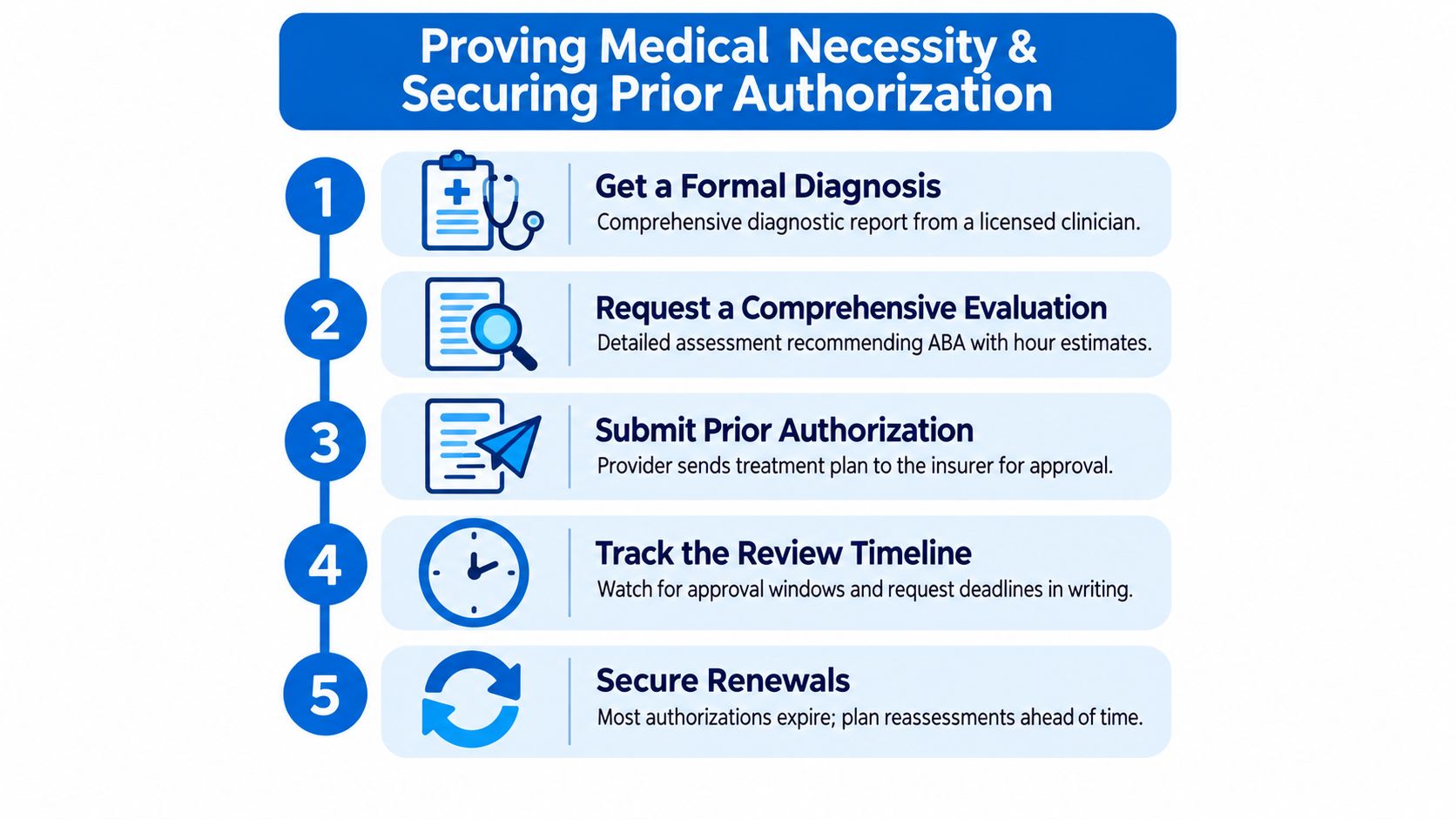
A plan can list ABA as a covered service and still require a review before treatment begins. The insurer may ask for a diagnosis, an individualized treatment plan, supporting clinical records, and an explanation of the goals and services being requested.
Medical necessity is the insurer's process for deciding whether the requested care fits the child's documented needs and the plan's criteria. Medicaid guidance explains that this review typically occurs after an individualized treatment plan has been developed and before ABA begins. The provider or plan may require prior authorization and documentation, as described in the Medicaid ABA services toolkit.
Build the file before the request
Ask the diagnosing clinician or treatment provider which documents they'll submit. The exact list varies, but families commonly need to coordinate information such as:
- Diagnostic report: Keep the formal report and any recommendations in one secure folder.
- Treatment plan: Ask the provider to explain the requested services, goals, setting, and expected review period in plain language.
- Supporting records: Confirm which clinical notes or evaluations the insurer requires.
- Provider details: Make sure names, licenses, billing information, and network status are accurate.
- Authorization form: Ask who submits it and whether the insurer accepts electronic or faxed requests.
The insurer may not approve a request just because a clinician recommends ABA. The review applies the plan's own criteria, and states or managed care plans may use different evidence standards. That's why the provider and insurer should agree on what must be submitted before services start.
Questions that prevent avoidable delays
Call member services and write down the representative's name, the date, and the call reference number. Ask:
- Is prior authorization required for the assessment, ABA treatment, or both?
- Which form should the provider use?
- What records and treatment-plan details are required?
- How will the insurer communicate its decision?
- When does the authorization expire?
- What is the process for renewal?
- If the request is denied, how do I obtain the written reason and appeal instructions?
Don't begin ongoing services based only on a verbal promise that they're covered. Ask the provider how billing will work while authorization is pending, and speak with the insurer before accepting financial responsibility for care.
Keep a paper trail: Save the authorization, denial letters, clinical submissions, and explanations of benefits together. These records help the provider identify missing information and help you understand an appeal.
Exploring Out-of-Network Options When Local Providers Are Full
A common insurance problem has nothing to do with whether ABA appears in the benefit booklet. The in-network providers may be full, too far away, or unable to offer the schedule your child needs. In that situation, an out-of-network provider may be the only practical possibility, but the financial rules can change.
Out-of-network benefits usually depend on the plan's reimbursement method. The plan may apply a separate deductible, reimburse at a lower percentage, or calculate payment using an allowed amount that differs from the provider's charge. Families may also need to submit claims themselves. Autism Speaks' guide to state-regulated health benefit plans explains that out-of-network coverage may reimburse part of the cost after a deductible and at a lower percentage than in-network care.
Use a decision path, not a guess
First, search the network carefully. Ask the insurer for an updated list of ABA providers, then call the listed offices. Record whether each provider serves your child's age, accepts new clients, offers the needed setting, and can provide an estimated start date.
Next, document the access problem. Keep names, call dates, waitlist information, distance concerns, and notes about unavailable services. This record may help when you ask the plan to consider an exception based on network inadequacy.
Then, ask about a gap exception or single-case agreement. An insurer may sometimes agree to treat an out-of-network provider as in network for a defined period or service arrangement when suitable in-network access isn't available. The insurer may decline, and the terms can be limited, so request the decision and reimbursement terms in writing before treatment begins.
Finally, compare the actual numbers in your policy. Ask about the out-of-network deductible, coinsurance, allowed amount, balance billing, prior authorization, claim forms, and payment timeline. A provider's charge and the insurer's reimbursable amount may not be the same.
The right question isn't only, “Is out-of-network ABA covered?” Ask, “If I use this provider, what amount does the plan calculate, what portion might I owe, and what approval must happen first?” A family can then compare waiting for an in-network opening with pursuing an out-of-network arrangement, without assuming either path will be affordable.
For a plain-language explanation of these terms, review out-of-network benefits for ABA therapy. You can also ask the provider whether they help submit claims or prepare documentation, but don't assume they accept your plan or can predict the insurer's final payment.
Planning for the Transition to Adult Autism Services
Many families plan carefully for the next appointment and the next authorization, but postpone the larger question: what happens when pediatric coverage rules no longer apply?
Recent reporting states that autism therapy mandates in many states are capped at or below age 21. Medicaid must cover medically necessary services for beneficiaries under age 21 through EPSDT, the Early and Periodic Screening, Diagnostic, and Treatment benefit. That protection can change when a young person ages out, creating a coverage cliff that families should plan for before the transition. The reporting on adult autism service access barriers describes this concern.
Start with the benefit end date
Find out whether your child's plan has an age limit, and whether the limit applies to diagnosis, ABA, related therapies, or a particular service category. Ask the plan what happens when the child reaches the stated age, including whether an authorization already in progress ends or can continue temporarily.
Then ask about adult pathways in your state. Depending on eligibility and local rules, these may include adult Medicaid benefits, Medicaid waivers, self-directed support programs, community services, or an employer plan. None should be assumed to apply automatically. A state Medicaid agency, benefits counselor, or social worker can explain the available application process.
Create a transition folder
Keep copies of diagnostic records, treatment summaries, progress notes, current goals, prior authorization decisions, and provider contact information. Ask the treating team to describe which supports are helping now and which needs may continue into adulthood.
A transition conversation should also include practical questions about daily living, communication, safety, education or employment supports, transportation, and caregiver involvement. Those needs may not fit neatly into a pediatric ABA benefit, so families may need to explore several funding and service systems rather than searching for one replacement benefit.
Start before the deadline: An application, waiver inquiry, or new insurance review may take time. Ask for transition guidance well before the current pediatric benefit ends.
Adult coverage may look different from childhood coverage, and some plans may not include the same services. Early planning won't remove every barrier, but it can reduce the risk of reaching an age limit without records, contacts, or a next step.
Your Next Steps for Securing Autism Care and Support
You don't have to solve the entire insurance system today. Start with three practical actions.
Verify the plan's funding type. Call the insurer and ask whether the plan is fully insured or self-funded. If it's employer-sponsored, ask the benefits office or plan administrator for confirmation. This tells you whether state autism mandate rules may apply.
Request a detailed benefits explanation. Ask for the autism and ABA provisions, in-network and out-of-network rules, deductibles, coinsurance, authorization requirements, age limits, hour or spending limits, and appeal instructions. Ask the representative to explain what happens if no suitable in-network provider is available.
Gather the clinical documents. Save the diagnostic report, treatment recommendation, individualized plan, provider information, and any prior authorization forms. Ask the treatment team which document they'll submit and whether the insurer needs anything else.
Make a simple call log. Record the date, the person you spoke with, the reference number, and the next action. If a provider is unavailable, document that too. Clear records can help your family and your care team identify the next available route.
Insurance questions can feel especially heavy when you're also caring for your child and managing a waitlist. You can ask your pediatrician, diagnostic clinician, state insurance department, Medicaid agency, employer benefits office, or a care-navigation service for general guidance, then confirm all coverage decisions directly with the insurer.
ABA Finder offers provider connections, insurance and out-of-network benefit review, and guidance on affordability options in selected locations. Visit ABA Finder for a no-obligation conversation about finding a provider and understanding possible payment pathways for your family.
Our Latest Insights













Every Child Deserves Access To Quality ABA Therapy
Whether you're searching for providers, exploring financial assistance, or trying to better understand your insurance options, we're here to help you take the next step with confidence.