



Autism Specialist Near Me: 10 Ways to Find Help
Searching for an autism specialist near me? Compare local ABA options, referral steps, insurance questions, and practical ways to find the right support.

A parent types autism specialist near me into a search bar at 10 p.m. because tomorrow's call can't wait. The hard part isn't just finding someone nearby, it's figuring out whether the first call should go to a BCBA, a child psychologist, a developmental pediatrician, or an ABA provider. That choice depends on whether your child still needs an evaluation or diagnosis, how long local waitlists are, whether you need center-based or in-home care, and what your plan or state might cover.
The search gets even more confusing because “coverage” doesn't always mean “easy access.” The CDC notes that identified autism prevalence has risen over time, which helps explain why families are competing for evaluation and therapy slots, and why local availability can change quickly by region and market CDC autism data. Insurance rules also vary by plan, state, and organization, so one family may find a clear pathway while another has to sort through prior authorization, deductibles, or out-of-network options.
This guide uses person-first language, like “child with autism,” because that's often the default in parent-facing support. Some families prefer identity-first language, like “autistic child,” and that preference is valid too.
Table of Contents
1. ABA Finder
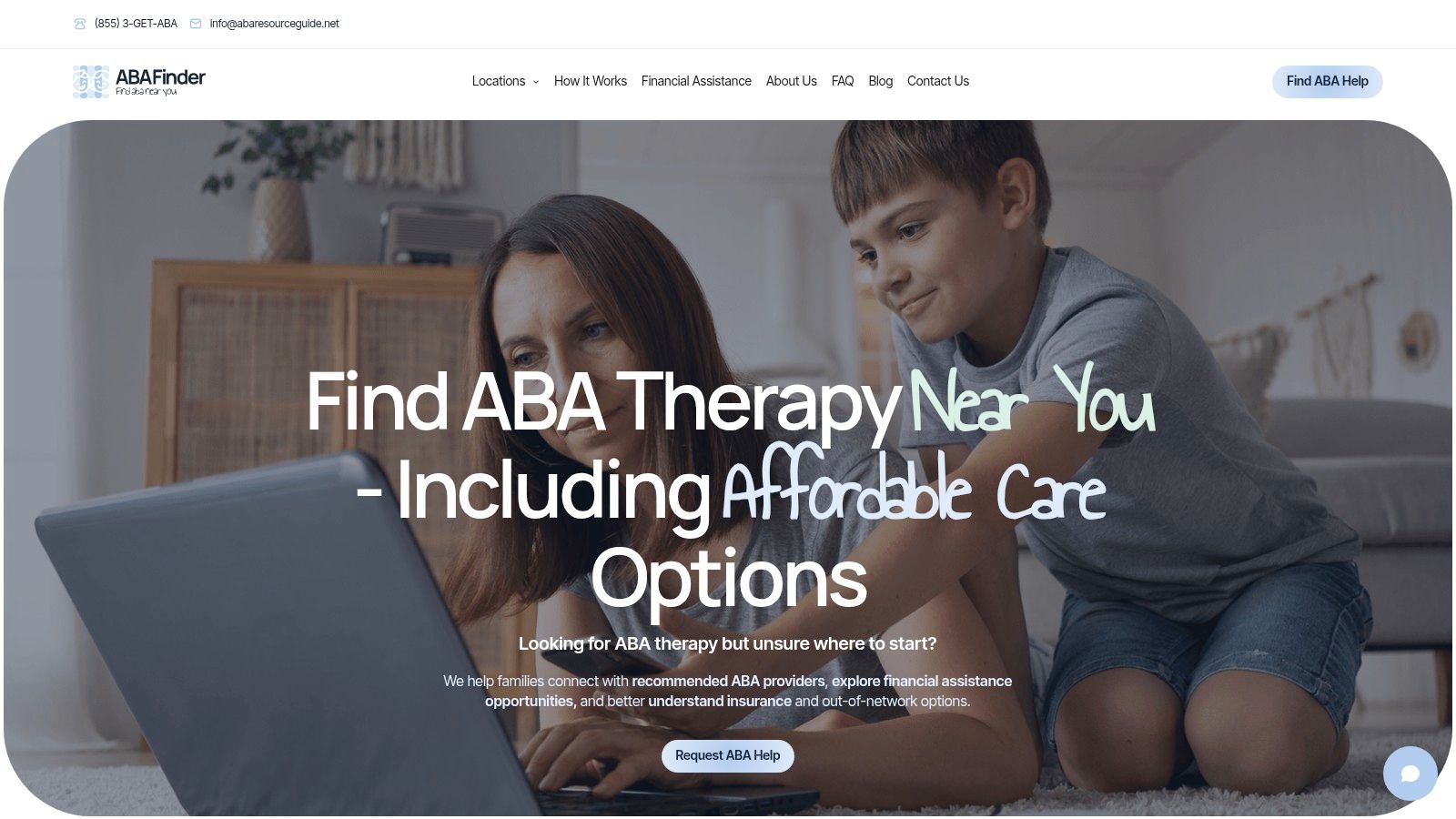
ABA Finder is built for the moment when you want less searching and more clarity. It helps families looking for Applied Behavior Analysis providers sort out location, likely coverage paths, and practical affordability questions in one place. That matters because many parents don't just need a provider list, they need a way to understand what to do next without calling ten offices in a row.
Why it stands out for stressed parents
The process is intentionally simple. You share your family details, the team reviews coverage and affordability options, then you get help finding a provider that fits your area and needs. ABA Finder says it supports families in Connecticut, Florida, Georgia, Maryland, Massachusetts, New Jersey, New York, North Carolina, South Carolina, Virginia, and Washington, which makes it especially useful if you live in one of those states and want location-based recommendations.
Practical rule: if the main barrier is not “Do I need ABA?” but “How do I even start?”, a guided intake can save time and reduce back-and-forth.
The platform focuses on plain-language help around insurance, out-of-network benefits, and affordability options such as grants, income-based plans, and provider assistance. That's useful because families are often told a service is “covered” without getting a clear explanation of deductibles, cost-sharing, or whether the provider is in network.
You can learn more through ABA Finder's ABA therapy reviews, then decide whether to ask for a no-obligation consultation.
Best for: families who want help matching a child with autism to an ABA provider and need support understanding payment pathways.
Watch out for: coverage is limited to select states, and ABA Finder isn't a payor or direct provider, so it can't guarantee funding, eligibility, or placement.
2. Little Leaves Behavioral Services
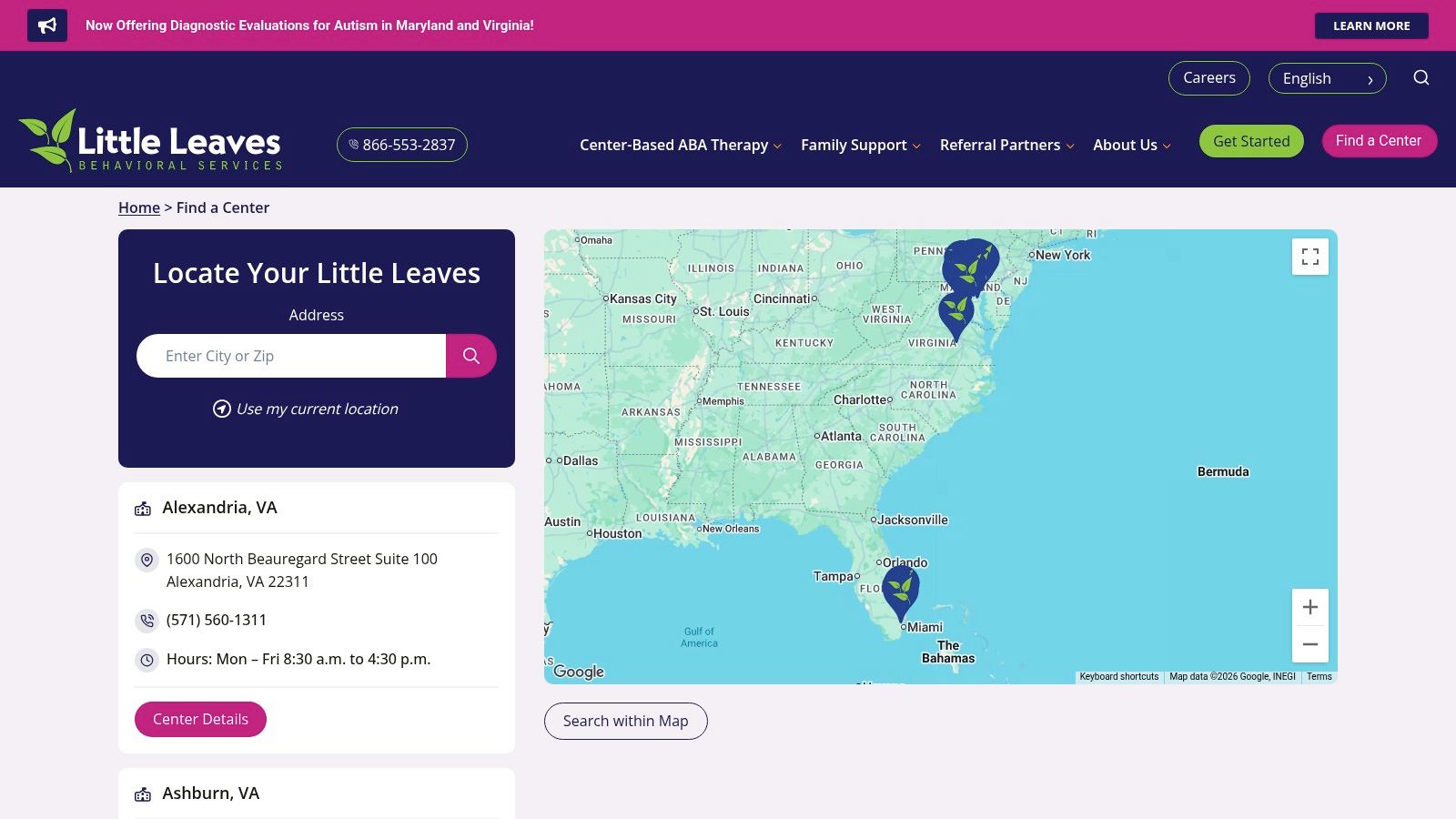
Little Leaves is a strong match for families who want a center-based setting that feels structured and classroom-like. Its preschool-style learning centers are geared toward young children, roughly ages 1 to 6, with an emphasis on early learning, peer socialization, and family training. That setup can feel more concrete for parents who want therapy to look and feel organized from day one.
The center model also fits families who like predictable routines. Little Leaves lists centers in Maryland, Virginia, and Florida, and its BHCOE accreditation may matter to parents who are comparing provider quality signals. The regular progress reviews can help caregivers track whether goals are being revisited in a way that feels visible and practical.
What families usually compare here
- Structured environment: preschool-like classrooms can support school-readiness routines.
- Age fit: the model is aimed at toddlers and preschoolers, so older children may need a different option.
- Family involvement: parent training can help carry skills home.
- Location limits: center hours and commute time may be harder to manage than home-based care.
For some families, the trade-off is worth it. A center can reduce distractions and give a child more chances to practice social routines with peers, but it can also mean less flexibility when life is already crowded with work, siblings, and appointments.
Best for: parents of younger children who want early-intervention structure and a school-readiness feel.
Watch out for: the narrow age focus and location-based care may not fit every family's schedule or child's age.
3. InBloom Autism Services
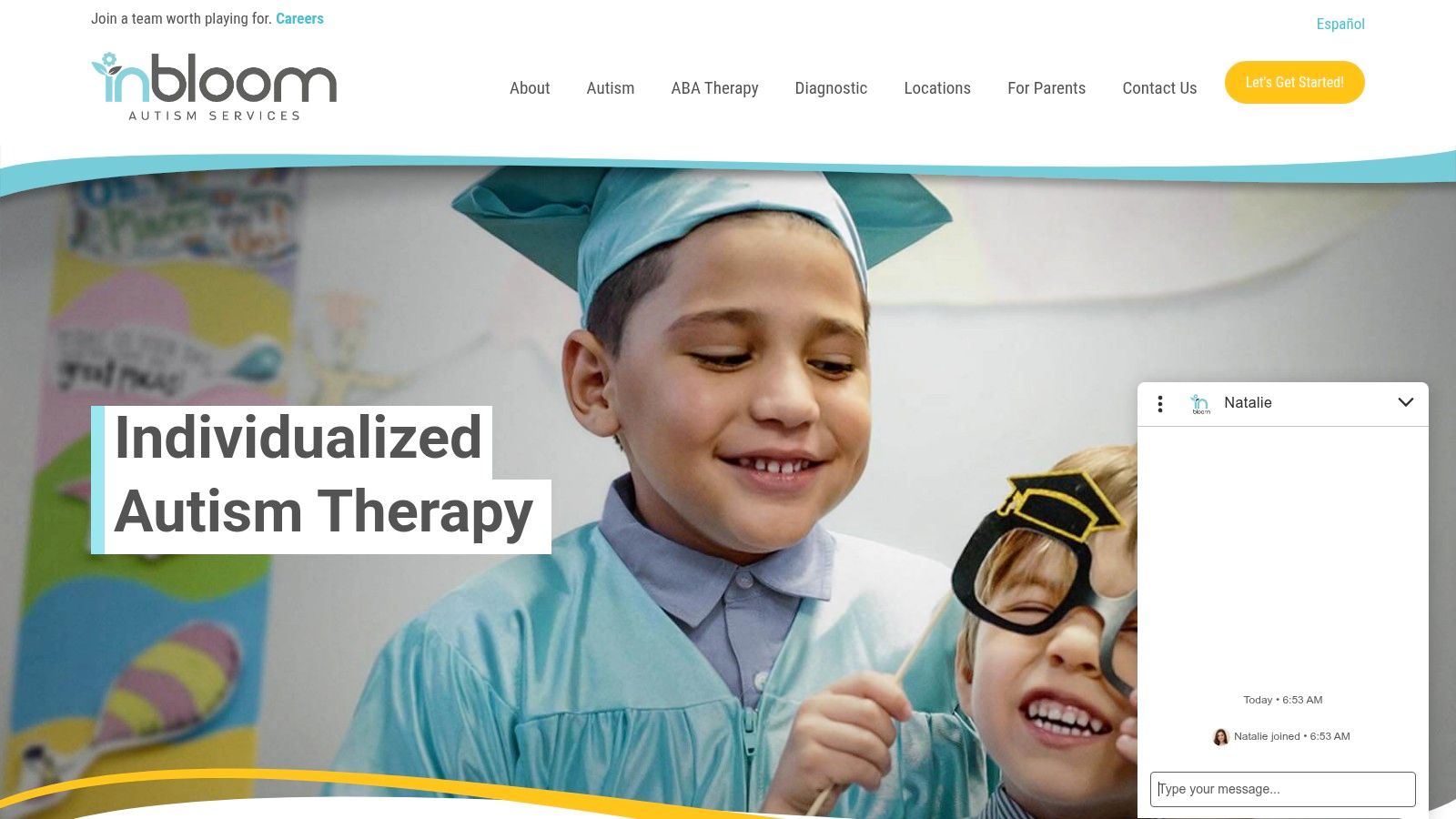
InBloom works well for families who want therapy in a bright, child-friendly clinic and prefer a more guided intake experience. It offers center-based ABA in Connecticut, Florida, and Massachusetts, along with caregiver coaching and parent training. For parents who want to understand the next step before making a dozen phone calls, that combination can feel reassuring.
A useful feature when diagnosis is still pending
In some locations, InBloom also offers in-house autism diagnostic evaluations, which can matter a lot when the bottleneck is not therapy but diagnosis. Many local searches focus on ABA providers first, but a family may need a diagnostician before therapy can start, so having evaluation and treatment in one organization can simplify the path where it's offered.
A family still needs to confirm what is available at the specific office. Diagnostic services are not listed for every state or center, and the model is mainly center-based, so families who need in-home care may need to keep looking. Still, the location directories and regional contacts make it easier to reach an intake team quickly.
The simplest question to ask is not “Do you offer autism care?” It's “Can you handle diagnosis, ABA, or both, and what happens first?”
That question helps families avoid a common mismatch, especially when a search result points to therapy but the child really needs an evaluation.
Best for: families who want clinic-based ABA with the possibility of diagnosis in the same organization.
Watch out for: diagnostic services aren't available everywhere, and center-based care may not work for every routine.
4. Helping Hands Family
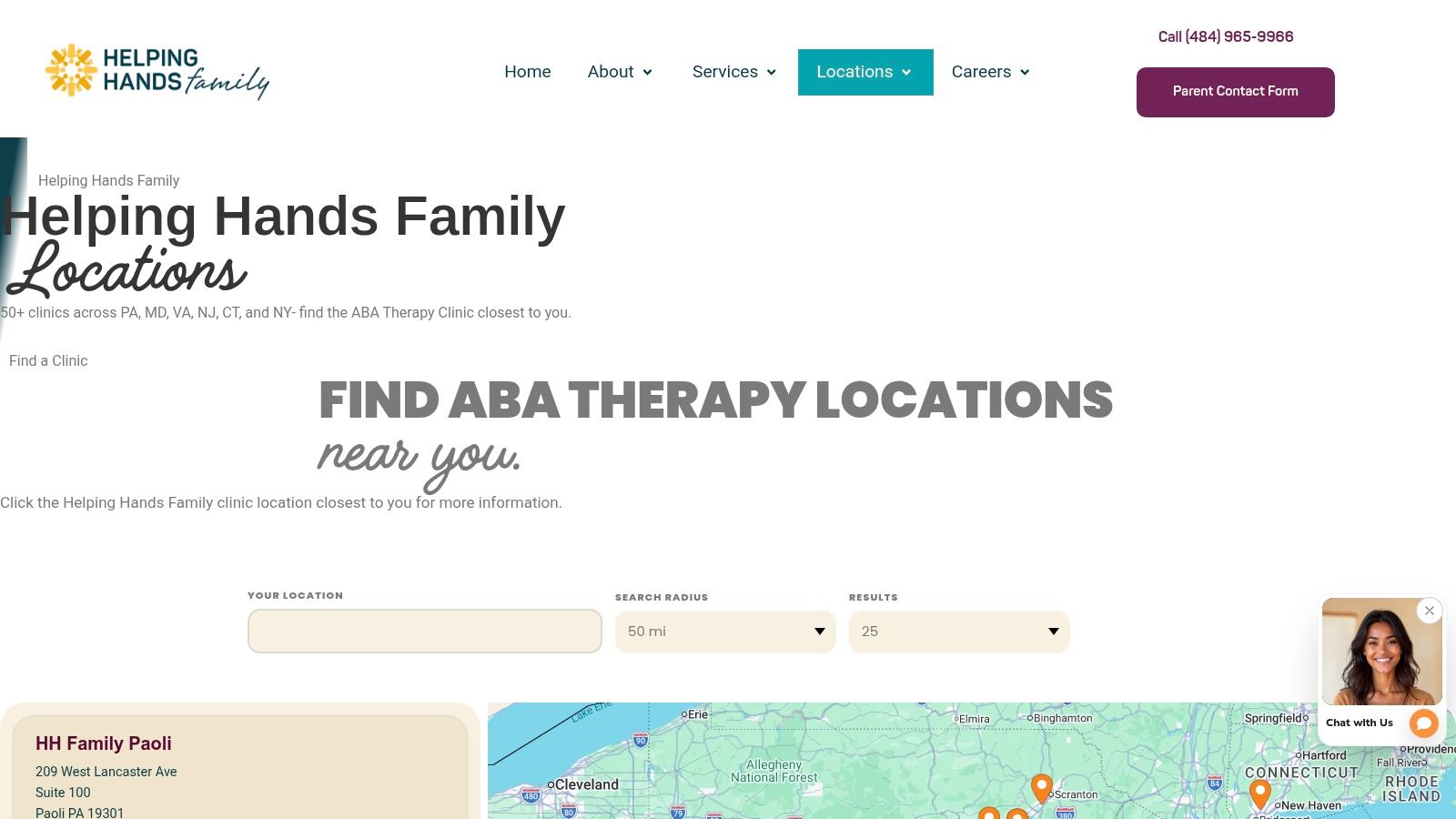
Helping Hands Family gives parents a broad East Coast clinic network to compare, which can matter when you're searching in a busy metro area. It has 50+ service locations across Connecticut, Maryland, New Jersey, Pennsylvania, and Virginia, and it offers parent training, school collaboration, and physician coordination. That mix helps families who want ABA providers to communicate with the rest of the child's care team.
The organization also has a Little Hands day program at select sites, which is an ABA-based alternative to preschool. For some children, that can create a more structured day and offer a bridge between therapy and school routines. Families still need to check whether the day program is offered at the exact site they're considering.
Insurance and school coordination matter here
Helping Hands Family includes an insurance hub and benefit-verification support during intake, which can help parents sort out the early paperwork. That doesn't mean a plan will approve services, but it does mean families can ask better questions before they commit time and energy.
You can also use the referral and update path at What to do after an autism diagnosis if diagnosis has already happened and you're trying to decide what to line up next.
Best for: families in East Coast markets who want multiple clinic options and school coordination.
Watch out for: the day-program option isn't at every clinic, and Medicaid acceptance is limited to certain areas and markets.
5. Butterfly Effects
Butterfly Effects is a good fit when the family wants in-home ABA rather than a clinic routine. Home-based therapy can make skills easier to generalize because the child practices them in the same place where daily life happens, like mealtime, bedtime, and sibling play. The organization also emphasizes caregiver coaching aligned with family routines, which can make the work feel more usable between sessions.
The service footprint includes several East Coast states, including Connecticut, Florida, Massachusetts, South Carolina, and Virginia. That gives it a useful regional reach, but availability still depends on ZIP code and local staffing. Families often find that home-based care is practical, yet it can take some persistence to line up a team in a specific neighborhood.
What home-based care can and can't do
- Real-life practice: skills are taught where your child uses them.
- Convenience: there's no commute to a center.
- Family fit: routines can be built around your household schedule.
- Less clinic structure: some families prefer the predictability of a center.
Butterfly Effects says it accepts most major insurance plans, but families should still verify benefits directly. “Accepted” doesn't mean the same thing as “fully covered,” and a plan may still require authorization or cost-sharing.
Best for: families who want coaching in the home and care woven into daily routines.
Watch out for: limited center options and ZIP-code-based availability.
6. Proud Moments ABA
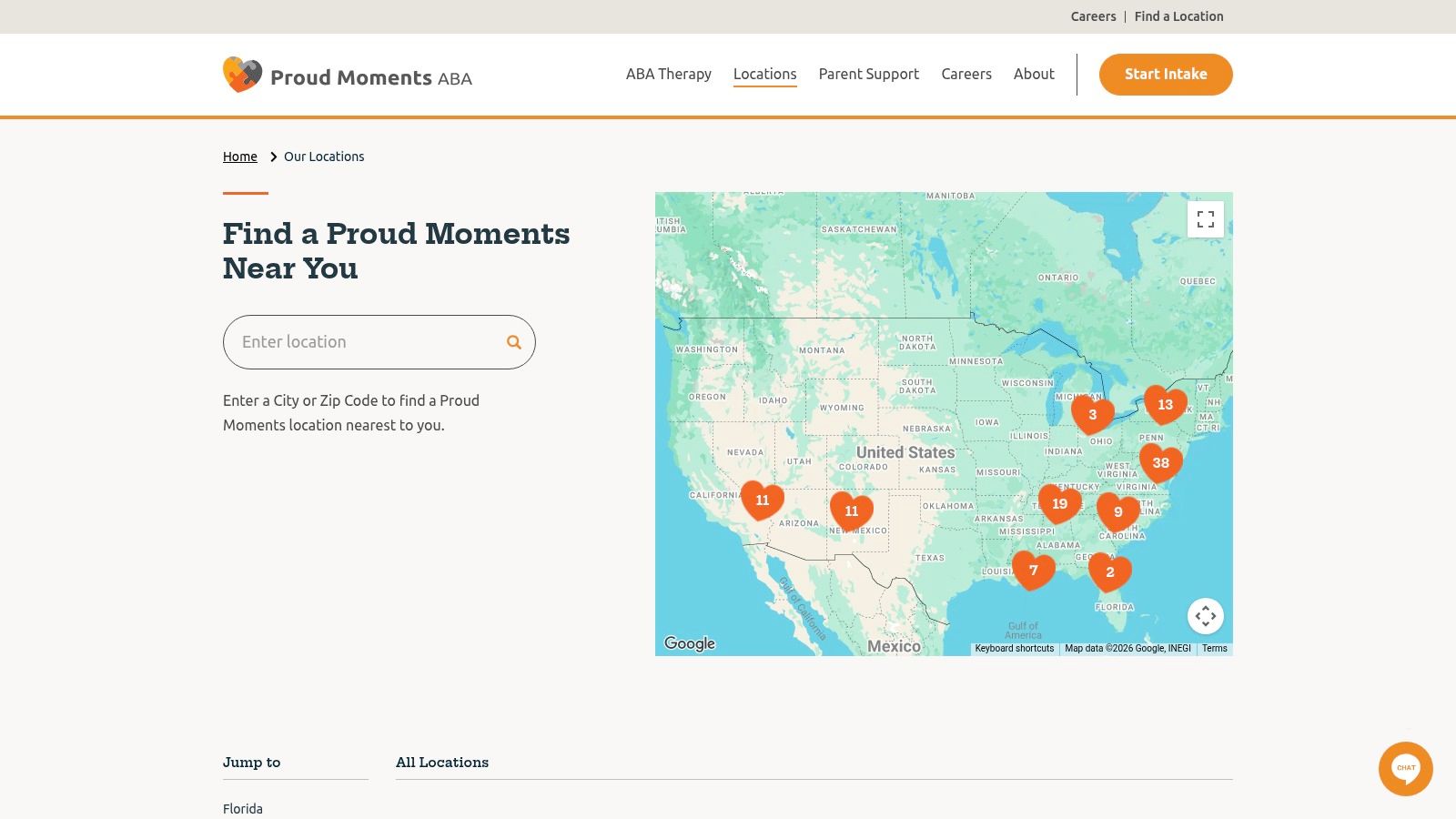
Proud Moments ABA makes sense for parents searching in dense East Coast markets, especially if they want to compare several nearby centers. The network has many locations across New York and New Jersey, plus sites in Maryland, North Carolina, Virginia, Florida, and more. That kind of footprint can matter when one office has a wait and another location is closer or more flexible.
The organization offers center-based therapy and, in some locations, supplemental home and community services. It also provides parent training and coordination with schools and physicians, which helps families keep everyone aligned around the same goals. Dedicated local phone lines can make it easier to reach the right intake team without getting lost in a generic call center queue.
A broad network can help, but it needs local checking
Large networks can sometimes shorten the search for a nearby clinic. They can also create variation from site to site, so the comparison is not just whether Proud Moments serves your area, but which specific office has the right hours, setting, and staffing for your child.
Bigger networks help most when they still answer one local question well, “Can my child actually start here, and who will be responsible for intake?”
That question protects parents from assuming every branch works the same way.
Best for: families in New York, New Jersey, and other East Coast hubs who want a sizable clinic network.
Watch out for: home services and offerings may differ by location, so don't assume one site's services apply everywhere.
7. Key Autism Services
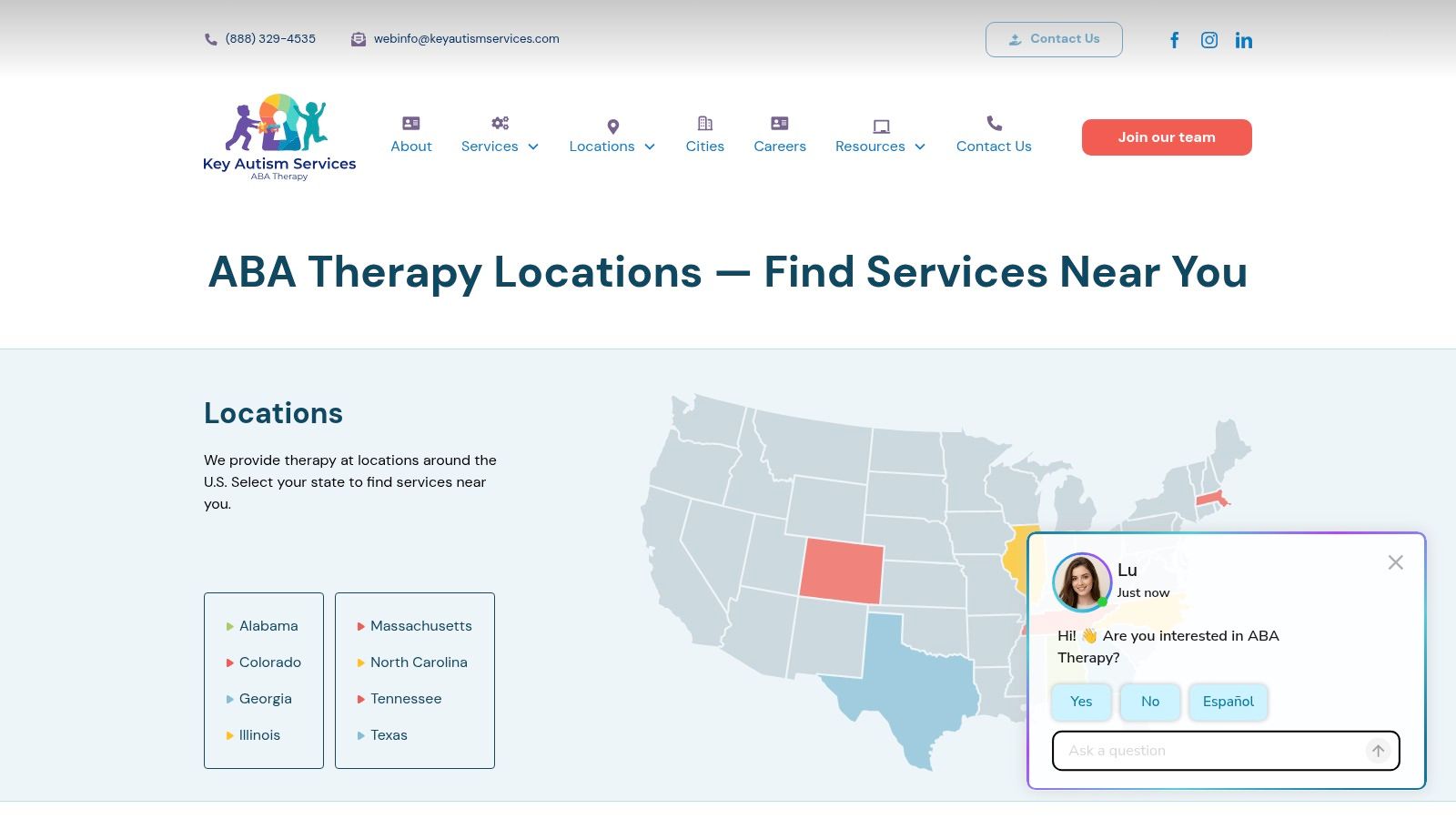
Key Autism Services is useful for families who want a choice between clinic-based and in-home ABA in markets where both are available. It has a strong presence in Georgia, Massachusetts, and North Carolina, with additional states in the mix, and the intake process includes a “Get Started” path with benefits checks. That can take some of the uncertainty out of first contact, especially when you're juggling school, work, and a child's daily needs.
The model centers on individualized behavior plans and family training. That combination matters because many parents want more than sessions, they want to understand how to carry strategies into dinner, car rides, and transitions. The exact service mix still depends on the city and center, so families should treat the location page as the starting point, not the final answer.
Why the setting choice matters
Some children do better with the structure of a clinic. Others need the flexibility of home-based work, especially if the family is dealing with transportation barriers or a tight schedule. Key Autism Services can support both in many markets, which gives families more room to choose based on practical life needs, not just provider availability.
Best for: families in states where the organization has deep coverage and both settings may be available.
Watch out for: service availability changes by location, so one office's setup may not match another's.
8. Behavior Frontiers
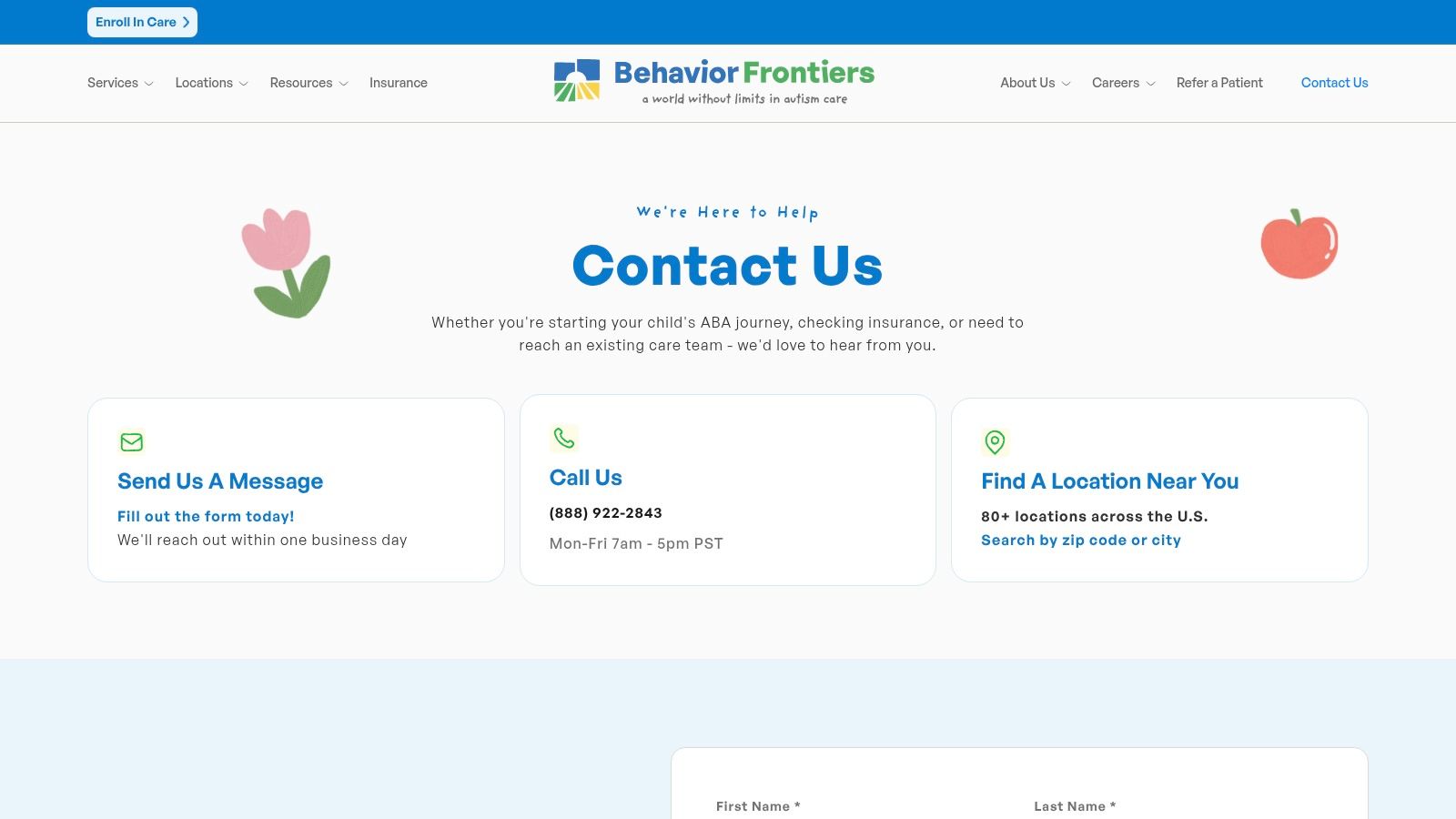
Behavior Frontiers gives families a wide network to search across, with 80+ locations nationwide and both clinic and home services depending on the market. That broad reach can be helpful if you're moving, if your first-choice provider has a wait, or if you need to see what's nearby without starting from scratch every time. The company also uses centralized intake and insurance coordination, which may reduce the number of separate calls you have to make.
Local center listings, such as those in Chelmsford, Massachusetts, Chesapeake, Virginia, and Smyrna, Georgia, show how the network works at the city level. Still, the service mix and wait times are local realities, not national ones. That means one office might be a fit while another nearby site is not.
What to ask before you assume a location works
- Setting: ask whether the site offers clinic, home, or both.
- Staffing: ask who supervises care and how often families get updates.
- Wait time: ask whether the team has immediate openings or a hold list.
- Insurance: ask how intake handles verification and authorizations.
Behavior Frontiers can be useful for families who want a large footprint and a centralized front door. It's less useful if you need very specific local timing, because availability can still vary sharply by site.
Best for: families who want a broad ABA network with multiple local options.
Watch out for: the experience can differ a lot by center, so local details matter more than the national brand name.
9. BlueSprig, Including Florida Autism Center Locations
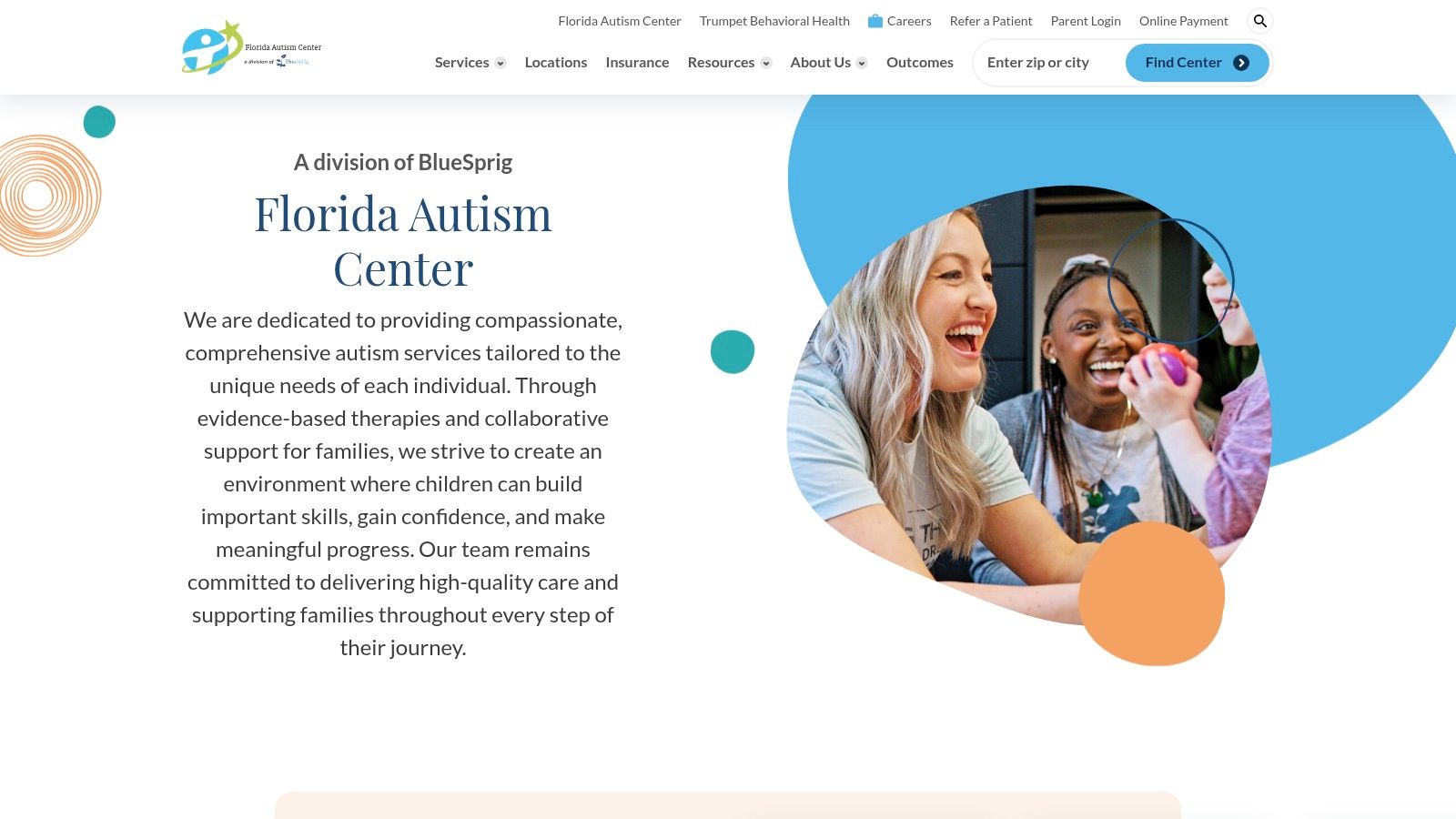
BlueSprig is a strong option for families in Florida who want a center-based ABA environment with lots of local reach. Many Florida clinics operate under the name Florida Autism Center, a division of BlueSprig, which gives the brand a broad statewide presence. That can be reassuring when families want a familiar clinic experience and don't want to start over every time they move within the state.
The centers use structured schedules, caregiver training, and collaboration with schools and local providers. That setup can help families keep therapy aligned with classroom expectations and home routines. The model is still clinic-based, so it tends to work best for families who want a consistent center experience rather than home visits.
A good fit for families who want structure
BlueSprig's standardized center model can make the day feel more predictable. Parents who value routine sometimes prefer that over a home schedule that changes with household chaos. The trade-off is flexibility, since center-based care may be harder to manage for families with transportation barriers or unpredictable work hours.
If you're comparing insurance and cost questions, ABA therapy cost per hour can help frame the conversation, but the numbers for your family still depend on your plan and your provider.
Best for: Florida families who want many center options and a consistent clinic setting.
Watch out for: the model is less flexible than in-home services, and coverage details still need to be checked directly.
10. Achieve Beyond
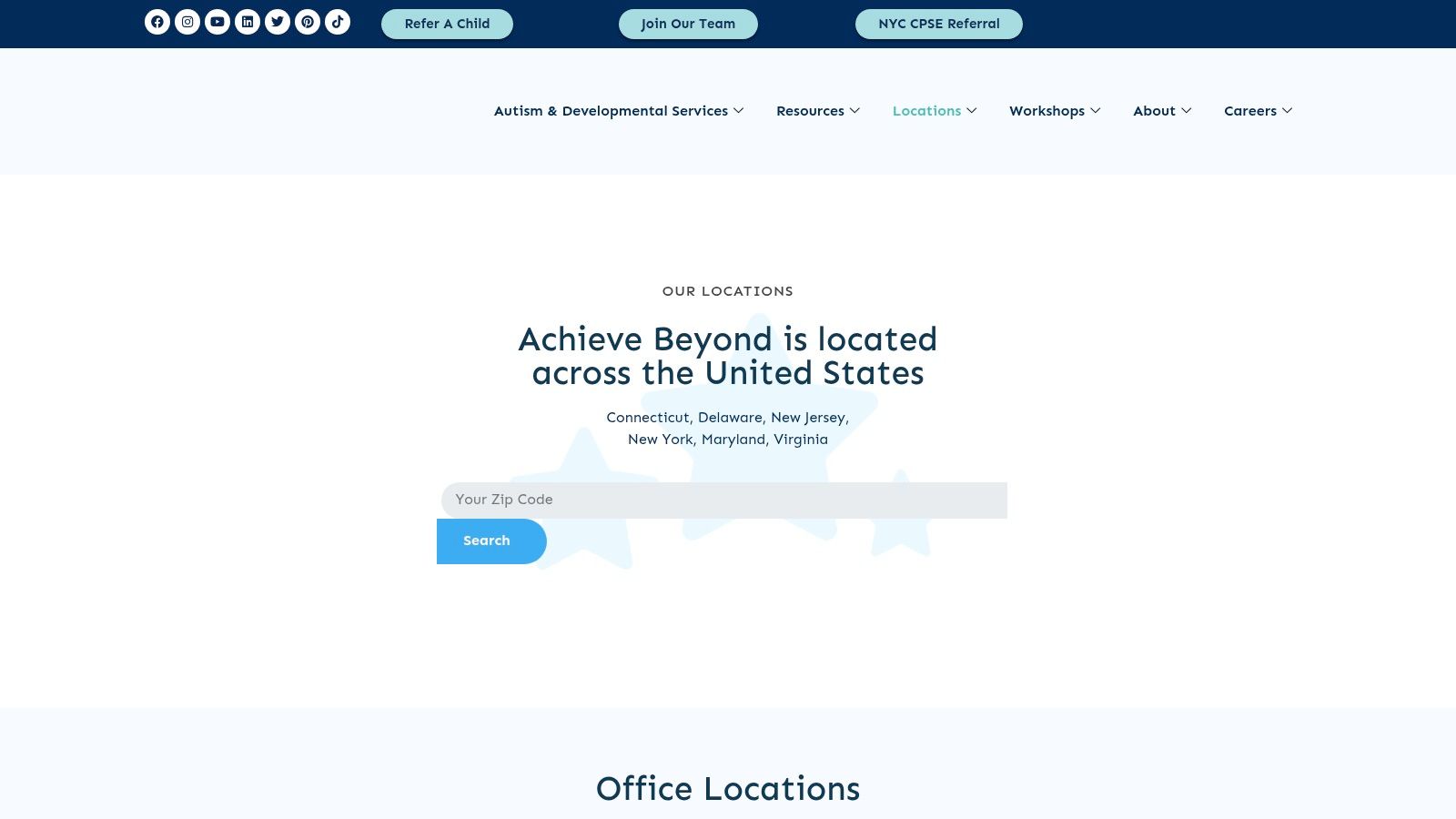
Achieve Beyond is a practical option for families who want ABA plus other pediatric therapies in some markets. It serves parts of New York, New Jersey, Maryland, Virginia, and Connecticut, and its mix can include speech therapy and occupational therapy in select locations. That matters when a child needs more than one service and the family wants coordination instead of separate providers who barely talk to each other.
The organization offers both home/community and center/clinic services depending on the office, which gives families some flexibility in how care is delivered. School collaboration and caregiver training are also part of the mix, which can be especially helpful if therapy goals need to connect with classroom support. In dense metro areas, though, waitlists can still happen, so it's smart to ask about capacity early.
Why multidisciplinary care can help
Some children with autism need support that crosses service lines. A child might need ABA for daily routines, speech therapy for communication goals, and occupational therapy for sensory or motor needs. A multidisciplinary provider can make that coordination feel less scattered, but families still need to confirm which services are offered at their local office.
Best for: families who want ABA alongside related pediatric therapies in the same organization.
Watch out for: service availability varies by office, and dense markets can still mean waiting.
Top 10 Local Autism Specialists Comparison
| Provider | Core features | Setting & coverage | 💰 Cost & value | 👥 Target & ✨ USP |
|---|---|---|---|---|
| 🏆 ABA Finder | Secure intake & needs assessment, insurance & out‑of‑network review, provider introductions, no‑obligation consult ★ | Location-based recommendations: CT, FL, GA, MD, MA, NJ, NY, NC, SC, VA, WA | Free guidance; referral-only (actual ABA services may have out‑of‑pocket costs) 💰 | 👥 Families/caregivers; ✨ centralized affordability navigation, secure privacy-conscious intake; 🏆 Recommended |
| Little Leaves Behavioral Services | Center-based early-intensive ABA, preschool classrooms, family training; BHCOE-accredited ★ | Centers in MD, VA, FL; age focus ~1–6 | Insurance varies; center fees typical, check benefits 💰 | 👥 Toddlers & preschoolers; ✨ school-readiness & peer socialization |
| InBloom Autism Services | Center-based ABA, caregiver coaching, comprehensive intake, in-house diagnostics in select locations ★ | Clinics in CT, FL, MA | Benefits verification during intake; center pricing varies 💰 | 👥 Families seeking diagnostic + therapy in one organization; ✨ in-house evaluations where offered |
| Helping Hands Family (HHF) | Center-based ABA, parent training, school coordination, insurance hub & benefit verification ★ | 50+ locations: CT, MD, NJ, PA, VA | Insurance support at intake; Medicaid acceptance varies by area 💰 | 👥 East Coast families; ✨ broad regional footprint & day-program options |
| Butterfly Effects | In-home ABA, caregiver coaching tailored to routines, benefits verification ★ | Multi-state (CT, FL, MA, SC, VA +), ZIP-dependent | Often accepts major insurers; flexible scheduling reduces travel costs 💰 | 👥 Families preferring home-based services; ✨ natural-environment skill generalization |
| Proud Moments ABA | Large multi-state network, center therapy + supplemental home/community services, parent training ★ | Strong presence in NY/NJ; sites across MD, NC, VA, FL, etc. | Local intake lines; insurance varies by site, multiple centers can reduce wait times 💰 | 👥 Families in NY/NJ & metro hubs; ✨ extensive local coverage |
| Key Autism Services | Clinic & in-home ABA (market-dependent), individualized plans, streamlined intake & benefits checks ★ | Strong in GA, MA, NC; additional markets | Benefits verification during intake; costs vary by market 💰 | 👥 Families wanting choice of setting; ✨ deep state-level coverage in select areas |
| Behavior Frontiers | 80+ locations, clinic & home services (market-dependent), centralized intake and clinical protocols ★ | Nationwide footprint with local center listings | Centralized insurance coordination; pricing and availability vary 💰 | 👥 Families needing broader network access; ✨ large national footprint |
| BlueSprig (Florida Autism Center) | Standardized center-based ABA, caregiver training, pediatric-focused clinics ★ | Very strong coverage in Florida; select centers elsewhere | Many centers accept insurance; standardized center fees 💰 | 👥 Families in Florida; ✨ statewide center network & consistent center experience |
| Achieve Beyond | ABA plus related pediatric therapies (speech/OT in some markets), home & center services, school collaboration ★ | Offices across NY, NJ, MD, VA, CT | Integrated therapy options; insurance and waitlists vary by office 💰 | 👥 Families needing multidisciplinary care; ✨ ABA plus allied pediatric therapies |
Turn a Local Search Into a Clear Next Step
The smartest way to use an autism specialist near me search is to turn it into a short decision list. First, decide whether your family needs an evaluation, a diagnosis, ABA therapy, or broader pediatric services that might include speech or occupational therapy. That first choice matters because the right starting provider is not always the same one who will deliver ongoing therapy.
Next, narrow the list by location and setting. Some families need a clinic with structure and peer interaction, while others need in-home care that fits daily routines. If travel, work schedules, or sibling care are tight, availability and hours may matter as much as the provider's name.
Then ask direct questions before you commit to anything. Ask whether the provider currently has capacity, who supervises care, how caregiver involvement works, whether they coordinate with schools or physicians, and whether they accept Medicaid or private insurance. If they don't take your plan, ask whether out-of-network reimbursement may be possible and what documents, such as a superbill, might be needed. It also helps to ask about prior authorization, deductible and coinsurance responsibilities, and likely out-of-pocket costs, because “covered” can still leave families paying a lot before benefits kick in.
You can also check state Medicaid websites, insurer directories, pediatricians, school teams, and reputable autism organizations for additional referral routes. Those sources may point you toward diagnosis, therapy, or funding paths, but availability and eligibility still depend on your child's situation and your location. The goal is not to chase every listing, it's to find the next phone call that gives you a real answer.
If you're in one of ABA Finder's covered states, you can use its secure, no-obligation process to ask for help sorting providers, insurance questions, and affordability options in plain language. It's a practical place to start when you want less uncertainty and a clearer path forward.
If you're tired of searching autism specialist near me and getting more confusion than answers, ABA Finder can help you sort the next step. It connects families with recommended ABA providers in select states and helps make sense of insurance and affordability questions in plain language. Visit ABA Finder to see whether its secure, no-obligation process fits your situation.
Our Latest Insights






Every Child Deserves Access To Quality ABA Therapy
Whether you're searching for providers, exploring financial assistance, or trying to better understand your insurance options, we're here to help you take the next step with confidence.