



Aba Therapy Cost with Insurance: What Parents Need to Know
Understand aba therapy cost with insurance, from deductibles to out-of-network benefits, with practical steps to minimize what you pay.


You've received an autism diagnosis, found a provider who may be able to help, and now you're looking at an insurance document that seems written in another language. The page mentions a deductible, an allowed amount, coinsurance, and prior authorization, but it doesn't answer the question you really have: How much will my family pay for ABA therapy?
That confusion is understandable. The answer isn't one fixed price because insurance changes the calculation at several points. Your plan, provider network, authorized hours, deductible, and out-of-pocket maximum can all affect the final bill. This guide breaks down the arithmetic in plain language, including what may happen when an in-network provider isn't available and an out-of-network option is the only practical path.
Table of Contents
- Deductible comes first
- Copay is usually a fixed amount
- Coinsurance is a percentage
- The out-of-pocket maximum changes the picture
Understanding Your Initial Insurance Journey
A parent may sit at the kitchen table with a coffee, a notebook, and several Explanation of Benefits forms. One document shows what the provider billed. Another shows what the insurer allowed. A third lists an amount the family may owe. None of the pages seems to use the same number.

The first important point is that an Explanation of Benefits usually isn't a bill. It's a record of how the plan processed a claim. The provider's billed charge may be different from the insurer's allowed amount, and your responsibility may depend on whether you've met your deductible or reached another limit in the plan.
Why the first phone call matters
Before services begin, ask your insurer to explain the ABA benefit for your child's specific plan. Ask whether the provider is in network, whether an authorization is required, and whether the benefit applies to assessment, direct treatment, supervision, or caregiver training. A representative may give general information, but eligibility and payment can still depend on the claim, documentation, authorization, and plan rules.
Write down the representative's name, the date, and the call reference number. Keep that record with your insurance card, diagnostic documents, treatment recommendations, authorization letters, and EOBs. Organized notes can make it easier to identify whether a problem concerns the benefit itself, a missing document, network status, or a processing error.
Practical rule: Don't ask only, “Is ABA covered?” Ask, “What would my family owe for this provider, these services, and the authorized treatment period?”
Families also benefit from learning what steps may follow an autism diagnosis, including evaluations, referrals, and service planning. The guide to what happens after an autism diagnosis can help put the insurance conversation into a broader sequence of next steps.
The process may feel personal because it involves your child, but insurance representatives handle these questions routinely. You're allowed to ask for plain-language explanations, request the relevant policy documents, and take time to compare options before agreeing to a payment arrangement.
Breaking Down Actual ABA Pricing
A family may hear an hourly quote and assume it predicts the final bill. In practice, the quote is only the first line in an ABA therapy cost with insurance calculation. A widely cited U.S. benchmark places ABA therapy at roughly $65 to $100 per hour when billed through state Medicaid programs and TRICARE. Technician-delivered services often fall toward the lower end, while BCBA-supervised time tends to fall toward the higher end, as described in this ABA therapy cost overview.
Treatment delivered across a regular weekly schedule can produce a large underlying service charge before insurance contributes. That total reflects the provider's rate multiplied by the approved hours and services. It does not automatically equal the amount a family pays from its bank account. Deductible payments, copays, coinsurance, and the out-of-pocket maximum can change the household's share.
Why the headline rate can mislead
Some families see listed charges of about $120 to $150 per hour. A listed charge is the provider's starting price, not necessarily the amount the insurer uses for payment. The provider may submit that billed rate, while the plan applies an allowed amount or negotiated rate. For an out-of-network provider, the difference between those figures may be especially wide.
That difference works like a gap between a store's posted price and the amount a discount plan recognizes. If the plan bases reimbursement on a lower allowed amount, the family may owe part of the difference, depending on the policy. A high deductible, limited reimbursement, or strict authorization requirement can increase the exposure even when the schedule appears manageable.
The useful question is therefore specific: Which amount does the plan recognize? How much of that amount counts toward the deductible? What portion remains the family's responsibility?
What insurance changes
Insurance usually reduces the underlying service cost rather than removing it. The insurer may pay part of the allowed amount, leaving the family responsible for the plan's assigned share. The final calculation depends on the benefit design, the provider's network status, the services approved, and the number of hours medically authorized.
If nearby in-network options are scarce, an out-of-network provider may still be worth evaluating. Check whether the plan includes out-of-network ABA benefits, how it calculates reimbursement, and whether the provider must obtain authorization. A higher billed rate does not by itself show what the family will owe.
For a clearer explanation of listed rates, service intensity, and household responsibility, review this breakdown of ABA therapy cost per hour. Treat online estimates as starting points. The insurer or benefits department must confirm the terms that apply to the child's plan.
How Insurance Terms Affect Your Bill
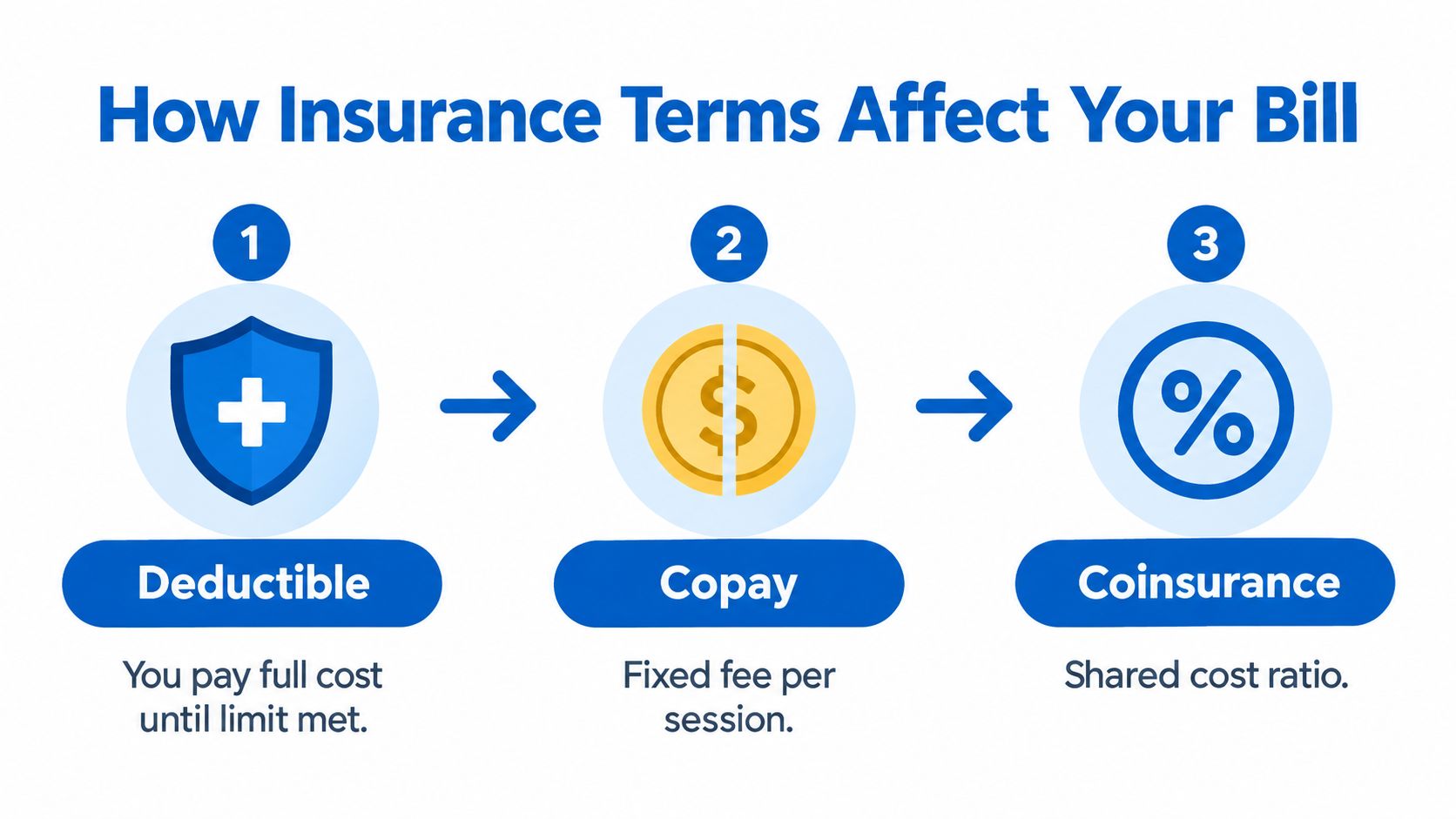
Insurance terms work like layers. Each layer determines which portion of the allowed charge reaches your household budget.
Deductible comes first
Your deductible is the amount you may need to pay for covered services before the plan starts sharing costs under its regular benefit design. A family may therefore see larger bills early in the treatment year, particularly if ABA claims apply to the deductible.
Commonly reported ABA-related plan designs include annual deductibles of $1,000 to $5,000, according to this ABA therapy financing guide. Those figures are examples of reported plan ranges, not a prediction for your policy. Your plan may use a different deductible, and some services may have separate rules.
A deductible isn't the same as a monthly premium. The premium keeps coverage active, while the deductible affects what you pay when you receive covered care.
Copay is usually a fixed amount
A copay is a set fee for a covered service or visit. It doesn't usually change just because the provider's total charge changes, although the plan's rules determine which services carry a copay and when it applies.
Reported copays for ABA may range from $20 to $50 per session, while another cost guide reports copays often ranging from $0 to $50 per session. These ranges show why you should ask whether the plan treats direct therapy, assessments, supervision, and caregiver training the same way. A session-based copay can also work differently from a percentage-based responsibility.
Coinsurance is a percentage
Coinsurance is the percentage of the insurer's allowed amount that you pay after the deductible rules have been satisfied. If a provider is in network, the insurer has usually negotiated the allowed amount with that provider. Your coinsurance is then calculated from that recognized amount, not necessarily from the provider's original billed charge.
Reported coinsurance ranges differ by plan. One guide describes 0% to 20% after the deductible, while another reports 10% to 30% after the deductible. The difference isn't a contradiction. It shows that the exact plan document matters more than a general online estimate.
The out-of-pocket maximum changes the picture
Your out-of-pocket maximum is the plan's annual limit on certain covered cost sharing. Once you reach it, the plan may cover eligible services at 100% for the rest of the plan year, subject to the policy's rules. Reported annual maximums for ABA-related coverage commonly range from $3,000 to $9,000 or more, while a separate 2026 source identifies federal maximums of $10,600 for an individual and $21,200 for a family for most non-grandfathered plans.
Ask which payments count toward the maximum. Premiums, non-covered services, balance bills, and some out-of-network charges may be treated differently.
Navigating In-Network Versus Out-of-Network
An in-network provider has a contract with your insurance plan. That contract typically sets the allowed rate and limits what the provider can charge for covered services. An out-of-network provider doesn't have the same agreement, so the family may face a higher deductible, a larger coinsurance share, more paperwork, or a difference between the insurer's allowed amount and the provider's charge.
That doesn't automatically make out-of-network care impossible. Some plans include out-of-network benefits, and those benefits may be useful when local in-network providers have long waitlists or can't offer the setting, schedule, or service model your child needs. The out-of-network benefits guide can help you identify questions to raise before starting care.
Compare the actual trade-offs
| Feature | In-Network | Out-of-Network |
|---|---|---|
| Provider agreement | The provider has a contract with the plan | The provider may not have a contract with the plan |
| Allowed amount | Usually based on a negotiated rate | The plan may calculate payment using its own allowed amount |
| Upfront payment | Often more predictable, depending on the plan | May require the family to pay the provider first |
| Paperwork | The provider often submits claims | The family may need to submit claims or track additional documents |
| Cost sharing | Deductible, copay, or coinsurance under in-network rules | A separate deductible or higher coinsurance may apply |
| Balance billing | Often restricted for covered services under network terms | The provider may bill the difference where permitted |
| Access | May be limited by network size or waitlists | May offer more provider flexibility |
| Prior authorization | May still be required | May still be required, even when the provider is outside the network |
Ask for the allowed amount
A common mistake is comparing the provider's full charge with the amount the insurer says it will pay. Instead, ask the insurer for the allowed amount, the out-of-network deductible, the reimbursement percentage, and whether the plan subtracts anything before applying coinsurance.
For example, an insurer may recognize an allowed amount that's lower than the provider's listed charge. Your coinsurance may apply to that recognized amount, but you could still owe a difference that the plan doesn't cover. Ask whether the provider can accept the insurer's payment as payment in full, whether balance billing is permitted, and whether a single-case agreement is possible.
Out-of-network benefits can widen your provider options, but they don't remove the need to calculate your exposure before treatment begins.
Request a written estimate from the provider and a benefits explanation from the insurer. Neither document may be a payment guarantee, but together they can reveal where the largest financial risks sit.
Understanding State Laws and Plan Types
A state autism insurance mandate may create a coverage pathway, but it doesn't make every plan identical. The plan type matters just as much as the state where your family lives.
Fully insured employer plans are generally subject to the insurance rules of the state that regulates the policy. Self-funded employer plans, by contrast, are often exempt from state autism mandates because the employer pays claims directly and the insurer or administrator manages the plan. The Medicaid autism services information explains why families need to identify both the policy and the funding arrangement rather than relying only on the insurance company's name.
A practical coverage map
Start by asking the employer's benefits team or plan administrator whether the plan is fully insured or self-funded. If it's fully insured, ask which state regulates the policy and request the autism or ABA benefit language. If it's self-funded, ask for the summary plan description and the federal appeal procedures that apply to the employer plan.
State mandates can differ in age limits, provider requirements, treatment limits, and authorization procedures. Even where a mandate applies, the plan may still require medical-necessity documentation and approval before services begin.
Medicaid is another potential pathway. Federal Medicaid guidance connects medically necessary services for eligible children under 21 to the Early and Periodic Screening, Diagnostic, and Treatment framework, often called EPSDT. The Medicaid ABA toolkit says states should connect sustained ABA coverage to a confirmed autism spectrum disorder diagnosis, although some states may authorize limited, time-bound services when there's strong clinical suspicion.
State rules can be detailed
For example, Georgia Medicaid covers autism spectrum disorder services for members under 21 effective January 1, 2018, and requires a documented DSM-5 diagnosis from a licensed clinician plus a recommendation from an authorized practitioner. Services remain subject to medical necessity and EPSDT standards, as described by Georgia Medicaid's autism spectrum disorder program.
These examples don't determine eligibility in another state. Ask your state Medicaid agency, managed-care plan, or employer benefits administrator which rules apply to your child.
Questions to Ask Your Insurance Provider
A family can leave an insurance call thinking ABA is covered, then discover that the deductible, coinsurance, provider status, or out-of-network rules change the actual bill. Keep a notebook open and ask the representative to answer for your exact plan, not for the insurer's general membership. Ask for clear explanations of both what the plan pays and what your family may owe.
Ask about the benefit
Use direct questions:
- Covered services: Does the plan cover ABA assessment, direct treatment, BCBA supervision, caregiver training, and related documentation?
- Annual limits: Are there annual hour limits, visit limits, dollar limits, or treatment caps?
- Authorization: Is prior authorization required before assessment or treatment? Who submits the request, and which documents must be included?
- Medical necessity: What clinical criteria does the plan use, and can the insurer provide the applicable policy?
- Billing codes: Which specific CPT codes does the plan recognize for the services the provider expects to submit?
- Network status: Is the exact provider, location, and plan product in network?
- Cost sharing: What are the ABA deductible, copay, coinsurance, and remaining out-of-pocket maximum?
- Out-of-network benefits: Does the plan reimburse out-of-network ABA, and does a separate deductible apply? Ask how the plan calculates its payment, since this can change your share of the bill when local in-network options are scarce.
- Appeals: If a claim or authorization is denied, where are the appeal instructions and deadlines?
These answers help you estimate the actual cost, rather than relying on a headline coverage statement.
Turn answers into records
Ask for the representative's call reference number and request written confirmation when possible. Compare the answers with your plan documents. A phone explanation may be incomplete or apply only while eligibility and plan terms remain unchanged.
The insurer may request a diagnosis, referral, assessment, treatment plan, provider credentials, and evidence of medical necessity. Ask the provider which documents it will submit and which ones you should keep. If the plan denies care, read the written notice carefully. A missing document, network issue, authorization problem, and medical-necessity decision each require a different response.
Use this video as another plain-language starting point before you call:
Overcoming Coverage Hurdles and Delays
Having an ABA benefit doesn't always mean treatment can begin smoothly. Insurers may require prior authorization before services, concurrent review while treatment continues, and reauthorization near the end of an approval period. A provider may recommend one level of care while the plan authorizes another, or a request may pause because the insurer needs additional records.
Coverage can still involve repeated reviews
The U.S. Department of Labor's 2025 MHPAEA report describes a case in which a plan limited ABA prior authorization to six months, while comparable medical and surgical services in the same classification didn't face the same restriction. The example, discussed in the Department of Labor report to Congress, illustrates why families should ask not only whether ABA is covered, but also how often the plan reviews it.
Medical-necessity review can involve the diagnosis, assessment, treatment goals, progress information, requested setting, and plan criteria. The treating clinician makes a clinical recommendation, but the insurer separately decides whether the requested services meet the plan's coverage rules. Approval can therefore differ from the provider's recommendation.
Prepare for an interruption before it happens
Ask when the authorization starts and ends, who submits the renewal, what information supports continued care, and whether services can continue while a renewal is pending. Keep copies of every authorization, denial, fax confirmation, portal message, and EOB.
If a claim is denied, start with the written notice. Identify whether the issue concerns a missing record, a coding error, network status, medical necessity, authorization dates, or a non-covered service. Follow the appeal instructions and deadline in the notice, and ask the provider whether corrected records or a clinical peer review may address the stated reason.
Before services begin, make a written plan for who will monitor authorization dates and what happens if approval is delayed.
The administrative work can feel exhausting, especially when your attention is already focused on your child. You don't have to understand every insurance term at once. Start with the allowed amount, network status, deductible, coinsurance, out-of-pocket maximum, and authorization period. Those details usually reveal the main sources of your potential ABA therapy cost with insurance.
ABA Finder can help families look for providers, review in-network and out-of-network benefit pathways, and understand affordability options that may be available in their area. Visit ABA Finder to request help finding a provider and sorting through the next insurance questions with no obligation.
Our Latest Insights

















Every Child Deserves Access To Quality ABA Therapy
Whether you're searching for providers, exploring financial assistance, or trying to better understand your insurance options, we're here to help you take the next step with confidence.