



Does Medicaid Cover ABA Therapy? A Guide for Families
Does Medicaid cover ABA therapy? Learn how EPSDT benefits work, common state requirements, access challenges, and practical steps to verify your child's plan.

Medicaid may cover ABA therapy, but coverage is not universal or automatic. Whether your child can receive it depends mainly on your state’s Medicaid rules, your specific plan, medical-necessity requirements, and whether providers are available nearby.
Table of Contents
- Medicaid ABA Coverage at a Glance
- How EPSDT Connects to ABA
- Watch for Limits and Reviews
- Why Approval and Access Don’t Always Match Up
- What to Do When the First Door Doesn’t Open
- Consider Out-of-Network Reimbursement
- Calculate the True Cost
- Keep a Written Record
- Getting Clearer Information
What Medicaid ABA Coverage Means for Families
Medicaid is funded jointly by the federal government and individual states. Think of it as one shared framework with different local rulebooks. That’s why the answer to “does Medicaid cover ABA therapy?” can change when a family crosses state lines.
Most children access coverage through Medicaid’s Early and Periodic Screening, Diagnostic, and Treatment (EPSDT) benefit. This provision generally requires medically necessary services for children under 21 when care helps address or improve a health condition. However, each state and managed-care plan can set its own processes for evaluations, authorization, documentation, and approved providers.
Medicaid ABA Coverage at a Glance
The table below gives you a quick snapshot of how coverage typically works—and where families often run into obstacles.
| Coverage Aspect | What It Means for You |
|---|---|
| State rules | Requirements and covered services can differ significantly depending on where you live. |
| Child’s plan | A managed-care plan may have its own network and approval process. |
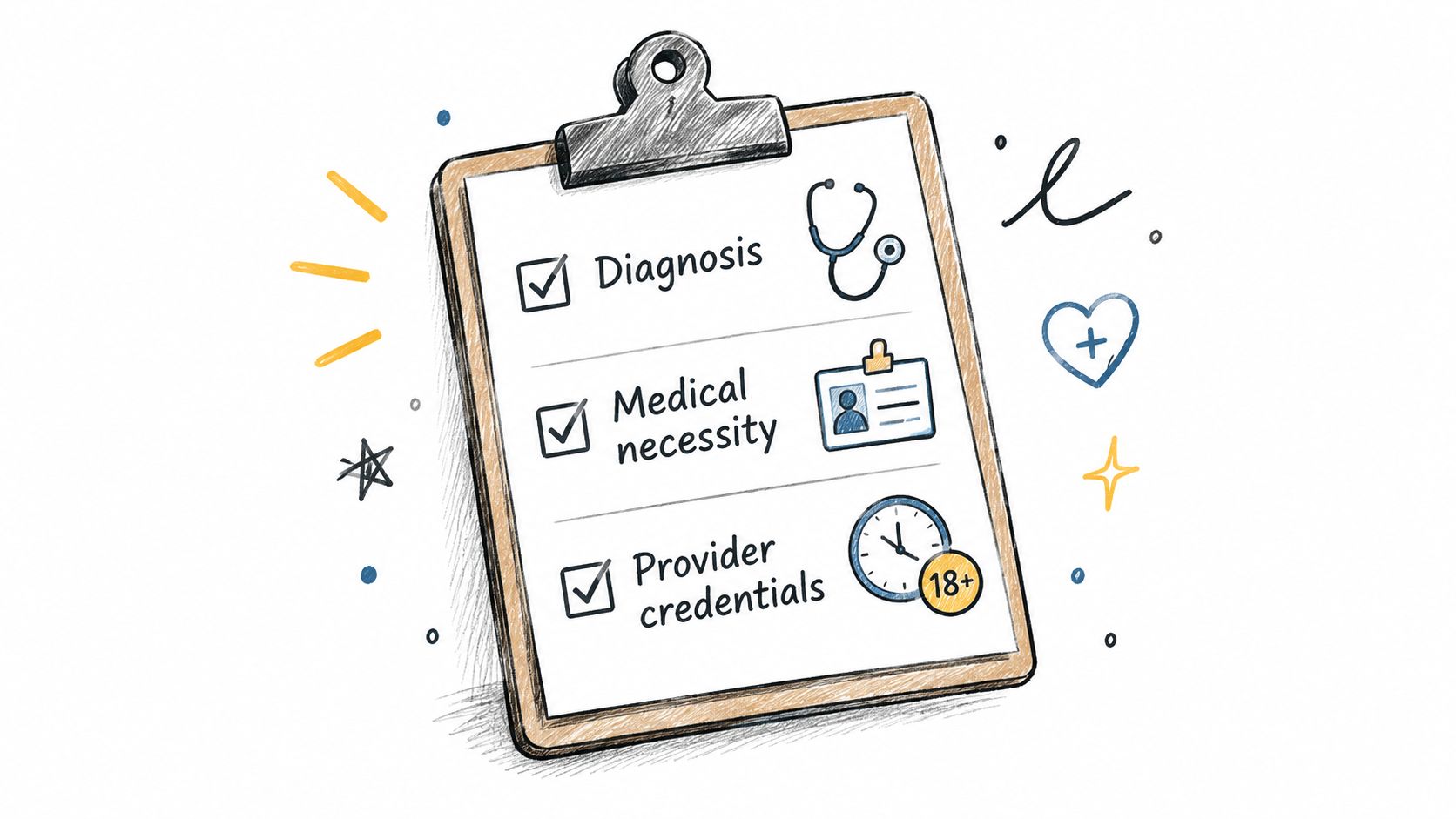
| Diagnosis | A qualified provider may need to formally document an autism diagnosis. |
| Medical necessity | A treatment plan may need to explain your child’s goals and expected benefit. |
| Provider access | Having coverage on paper does not always mean there is an in-network provider near you. |
Coverage approval and access are separate steps. A plan can recognize ABA as a covered service while families still need to navigate authorization and find an available provider. Getting approval does not guarantee an immediate appointment.
Before you call, gather your child’s Medicaid card, diagnosis records, and any provider information you have. Ask whether ABA is covered under your specific plan, what credentials providers need, whether prior authorization is required, and whether session limits apply. It may also help to learn more about steps after an autism diagnosis before beginning the insurance process.
If the language feels confusing, you do not need to solve everything in one call. Write down the representative’s name, reference number, and instructions, then contact ABA Finder to help you understand provider and payment options in plain terms.
One reason Medicaid may cover ABA therapy is a federal rule called Early and Periodic Screening, Diagnostic, and Treatment (EPSDT). In simple terms, EPSDT is intended to help children and teens on Medicaid receive care considered medically necessary—the kind of care that may address or improve a health condition before age 21. For the official overview, Medicaid.gov has a plain-language breakdown of EPSDT.
This matters in states that do not have a separate autism insurance mandate. Instead of thinking of EPSDT as one national ABA policy, it may be more useful to view it as a federal floor with state-level details added on top. Federal requirements establish a baseline, while each state Medicaid agency and managed-care plan fills in the specifics.
Here’s the bottom line: EPSDT may open a coverage pathway for children under 21, but it does not guarantee ABA. Most families still need a qualifying diagnosis, paperwork supporting the request, an approved treatment plan, and a provider who meets the state’s credentialing rules.
EPSDT may support medically necessary ABA care, but your state and plan determine how you request, authorize, and receive services.
How EPSDT Connects to ABA
Under EPSDT, a Medicaid program generally must cover services that are medically necessary for a child, even if the service would not be covered the same way under an adult benefit. For a child with autism, ABA may qualify when a qualified professional documents that it addresses functional needs and builds health-related skills.
However, federal rules do not require every state to use the same treatment model or the same name for the benefit. North Carolina, for example, describes its offering as a research-based behavioral health treatment benefit. That benefit may include ABA and other evidence-backed approaches, but only within the state’s clinical policy and authorization process—details outlined in this North Carolina Medicaid provider bulletin.
States tend to differ in several important ways:
- Eligibility: Standard Medicaid enrollment and age limits still apply.
- Documentation: You may need to provide a formal diagnosis and a functional assessment.
- Authorization: Many plans review and approve a treatment request before sessions begin.
- Provider standards: Clinicians and behavior technicians may need specific licenses, certifications, or supervision structures.
- Service settings: Approved locations vary. Some plans may allow home, clinic, school, or community settings, while others are narrower.
That’s why two families can both receive a “yes” to does Medicaid cover ABA therapy and still follow completely different instructions depending on their state. Start by asking your Medicaid agency or health plan how EPSDT applies to your child’s situation. If you would rather not navigate it alone, ABA Finder can help compare providers and payment options in your area.
Once you confirm that Medicaid may cover ABA therapy, the next step is understanding the requirements attached to that coverage. These requirements can feel like a maze of paperwork, but they are usually standard approval steps—not a reflection on you or your child.
Most states and managed-care plans may ask for several items before approving treatment:
- A formal autism diagnosis from a qualified, licensed professional
- A behavioral, developmental, or functional assessment
- Documentation explaining why ABA therapy is appropriate for your child’s specific situation
- An individualized treatment plan with concrete, measurable goals
- Services delivered by providers who meet state licensing, certification, and supervision standards
North Carolina’s Medicaid program offers one example. Its behavioral treatment requirements call for validated diagnostic tools, a thorough assessment, a customized treatment plan, and an intensity of care based on documented medical need. Some states may accept a provisional diagnosis for children under three but require a final, confirmed diagnosis within a specified timeframe.
Watch for Limits and Reviews
Coverage on paper does not always mean unlimited access. Your plan may impose restrictions involving age, location, weekly hours, approved services, or authorization periods. Some programs may also have spending caps, waiver-specific requirements, or rules about services that cannot be billed under ABA.
Periodic reassessments are common. Before continuing care, the plan may review your child’s progress, current needs, treatment goals, and whether the requested hours still appear appropriate. Illinois provides an instructive example: Medicaid and All Kids coverage for children under 21 typically requires a doctor’s prescription and a licensed provider, while state waiver programs may offer another pathway when families need additional support, depending on eligibility.
A request for more records does not mean coverage has been rejected. The plan may simply need specific details before making a decision.
Before starting services, ask the Medicaid agency or plan administrator:
- Is ABA therapy covered under my child’s specific plan?
- What diagnosis and medical-necessity documentation do you need?
- Does the provider need prior authorization before treatment begins?
- Are there limits on age, hours, dollar amounts, or service settings?
- How often must the treatment plan be reviewed or renewed?
- What is the appeal process if the request is denied?
Keep copies of everything: reports, authorization letters, denial notices, and phone reference numbers. If answers remain unclear, ABA Finder can help you prepare questions for providers and insurers. You may also find it useful to read this guide to autism insurance coverage for related payment information.
Learning that Medicaid might cover ABA therapy can feel like a weight off your shoulders. However, coverage is only the starting point. Families may still encounter provider shortages, long waitlists, narrow service areas, or no in-network therapist nearby. An approval can feel like receiving a ticket to an event where the next seat is not available for months.
A Medicaid authorization approves care under specific terms: an approved treatment plan, service dates, a credentialed provider, and a set number of hours. Payment still depends on accurate billing, eligible service dates, any required prior authorization, and the details of your plan. Even a signed approval letter may not be the final step.
Coverage approval means the plan may pay for an authorized service. It does not guarantee an open appointment or uninterrupted care.
Why Approval and Access Don’t Always Match Up
More Medicaid spending or enrollment does not automatically mean every eligible child can begin therapy quickly. One clinic may accept Medicaid but be fully booked. Another may have openings but be outside your plan’s network or service area.
Federal reporting data has shown that only a small percentage of beneficiaries receive ABA treatment. That gap matters. An autism diagnosis and active ABA treatment are two different things—they are not substitutes for each other. Find more in this breakdown of ABA treatment-use figures.
When you start calling providers, ask:
- Is the clinic currently accepting new Medicaid clients?
- Does it participate in my child’s specific Medicaid plan?
- How long is the current waitlist?
- Can services begin while authorization is processing?
- Are home, clinic, school, or community-based sessions available?
What to Do When the First Door Doesn’t Open
If a provider cannot take you, ask whether it has a cancellation list or knows another Medicaid-friendly clinic. Calling several places may reveal very different timelines. Do not let the pressure push you into a decision without asking about staff qualifications, supervision, treatment goals, and family communication.
Paper trails help. Keep referrals, authorization letters, denial notices, call reference numbers, and written waitlist confirmations. These records may be useful when asking the plan about alternatives or requesting an updated provider directory.
ABA Finder can help families locate available providers and explore possible insurance or payment paths in select areas. If you are stuck, consider a no-obligation conversation while remembering that eligibility, funding, provider capacity, and timing vary by plan and location.
Even when Medicaid covers ABA therapy, many costs may not appear in a benefits summary. Transportation, parking, missed work, childcare for siblings, and unpaid time spent coordinating appointments can add up.
Some plans may also exclude particular evaluations, reports, supplies, or service settings. North Carolina Medicaid, for example, does not cover transportation to certain treatment sites, childcare, or services that duplicate what a child already receives through school-based supports under its behavioral-treatment policy (North Carolina Medicaid guidance).
Covering therapy sessions does not mean everything around the therapy is covered. Ask what you may need to pay before services begin.
Consider Out-of-Network Reimbursement
If an in-network clinic has a long waitlist or no nearby options exist, check whether your plan offers out-of-network benefits. These benefits may allow the plan to reimburse part of the cost of an eligible provider outside its network, although the reimbursement rate may be lower and your share may be higher.
Think of it like filling a prescription at an out-of-network pharmacy. Your plan might contribute, but the price, paperwork, and amount you owe can change. Medicaid rules also vary significantly by state and plan, so private-insurance out-of-network rules may not apply.
Ask the plan:
- Does my child’s Medicaid plan allow out-of-network ABA services?
- What percentage or allowed amount might the plan reimburse?
- Is there a separate deductible, copayment, or annual limit?
- Does the provider need prior authorization first?
- Can the plan approve an exception if no in-network provider is available?
- Would we pay the provider upfront and file the claim ourselves?
For a step-by-step breakdown of how this process usually works, read this guide to out-of-network ABA benefits.
Calculate the True Cost
Before choosing a provider, ask for a written estimate whenever possible. Consider the projected session cost, evaluation fees, travel, missed work, supplies, and any balance that may remain after reimbursement.
| Cost Area | What to Confirm |
|---|---|
| Sessions | Who bills, and what portion might the plan pay? |
| Evaluations | Are assessments and progress reports covered separately? |
| Travel | Are home visits or transportation expenses excluded? |
| Authorization | Could sessions go unpaid if approval is delayed? |
If local options are limited, ABA Finder can help families map out possible insurance and out-of-network paths in select states. No provider match or reimbursement amount is guaranteed, so confirm every detail with your Medicaid plan and ask a qualified provider for a realistic cost estimate before beginning services.
You have the basics down. Now it is time to check what your child’s specific plan covers. Take out the Medicaid card and call the member-services number on the back. You can say, “I want to understand my child’s ABA therapy benefits for autism.” Keep the card, diagnosis paperwork, and a notebook nearby.
Here’s what to ask:
- Is ABA therapy covered under this specific Medicaid plan?
- What diagnosis and medical-necessity documentation do you require?
- Does a doctor’s prescription or referral need to be on file?
- Is prior authorization required before starting sessions?
- Are there caps on age, weekly hours, locations, or treatment duration?
- Which providers are in-network and currently accepting new clients?
- How often does the treatment plan need to be reviewed?
- What is explicitly excluded—certain evaluations, transportation, or supplies?
Remember that rules can differ by state and even by plan. North Carolina Medicaid, for instance, outlines requirements for a qualifying autism diagnosis, functional assessment, individualized treatment plan, and supervised providers. Your state may follow a similar framework or use different language and steps.
Keep a Written Record
Insurance calls can feel like incomplete conversations as soon as they end. Write down the representative’s name, the date, any reference number, and the exact guidance provided.
Ask for written confirmation of benefits, authorization requirements, provider-network details, and limitations. A printed benefits summary can help, but it may not determine whether a particular treatment is approved.
Do not start billable ABA sessions until you know whether prior authorization is required. Whenever possible, ask the provider and plan to confirm this in writing.
If a claim or request is denied, ask for the specific reason, appeal deadline, and exact steps for submitting supporting documents. Appeal rights exist, but timelines and procedures differ. A provider, your state Medicaid office, or a qualified benefits adviser may help you understand the process, without guaranteeing a particular result.
Bring your notes to any provider you are considering. Ask whether the provider handles authorization, whether it is in your plan’s network, and what out-of-pocket costs you might face. ABA Finder can help families in select locations compare provider options and explore insurance pathways. Start with a no-obligation conversation, then return to your Medicaid plan to confirm eligibility, costs, and approval details.
Hours on hold with Medicaid, stacks of paperwork, and weeks spent contacting providers who are not accepting new clients can wear anyone down. ABA Finder offers a no-obligation consultation to help families sort through possible options, without promising specific services, providers, or funding sources.
The conversation may cover your insurance benefits, potential out-of-network alternatives, and questions to ask about authorization and eligibility. In certain states, ABA Finder may also point you toward providers, including Connecticut, Florida, Georgia, Maryland, Massachusetts, New Jersey, New York, North Carolina, South Carolina, Virginia, and Washington.
Getting Clearer Information
Through a secure intake and needs assessment, families share basics such as their location, insurance details, and the type of therapy they are seeking. The goal is to make the next steps feel less overwhelming.
Depending on your situation, guidance may include:
- Insurance review, including questions to ask about Medicaid and managed-care plans
- Out-of-network options when nearby in-network providers have long waitlists
- Affordability resources, such as grants or income-based programs, when available
- Provider introductions based on location, service needs, and current openings
ABA Finder can walk you through possible paths, but it cannot guarantee funding, qualification, reimbursement, or an immediate opening.
Your Medicaid agency and health plan still make the final decisions about coverage, authorization, and appeals. Any provider you are considering must also confirm that it accepts your plan and can deliver the services your child needs.
When you contact ABA Finder, have your Medicaid card, diagnosis documents, plan letters, and notes from previous calls nearby. Ask the team to explain what is confirmed, what still needs checking, and which questions should go directly to your insurer.
You do not need to speak fluent insurance jargon before asking for help. A straightforward conversation may help you weigh realistic options, avoid surprise bills, and keep your child’s needs at the center.
ABA Finder can help you look for provider and payment options in your area. Start a no-obligation conversation with ABA Finder to discuss possible next steps.
Our Latest Insights










Every Child Deserves Access To Quality ABA Therapy
Whether you're searching for providers, exploring financial assistance, or trying to better understand your insurance options, we're here to help you take the next step with confidence.