



ABA Therapy Cost Without Insurance: A Real Guide
ABA therapy cost without insurance can be high but manageable. Learn real rates and smart strategies to pay less for the care you need.


Without insurance, ABA therapy is typically priced at $120 to $200 per hour. At a standard 20-hour weekly schedule, that can amount to roughly $2,400 to $4,000 per week before discounts, grants, or reimbursement. (Achieving Stars Therapy)
You may be looking at a provider quote while also trying to understand a diagnosis, schedule an assessment, and decide whether your health plan might help. That combination can make the numbers feel impossible to untangle. The good news is that ABA therapy cost without insurance isn't one single bill. It usually has a startup cost, an ongoing therapy cost, and an administrative cost tied to authorizations, claims, appeals, or payment arrangements.
Table of Contents
Understanding the True Cost of ABA Therapy
A provider may hand you a quote that seems easy to read: one hourly rate multiplied by the planned therapy hours. Then the estimate adds an assessment, BCBA supervision, caregiver meetings, and paperwork. The total can change quickly, leaving you unsure whether you misunderstood the office's explanation. You likely did not. The quote is showing several cost centers at once.
ABA, or Applied Behavior Analysis, can involve multiple professionals and service types. A technician may deliver direct sessions, while a BCBA, or Board Certified Behavior Analyst, may assess your child, design the program, supervise care, and review progress. With private pay, each applicable service may appear as a separate charge unless the provider offers a bundled rate.
The three buckets on your estimate
Startup costs come before regular sessions. An autism diagnostic evaluation may cost about $1,000 to $5,000 out of pocket, while an ABA assessment may add approximately $500 to $2,000. (Alpaca Health) Some providers include part of the assessment in an intake package. Others bill it separately. Ask which services are included and request each fee in writing.
Weekly therapy costs depend on the hourly rate and the recommended or approved schedule. Private-pay guidance places direct therapy commonly at $120 to $150 per hour, with higher-cost areas sometimes exceeding $200 per hour. (Achieving Stars Therapy) The direct-therapy line may be the largest recurring charge, but the itemized estimate matters because supervision, caregiver support, and assessment work can add separate amounts.
Administrative costs may include missed-session policies, report fees, reassessments, records requests, and time spent resolving rejected claims if you later seek reimbursement. These charges vary. Do not assume they are included in the hourly rate.
Practical rule: Request two figures: the estimated first-month total and the expected regular weekly total. The first month may contain startup fees that will not recur at the same frequency.
Why the first bill feels especially difficult
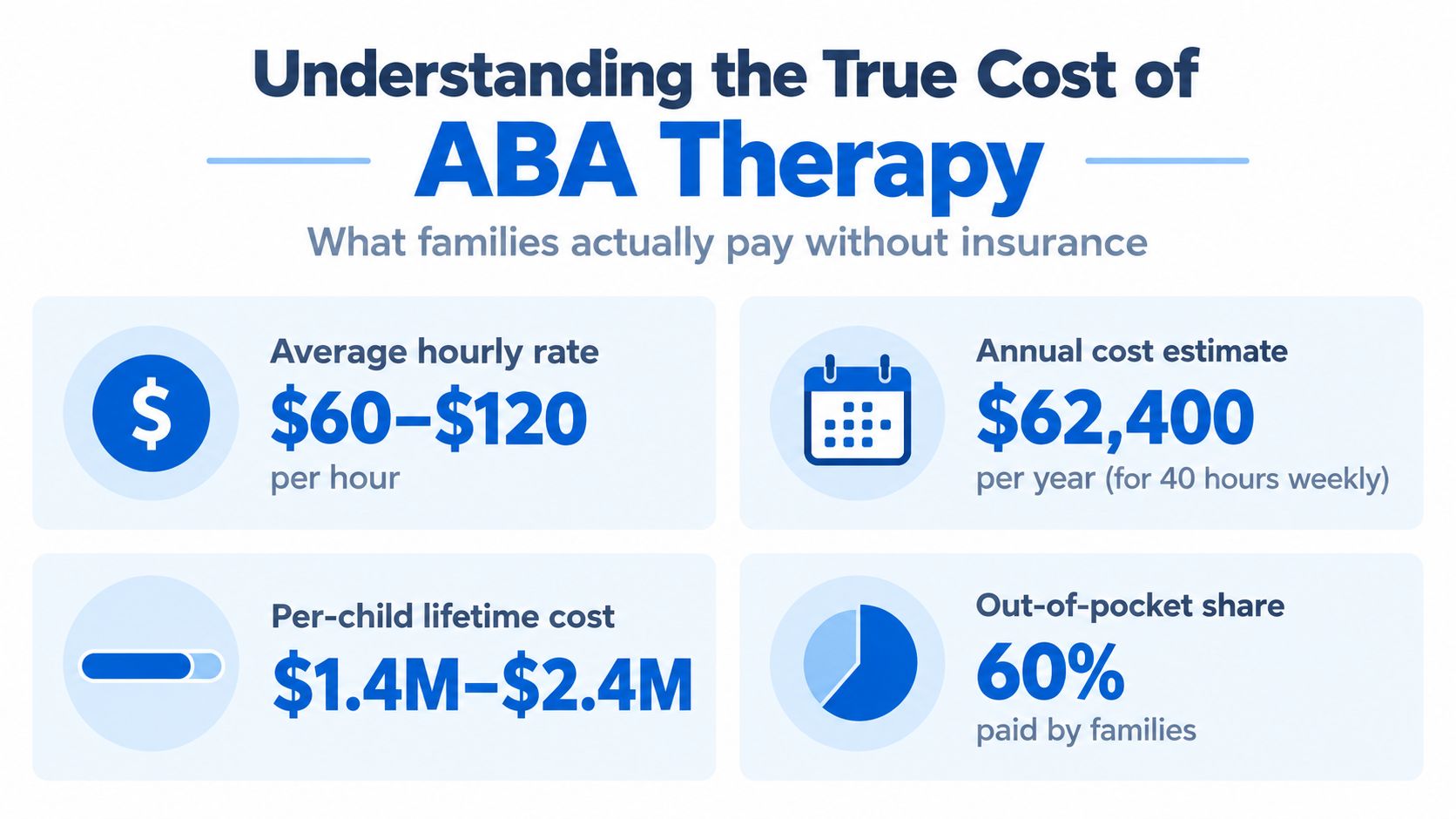
A broader care-intensity estimate places many programs between 10 and 40 hours per week. Using a $120 hourly baseline, that range works out to about $62,400 to $249,600 per year, before discounts, grants, or reimbursement. (Inclusive ABA) These figures do not predict what your child needs. They show why the schedule can influence the total as much as the posted rate.
Before agreeing to services, request a written breakdown of the assessment, direct therapy, BCBA involvement, caregiver training, cancellation rules, and expected payment dates. Read it like a building directory: identify the starting fees, recurring charges, and administrative doors you may need to pass through. A clear estimate cannot remove every financial challenge, but it can replace a surprise with a plan.
Breaking Down Hourly Rates and Weekly Hours
A parent may hear an hourly quote and assume the bill is simple. Then the estimate arrives with assessment, supervision, caregiver meetings, and cancellation terms. Reading the quote in three buckets, startup, weekly care, and administration, makes the financial maze easier to understand.
The startup bucket can include an initial BCBA assessment of about $500 to $2,000. The weekly bucket may combine direct therapy at approximately $50 to $100 per hour with BCBA supervision at about $100 to $200 per hour. At 25 hours per week, one estimate places the monthly total around $5,000 to $12,000 before insurance offsets. (Find ABA Therapy) The range is broad because providers use different clinician mixes, schedules, and amounts of supervision.
Read the quote by service type
| Line item | What it usually represents | What to clarify |
|---|---|---|
| Direct therapy | One-to-one or structured work delivered by a therapy technician or clinician | Is the rate per hour, per session, or another unit? |
| BCBA supervision | Clinical oversight, program updates, observation, and staff guidance | How often is supervision billed, and is it separate? |
| Assessment | Initial review of needs and treatment planning | Is the assessment a one-time fee or split across visits? |
| Caregiver support | Meetings or coaching that help caregivers use strategies at home | Are these sessions included or billed separately? |
The schedule often creates a larger swing than a small change in the hourly rate. For example, a 25-hour schedule at $120 per hour runs about $13,000 per month before supervision. Use a guide to ABA therapy cost per hour to prepare for a focused conversation about direct service and clinical oversight. Ask the provider to price two or three intensity levels before committing, such as a lower, middle, and higher weekly schedule.
Regional differences and provider type can also affect the quote. Compare estimates only after aligning the assumptions: hours, setting, supervision, assessment, caregiver support, and cancellation rules. A lower hourly rate may not produce a lower total if the schedule or added services differ.
The administrative bucket includes the details that can change what you pay: session units, payment dates, missed-session policies, report fees, reassessments, records requests, and claim paperwork. Request both the first-month estimate and the expected recurring weekly amount. That comparison shows which costs are startup charges and which will continue.
Exploring Financial Assistance and Payment Plans
A high private-pay estimate doesn't mean you have only two choices, paying the full amount or giving up. It means you need to check several possible funding routes, one at a time, while keeping careful records.
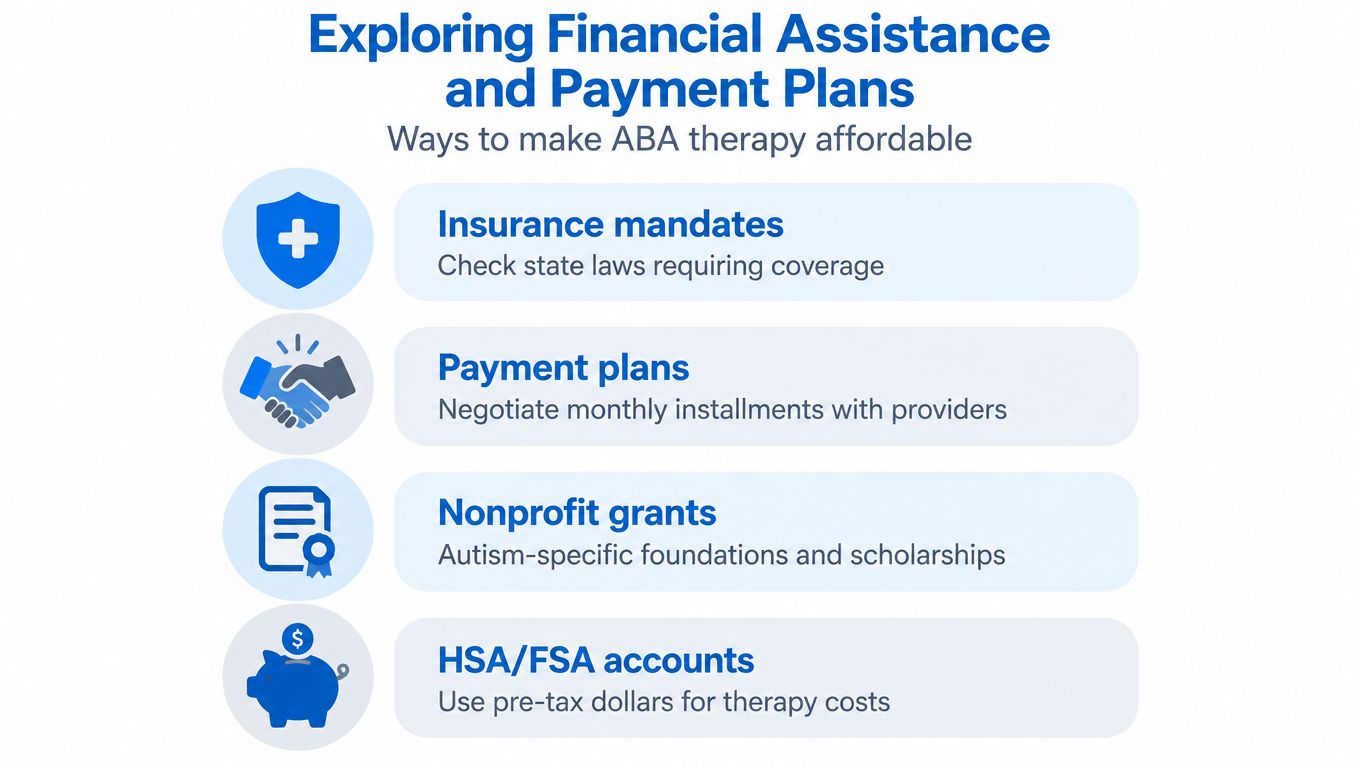
Start with your health plan, even if you believe ABA isn't covered. Ask whether your policy includes autism-related services, whether prior authorization is required, and whether the provider must be in network. Coverage can depend on your plan, state, benefit design, medical-necessity rules, and provider qualifications.
A practical affordability search
Ask the provider about reduced-rate options. Some practices may offer sliding-scale pricing, income-based arrangements, limited scholarship slots, or installment plans. None of these options is automatic, so ask what documentation and availability rules apply.
Check Medicaid through your state. Medicaid doesn't require ABA by name in every state. However, eligible children under 21 receive medically necessary services through the federal EPSDT benefit, and CMS says ABA-related care may fit several benefit categories when the service and provider meet the applicable requirements. (CMS ABA Toolkit) CMS also explains that states decide medical necessity for eligible individuals. (CMS Medicaid FAQ)
Look for grants and nonprofit assistance. Autism-focused foundations, local disability organizations, family resource centers, and community programs may have applications for therapy support. Eligibility, deadlines, documentation, and allowable expenses vary, so confirm whether an award can be used for ABA.
Ask a tax professional about HSA or FSA use. A Health Savings Account or Flexible Spending Account may allow eligible medical expenses to be paid with pre-tax dollars, depending on your account rules and the expense. Your plan administrator or tax adviser can explain what applies to your family.
When you contact a program, keep the same packet ready: diagnostic records, the provider estimate, household documentation if required, and a short explanation of the requested support. You can use this financial assistance program application guide to organize questions before applying.
A payment plan should be written down. Confirm the amount due at signing, installment dates, late-payment rules, cancellation charges, and what happens if insurance or grant money later arrives. A manageable arrangement is one you understand before services begin.
Navigating Out-of-Network Benefits and Reimbursements
Having insurance doesn't always mean your preferred provider is treated as in network. An out-of-network benefit is a plan feature that may reimburse care from a provider who doesn't have a contract with your insurer. Your share may be larger, and some plans may pay little or nothing for certain out-of-network services.
The key question isn't just, “Do I have insurance?” Ask, “How does this plan handle out-of-network ABA services?” Neutral insurance guidance notes that using an out-of-network provider can mean paying a larger share, sometimes the full amount, depending on the plan rules. (Cross River Therapy)
What to confirm before scheduling
Call the member-services number on your insurance card and ask for answers in writing when possible:
- Is ABA included under my plan?
- Does the plan have out-of-network benefits for ABA?
- Does the deductible apply before reimbursement begins?
- What percentage or allowed amount does the plan use?
- Is prior authorization required?
- Must a specific diagnosis, referral, or treatment plan be submitted?
- Does the provider need particular credentials?
- What claim form, receipt, or clinical record is required?
- Where should I send claims, and how can I track them?
Ask the insurer to explain the allowed amount, which is the figure the plan uses when calculating its share. A provider's charge and the insurer's allowed amount may not be the same. You may also need to pay the provider first and submit a claim for possible reimbursement, so ask about timing and cash-flow expectations.
A provider's billing office may help supply invoices, service dates, and clinical documentation, but don't assume it can interpret your policy. Your insurer's written benefit description controls your coverage, and customer-service representatives may give only general information. Save names, call dates, reference numbers, and copies of every submission.
This out-of-network benefits guide can help you make a call checklist. If a claim is denied, request the reason in writing and ask about the internal appeal process. Speak with the insurer and a qualified benefits advocate about your specific case rather than assuming the denial is final.
Questions to Ask Providers About Affordability
A good affordability conversation starts before the intake appointment. Tell the provider that you need to understand the full financial commitment, not just the advertised hourly rate. A transparent provider should be able to explain which services are proposed, which are optional or variable, and which may be billed separately.
Bring these questions to the first call
- What is the expected first-month cost? Ask the provider to include the diagnostic review, ABA assessment, direct sessions, supervision, caregiver meetings, and any enrollment fees.
- What is the recurring weekly cost? Request an example based on the expected schedule, while remembering that recommended hours can change.
- Which professional provides each service? Ask whether a technician, BCBA, or another qualified professional performs the work.
- Are assessment and supervision billed separately? A lower direct-therapy rate may not represent the full program cost if clinical oversight is separate.
- What happens if a session is canceled? Ask about notice periods, weather closures, caregiver cancellations, and charges for missed appointments.
- Do you offer sliding-scale pricing or installment plans? Ask whether income, household size, or available funds affect eligibility.
- Can you help with insurance paperwork? Clarify whether the office verifies benefits, submits claims, supports prior authorization, or only provides receipts.
- Do you accept out-of-network reimbursement? If yes, ask what documents the billing office supplies and whether you must pay upfront.
- Are there grants or local programs families commonly investigate? The provider may know community resources, but you should verify each program directly.
Don't compare providers by hourly price alone. Compare the same schedule, clinician mix, assessment work, supervision, caregiver support, setting, cancellation policy, and administrative help. If a quote is unclear, ask the office to rewrite it in plain language before signing.
For external support, contact your state's Medicaid office, a local family-to-family health information center, autism-focused nonprofits, and your insurer's member-services department. These organizations may point you toward resources, but eligibility and funding depend on the program and your circumstances.
Putting It All Together - Your Affordability Roadmap
You don't need to solve the entire financial problem in one phone call. Treat the process like a series of doors, and open them in an order that reduces uncertainty.
First, build the baseline. Ask for a written provider estimate that separates startup, weekly, and administrative charges. Include the assessment and any BCBA supervision instead of focusing only on direct therapy.
Next, test every coverage route. Contact private insurance about in-network and out-of-network benefits. If your child may be eligible for Medicaid, ask your state program how medically necessary autism-related services are handled. CMS explains that coverage may fit different Medicaid benefit categories and that states determine medical necessity, so the state agency's answer matters. (CMS Medicaid FAQ)
Then, create a funding folder. Save the diagnosis, assessment, provider quote, insurer correspondence, claim forms, denial letters, grant applications, and payment-plan terms. A simple record can prevent you from repeating the same explanation to every office.
Finally, compare workable paths. One provider may be in network but have a waitlist. Another may offer earlier availability but require out-of-network payment. A third may have a payment arrangement or know of a local assistance program. None is automatically right for every family, and no program can guarantee funding or acceptance.
ABA Finder provides location-based provider options in select U.S. locations, along with guidance on insurance, out-of-network benefits, and affordability resources. Its intake can help families organize their needs and discuss possible provider and payment pathways, subject to provider availability and program eligibility.
The phrase ABA therapy cost without insurance can make the situation sound like a single yes-or-no decision. In practice, families often investigate several routes at once: a clearer quote, a coverage review, a Medicaid inquiry, a grant application, and a provider payment discussion. You can take those steps gradually and ask each office to explain the next one in plain language.
If you're trying to find a provider or make sense of possible payment options, ABA Finder can help you review provider options, insurance pathways, out-of-network benefits, and financial assistance resources. Visit the site to submit a no-obligation inquiry and take the next step with clearer information.
Our Latest Insights

















Every Child Deserves Access To Quality ABA Therapy
Whether you're searching for providers, exploring financial assistance, or trying to better understand your insurance options, we're here to help you take the next step with confidence.