



Financial Assistance Program Application: A Parent's Guide
Confused about paying for autism therapy? This parent-friendly guide walks through each financial assistance program application, documents, timelines

You may be looking at a diagnosis letter with one hand and a confusing insurance form with the other. Your child needs support, but the cost of therapy, evaluations, transportation, or equipment can make the next step feel out of reach. If you've found yourself opening an assistance application and closing it again, you're not alone.
A financial assistance program application isn't a test of whether your family needs help. It's an administrative process, and administrative processes can be learned. Eligibility varies by program, state, household circumstances, and insurance plan, so nothing is guaranteed. Still, knowing where help may come from, how programs screen applicants, which documents to gather, and how to follow up can make the process less intimidating.
Table of Contents
- Why Applying Feels So Overwhelming and Why It's Still Worth It
- Medicaid and Medicaid Waivers
- Private Insurance and Out-of-Network Benefits
- Grants and Provider Assistance
Why Applying Feels So Overwhelming and Why It's Still Worth It
A parent might begin with a provider's estimate for ABA therapy, a treatment plan, or a request for prior authorization from an insurer. Then another form asks for income, household details, diagnosis records, or proof of residence. Each request may make sense on its own, but together they can feel like a wall of paperwork arriving at the exact moment your family is already tired.
That confusion doesn't mean you're doing anything wrong. Financial assistance is delivered through several systems, including Medicaid, private insurance, provider payment programs, nonprofit grants, and state-based resources. The rules don't line up neatly, and one program may ask for documents that another doesn't.
The need is broad. Federal assistance reporting has operated quarterly since 1982, and the Census Bureau says the reports typically cover about 250,000 to 350,000 financial assistance award transactions each quarter, including recipient, project, and funding details in its public assistance data description. That scale helps explain why programs use structured applications and formal eligibility records rather than informal requests.
Applying is a skill, not a verdict on your family. You can learn how to find the right program, check the basic rules, prepare documents, submit carefully, and ask what happens next.
Start with one program at a time, but don't assume one application represents every possible option. A rejected insurance claim, a provider's income-based payment plan, and a nonprofit grant each answer a different funding need. Your task is to identify which path fits the expense and then ask what information that path requires.
Where Financial Assistance Actually Comes From
Financial help usually comes from a combination of sources rather than one universal benefit. The Federal Program Inventory describes assistance listings that include grants, loans, scholarships, insurance, and other awards. For a family seeking autism-related care, that means “assistance” can refer to coverage, reimbursement, a grant paid to a provider, or a reduced payment arrangement.

Medicaid and Medicaid Waivers
Medicaid is a public health coverage program, but autism-related services aren't handled identically in every state. Some state programs cover services under medical-necessity rules, meaning the plan may review the child's documented needs, age, diagnosis, and requested service before deciding what it covers.
The federal Medicaid overview of autism services notes that Georgia Medicaid has covered autism spectrum disorder services for people under age 21 since January 1, 2018. In that example, adaptive behavior services require a documented DSM-5 autism diagnosis from a licensed clinician. Other states may use different rules.
Medicaid Waiver programs, also called 1915(c) Home and Community Based Services, may support a person at home or in the community instead of in an institution, nursing home, or hospital. Autism Speaks' financial support guide explains that most states have Medicaid Waiver programs, although availability and waiting processes vary.
Private Insurance and Out-of-Network Benefits
Private insurance may cover some ABA services or related care depending on the plan, state requirements, prior authorization rules, and medical-necessity review. Ask whether the provider is in network, which means the provider has a contracted rate with your plan, or out of network, which generally means you may pay the provider first and seek reimbursement under separate plan rules.
Out-of-network benefits may involve a deductible, coinsurance, reimbursement limits, or claim forms. Ask the insurer to explain the process in writing before assuming that a provider's participation status determines your final cost.
Grants and Provider Assistance
Nonprofit grants, charity funds, scholarships, and income-based payment programs can help with costs that insurance doesn't fully address. This caregiver resource directory lists programs with different award limits and payment methods. Autism Care Today, for example, says it offers funding assistance across the United States and may provide grants up to $5,000, while other listed programs may cap awards at $1,500 or $1,000, depending on the organization and need.
Some programs pay the provider or service vendor directly instead of sending money to your household. Ask who receives the award, whether it can cover copays or therapy invoices, and whether you must use an approved provider.
A provider may also offer a sliding-scale fee, an income-based payment plan, or a temporary arrangement during a financial crisis. These options don't replace insurance or Medicaid, but they may help close a gap while you appeal a decision or search for another resource.
Checking Your Eligibility Before You Start Paperwork
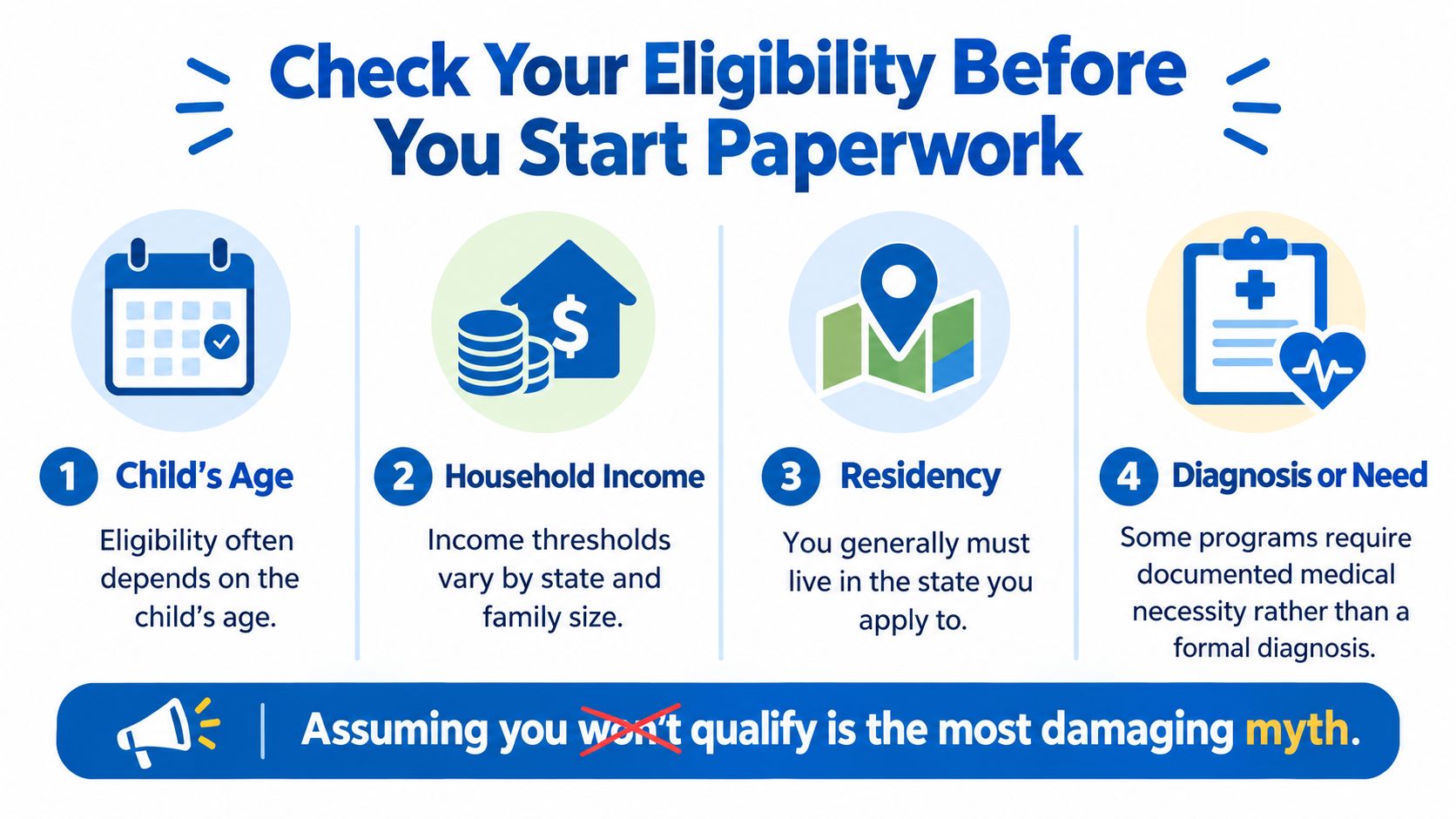
The most damaging eligibility myth is simple: “I probably won't qualify.” Families often make that decision without checking, especially when income changes from month to month or a previous application felt discouraging.
Programs may look at your child's age, documented diagnosis, household income, insurance type, state residency, and the specific service requested. Some programs may require a formal diagnosis, while others may focus on documented need or medical necessity. Because rules differ, ask a provider or insurer what documentation they need before you begin care.
A quick screening call
You don't need to explain your entire family history during the first call. Try asking:
- Age rules: Does the program serve children in my child's age group?
- Diagnosis or need: Do you require a formal diagnosis, a referral, or documentation of medical necessity?
- Income rules: How do you calculate household income when work hours or pay change?
- Insurance rules: Can families with private insurance, Medicaid, or no coverage apply?
- Residency: Do we need to live in a particular state or service area?
- Expense rules: Can assistance be used for ABA therapy, copays, evaluations, equipment, or transportation?
- Provider rules: Must we use an approved provider, or can assistance follow the family?
If the answers sound possible, apply even if you're uncertain. You may also apply to more than one program because award amounts, deadlines, covered expenses, and provider requirements vary.
For a plain-language explanation of insurance-related costs, review ABA therapy cost with insurance. Use it as general education, then confirm your own benefits directly with the insurer.
Gathering the Documents You'll Likely Need
Documents can become the hardest part when income is unstable, a parent is self-employed, records are spread across several portals, or a family has recently moved. Some assistance programs may request pay stubs, tax returns, bank statements, insurance cards, proof of residence, diagnosis records, or custody documents. A 2026 KFF Health News report describes patients being asked for bank statements, pay stubs, tax returns, divorce filings, and in-person, mail, or fax submissions, which illustrates why families may experience the process as burdensome.
Don't wait until you've found every possible record before making a screening call. Ask the program for its current document list and whether it accepts alternative proof. A caseworker may be able to explain how to document seasonal work, recent job loss, self-employment, unpaid caregiving, or a change that isn't reflected on an older tax return.
Build one reusable folder
Create a secure digital folder and, if useful, a paper folder. Keep copies rather than sending originals, and remove unnecessary personal information when a program doesn't require it.
| Document | Why It's Requested | Possible Alternatives |
|---|---|---|
| Diagnosis or evaluation record | To confirm the child's documented condition or requested need | Provider letter, referral, treatment plan, or another record accepted by the program |
| Pay stubs or income statements | To review current household income | Employer letter, benefits statement, self-employment records, or written explanation of irregular income |
| Tax return | To review reported annual income | Recent income records or a program-specific income declaration |
| Bank statements | To assess financial circumstances under the program's rules | Ask whether selected pages, redacted records, or another financial document is acceptable |
| Insurance card and benefit details | To identify the payer and coverage pathway | Member portal summary or written benefit confirmation |
| Proof of residence | To confirm state or service-area eligibility | Lease, utility record, government letter, or another accepted address document |
| Custody or legal documents | To clarify who can apply or make decisions | Ask which pages are required and whether a caseworker can review alternatives |
| Bills or provider estimates | To connect assistance to a specific expense | Invoice, estimate, treatment plan, or provider statement |
Unstable income doesn't automatically mean you can't apply. Explain the change clearly, include the records you do have, and ask what the program uses when current income and prior-year income tell different stories.
Some families may also qualify for a quicker screening route. A policy analysis of charity care at critical access hospitals describes concerns about restrictive eligibility rules and heavier documentation demands, while recent reporting notes that six states require presumptive eligibility for certain patients to bypass applications in specified circumstances (policy analysis on charity care). Ask whether your program offers automatic screening, presumptive eligibility, or a preliminary review.
Completing and Submitting Your Application
Read the eligibility criteria before writing answers. This prevents a common mistake, applying for an expense or service the program doesn't cover and discovering the mismatch only after spending hours on the form.
Answer every required question completely. If a question doesn't apply, write “not applicable” when the form permits it rather than leaving the space blank. Use the same spelling of names, dates, household details, and income figures across the application and supporting documents.
Keep the paperwork aligned
A budget or income number should match the record attached to it, or the application should include a short explanation for the difference. For example, if a pay stub reflects a recent reduction in hours but a tax return shows an older annual income, explain that the household's circumstances changed and ask whether additional proof is needed.
Common administrative problems include incomplete paperwork, missing documentation, and eligibility mismatches. In Washington's paid-family-leave program, 38% of denials were attributed to not meeting hours-worked requirements, 25% to missing or insufficient qualifying-event documentation, and 99% of sampled denials had only one listed reason, according to the program's annual report. Those figures concern a specific program, not autism assistance overall, but they show how a single missing requirement can control an outcome.
Grant application reviews also commonly identify eligibility checks, deadlines, inconsistent or incomplete forms, and budget or narrative misalignment as pitfalls. Treat the form like a document another person must verify quickly. Clear answers and organized attachments help that reviewer understand your situation.
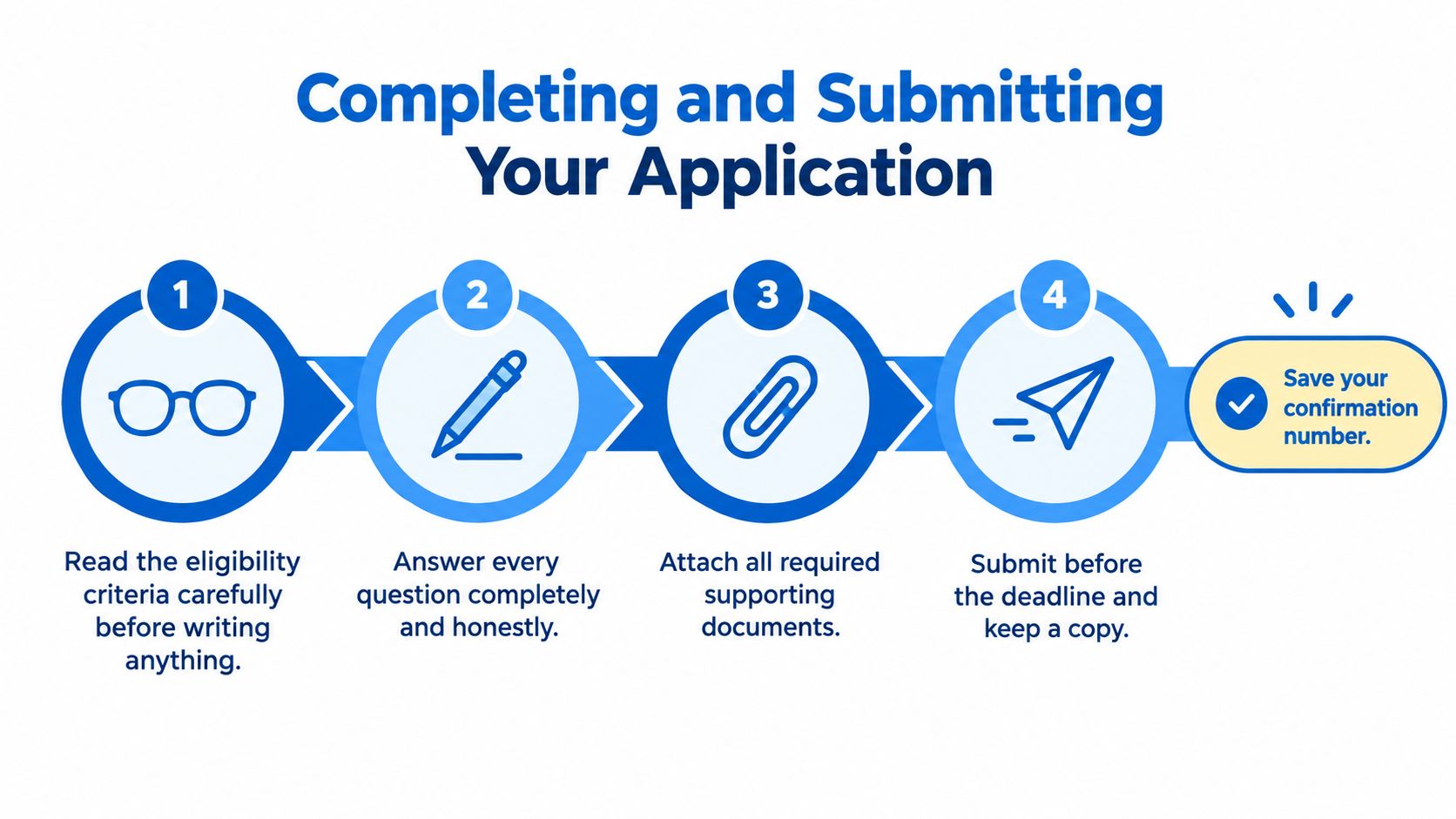
Submit the application through the method the program specifies, whether that's an online portal, mail, fax, or in-person delivery. Save the completed form, attachments, submission date, confirmation email, fax receipt, tracking number, and any confirmation number.
A simple tracking note can include:
- Program name: Record the exact program and contact details.
- Submission record: Note the date, method, and confirmation number.
- Follow-up date: Write down when you plan to contact the program if you haven't received an update.
- Open requests: List every document or answer the program asks you to provide.
What Happens After You Hit Submit
Waiting times vary widely by program, and silence doesn't automatically mean rejection. The reviewer may be checking documents, requesting information from a provider, confirming eligibility, or working through a queue.
Follow up calmly and keep a record of every conversation. Write down the person's name, the date, the questions you asked, and what they told you. If the program asks for more information, respond as quickly as you can and ask whether there's a deadline or a preferred submission method.
The gap between applying and receiving assistance can be larger than many parents expect. A hospital-care study found that only 29% of patients with unaffordable hospital bills were able to learn about, apply for, and receive financial assistance, while approval among people who applied was much higher. The same study found a 78.8 percentage-point increase in approval for applicants below the income threshold, with virtually all applicants below the cutoff approved and about one-fifth of applicants above the cutoff qualifying through expense-based criteria (the hospital-care study). This is not a promise about an autism grant, Medicaid decision, or insurance claim. It does show why families shouldn't treat uncertainty before applying as proof they won't qualify.
A denial may reflect a missing document, an eligibility mismatch, an incomplete answer, or an expense the program doesn't cover. Read the notice carefully and ask whether you can correct the problem, appeal, submit additional information, or reapply.
Persistence is part of the process, not evidence that you've failed.
Continue exploring parallel options where appropriate. One program may assist with a provider invoice, another with equipment, and an insurer may handle reimbursement through a separate claim process. For a clearer explanation of reimbursement questions, see out-of-network benefits.
Questions to Ask and Where to Get More Help
A short list of prepared questions can make phone calls less exhausting. Keep your insurance card, provider information, and notes nearby, but don't share more personal information than the person needs to answer your question.
Questions for your insurer
Ask:
- Is ABA therapy covered under this specific plan?
- Does the plan require prior authorization, a referral, or a treatment review?
- What does the plan require to show medical necessity?
- Is the provider in network?
- If the provider is out of network, how are claims submitted and reimbursement calculated?
- What deductible, coinsurance, visit limits, or exclusions should I understand?
- Can you send the answer and relevant benefit language in writing?
Questions for a provider
Ask whether the provider can verify benefits, help identify required records, and explain expected billing steps. You can also ask whether the practice offers an income-based payment program, accepts grant payments, uses a financial assistance fund, or can suggest another provider if its capacity or network status doesn't fit.
Questions for an assistance program
Ask whether your child's age, diagnosis, state, insurance type, and expense appear to fit the basic rules. Then ask which documents are required, whether unstable income has an accepted documentation path, how long the review may take, how an award is paid, and what to do if the program denies the application.
Families looking for broader support may also review autism help for families. This article is general information, not medical, legal, or financial advice. Your insurer, provider, Medicaid office, or assistance program can explain the rules that apply to your specific situation.
ABA Finder can help families in select locations explore provider options, insurance and out-of-network benefit questions, income-based payment programs, grants, and other affordability resources. You can reach out for a no-cost, no-obligation conversation about finding care and understanding possible payment paths, with the understanding that funding and qualification can never be guaranteed.
ABA Finder helps families compare recommended ABA therapy providers and clarify possible insurance, out-of-network, and financial assistance options. Visit ABA Finder for a no-cost, no-obligation conversation about your next practical step.
Our Latest Insights














Every Child Deserves Access To Quality ABA Therapy
Whether you're searching for providers, exploring financial assistance, or trying to better understand your insurance options, we're here to help you take the next step with confidence.