



Autism Services for Children: A Parent's Guide to Care
Discover autism services for children, from therapies to school support. Our 2026 guide helps you find the right care for your child's needs.

A diagnosis report can feel heavier than it looks. You may be sitting at the kitchen table, holding a few printed pages while your toddler plays nearby, wondering what Monday morning is supposed to look like now. Which phone call comes first? Will insurance pay? Is there a therapist nearby who understands your child?
Those questions don't mean you're unprepared. Autism services for children often involve several systems at once, including healthcare, schools, Medicaid or private insurance, therapy providers, and family support programs. Waitlists, insurance requirements, state-specific Medicaid rules, and the gap between a clinical diagnosis and a practical care plan can make the process feel like a maze.
This guide treats you as a capable parent who needs clear directions, not as a case file. Every child's needs and every family's resources are different, but most families begin by sorting through four overlapping service lanes. Once those lanes are easier to see, the terms become less intimidating, and the next phone call becomes more manageable.
Table of Contents
- Lane one focuses on early development
- Lane two helps a child access school
- Lane three addresses behavior and developmental learning
- Lane four fills practical and participation needs
Where to Start When the Word Autism Enters Your Life
The first step isn't choosing a therapy immediately. It's gathering enough information to understand what your child needs and which door leads to that support.
Autism identification has increased substantially in the United States. In the CDC's Autism and Developmental Disabilities Monitoring Network, 1 in 36, or 2.8%, of 8-year-old children was identified with autism in 2020, compared with 1 in 44, or 2.3%, in the comparable 2018 estimate. The estimate came from 11 U.S. communities, so it isn't a nationally representative prevalence rate, but it remains an important planning benchmark for services. You can read the CDC's explanation of the 2020 autism surveillance estimate for the limitations and context.
That growing need doesn't mean autism itself suddenly became more common. Screening practices, diagnostic methods, identification across demographic groups, and access to evaluation can all affect observed rates. For families, the practical reality is simpler: local providers may have waitlists, and the path from screening to diagnosis, treatment, school support, and family assistance may not be connected automatically.
Begin with a small information folder
Keep one physical folder or shared digital document with:
- Diagnostic records: Save the evaluation report, recommendations, and any supporting assessments.
- Current concerns: Write down examples involving communication, daily routines, learning, safety, sleep, eating, or behavior.
- Provider details: Record names, phone numbers, locations, specialties, and whether each provider accepts your insurance.
- Questions and answers: Note who you called, what they said, and what they asked you to send.
- Time-sensitive dates: Track school enrollment deadlines, evaluation appointments, authorization renewals, and waitlist follow-ups.
You don't have to solve every service question this week. A diagnosis is a starting point for organizing support, not a demand to make every decision at once. The sections ahead translate the major therapy and insurance terms into plain language, so confusion can become a list of reasonable next steps.
The Four Lanes of Autism Services for Children
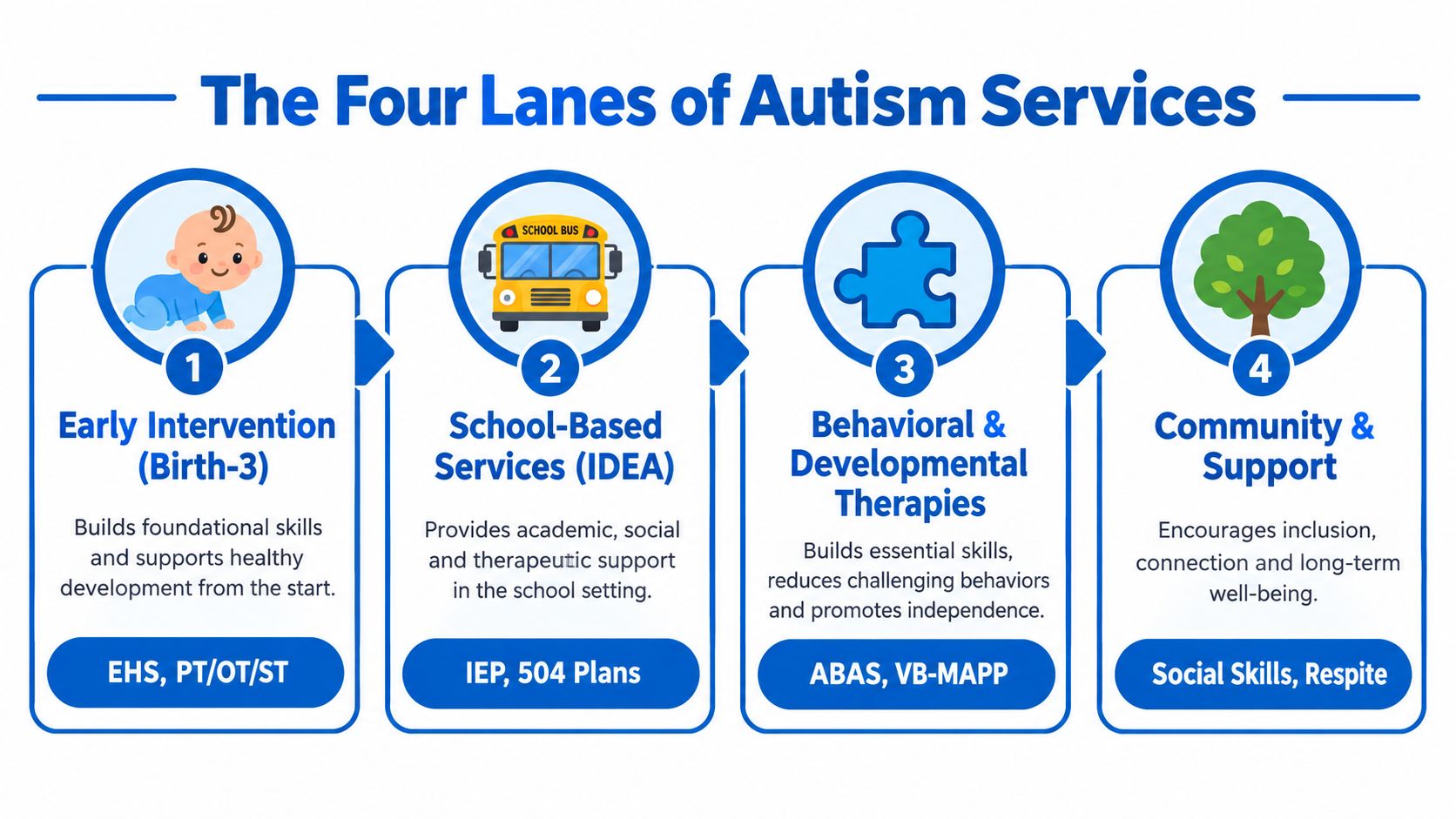
Think of autism services as four lanes on a highway. Your child may use one lane for a while, move into another, or travel in several at the same time. The lanes overlap, but each one has a different purpose and funding pathway.
Lane one focuses on early development
Early intervention serves very young children, commonly from birth through age three, through state or local programs. It may include speech-language, occupational, physical, developmental, or family coaching services delivered at home, in a clinic, or in another natural setting. The central question is, “What support can help this child and family participate in everyday routines right now?”
Lane two helps a child access school
School-based services under IDEA support a child's education. An Individualized Education Program, or IEP, may include specialized instruction, speech-language therapy, occupational therapy, behavioral support, or classroom accommodations when the child meets eligibility requirements. These services generally happen at school and are designed around educational access rather than a particular therapy schedule.
Lane three addresses behavior and developmental learning
Behavioral therapies such as Applied Behavior Analysis, or ABA, may work on communication, social interaction, daily living skills, learning readiness, and behaviors that interfere with safety or participation. Services may occur at home, in a clinic, at school, or through another approved setting. A Board Certified Behavior Analyst, or BCBA, typically helps assess needs and design a plan.
Lane four fills practical and participation needs
Related therapies and community supports can include speech-language therapy, occupational therapy, social-skills work, movement activities, respite, and family support. Speech therapy may focus on functional communication, while occupational therapy may address participation in dressing, feeding, play, or other daily activities. These services aren't interchangeable, and a diagnosis alone doesn't determine which ones are appropriate.
A useful rule: Match the service to the functional barrier, not just to the diagnosis.
Eligibility, payment, provider qualifications, and scheduling can differ across these lanes. A child might receive school-based speech therapy while a separate clinic provides ABA and a state program supports family coaching. The rest of the process becomes easier when you ask which lane you're entering before asking how many hours or visits are available.
Early Intervention from Birth to Age Three
Early intervention usually begins with a concern, not necessarily a completed autism diagnosis. A pediatrician may recommend an evaluation, a parent may contact the state's early intervention program directly, or a family may be referred by another professional. In many states, parents can also self-refer.
The first call should be practical and direct. Tell the intake person your child's age, the concerns you're seeing, your location, and whether your child already has an evaluation. Ask what paperwork is needed and whether the program has an age-based deadline. Starting the process early matters because eligibility for infant and toddler programs generally changes when a child reaches age three.
What the evaluation may look like
An evaluation may happen in your home, at a clinic, or in another setting selected by the program. Professionals may observe how your child communicates, plays, moves, responds to routines, and interacts with familiar adults. They may also ask you what happens during meals, dressing, sleep, transitions, and community activities.
The evaluation isn't a judgment about your parenting. It helps the team identify functional goals and decide which services may fit. You don't need polished language. Specific examples are more useful than labels. “My child pulls my hand toward the refrigerator but doesn't point or use words for food” gives a team something concrete to discuss.
Translating the IFSP
An Individualized Family Service Plan, or IFSP, is the written plan for early intervention. In plain English, it should answer:
- What are we working on? For example, requesting help, tolerating a routine, or participating in play.
- Who provides support? The plan should identify the service type and responsible professional.
- Where will it happen? Services may be provided at home, in childcare, in a clinic, or another everyday setting.
- How will the family participate? A plan may include coaching so caregivers can practice strategies during ordinary routines.
State programs may offer services at no cost or at reduced cost, depending on eligibility and local rules. Ask the program how insurance, family income, and other funding sources affect your situation rather than assuming that a diagnosis automatically determines payment.
Before calling, gather the evaluation report, pediatrician's contact details, insurance information, a short list of concerns, and your child's daily schedule. The early intervention guide for families can help you organize questions before the intake conversation.
School-Based Services and the IEP Process
School services and private therapy can support the same child without serving the same purpose. A school asks, “What does this student need to participate in learning?” A clinic may ask, “What skills or behaviors should we target during treatment?” Those questions can lead to different goals, schedules, and service decisions.
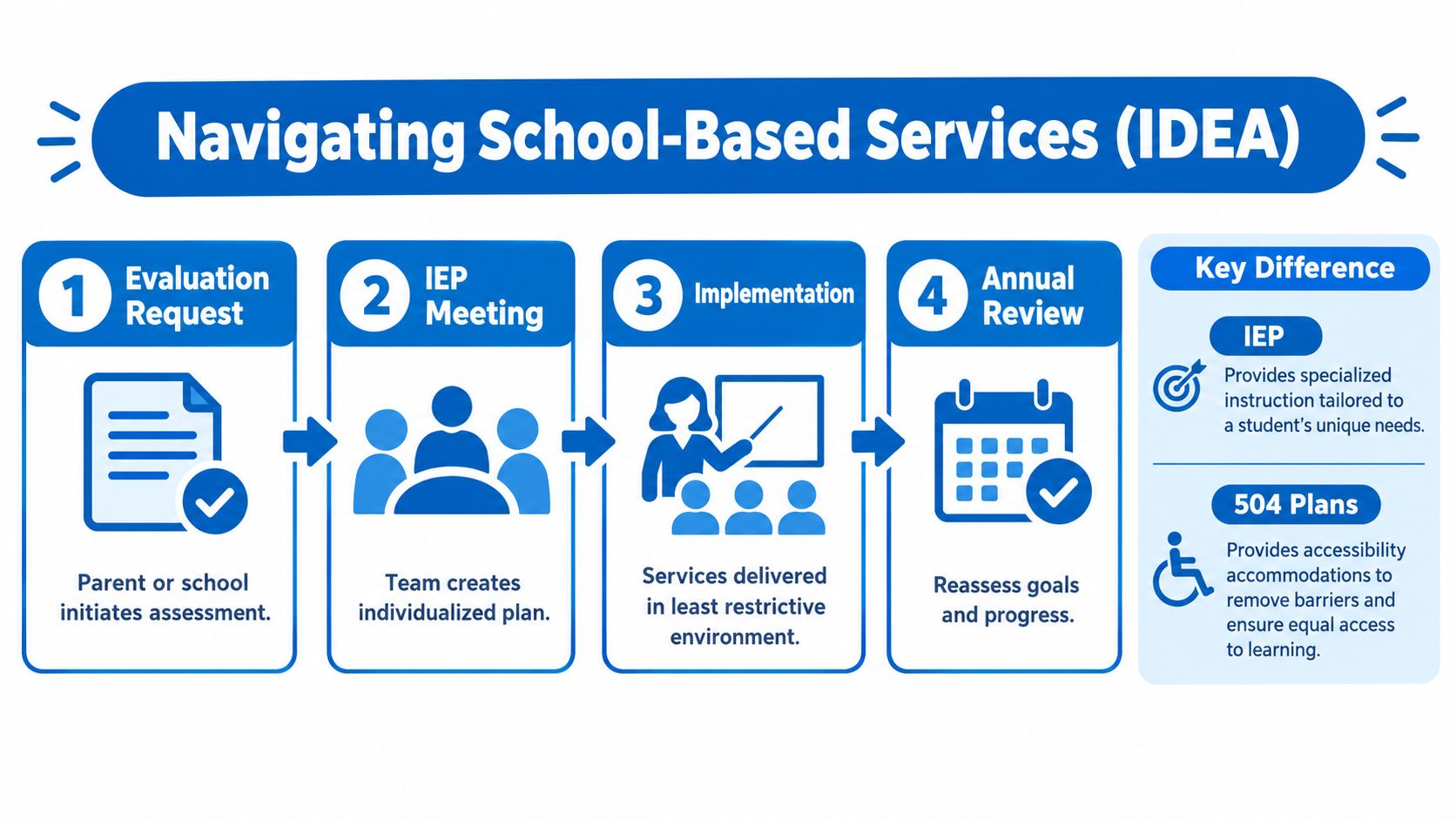
Under the Individuals with Disabilities Education Act, or IDEA, a parent or school can request an evaluation for special education. Put the request in writing and keep a copy. The school then follows its required evaluation process, which may include classroom observation, academic testing, speech and language assessment, occupational therapy input, and interviews with caregivers and teachers.
IEP and 504 plans serve different purposes
An IEP is an individualized education plan for eligible students in kindergarten through grade twelve. It can include specialized instruction, measurable educational goals, related services, classroom supports, and a description of how progress is monitored.
A 504 plan generally focuses on accessibility accommodations. It may help a student access the school environment through changes such as sensory accommodations, communication supports, extra transition preparation, or adjustments to how assignments are presented. A 504 plan doesn't serve the same role as an IEP, and eligibility decisions depend on the child's circumstances and school evaluation.
Who joins the team
The IEP team may include you, a general education teacher, a special education teacher, a school representative, evaluators, and other professionals with relevant knowledge. You can ask whether a speech-language pathologist, occupational therapist, behavior specialist, or interpreter should attend.
School-based service hours vary by district, eligibility determination, goals, staffing, and the child's educational needs. Schools aren't generally required to reproduce the intensity of a clinic-based ABA program. A private therapy plan may therefore run alongside school support.
Bring a trusted advocate if you can, and send questions before the meeting. Ask the team to explain each goal in observable terms, identify who provides each service, and state how progress will be measured. If a proposed support isn't delivered, write down the date, contact the school, and keep copies of your messages.
Understanding ABA and Other Behavioral Therapies
A child may need help communicating, joining family routines, learning safely, or managing situations that feel overwhelming. Applied Behavior Analysis, or ABA, is a treatment framework that examines how a child learns and participates in daily life. A plan may address functional communication, social skills, adaptive behavior, learning routines, or behaviors that limit safety and participation. For a deeper walkthrough, see Understanding ABA Therapy: What Every Parent Should Know.
A BCBA usually reviews an assessment, speaks with caregivers, observes the child, and sets goals that can be tracked. One goal might involve requesting a break, following a routine, using a communication system, or completing part of a self-care task. The team should review its data with the family and change the plan when it is not producing useful progress.
The American Academy of Pediatrics reports that many evidence-based autism treatment models are grounded in ABA. It also reports support from randomized controlled trials and substantial single-case research for ABA programs for younger children, often called early intensive behavioral intervention. The AAP clinical report on autism evaluation and management emphasizes individualized goals and ongoing measurement.
The label doesn't tell the whole story
Families may encounter Pivotal Response Treatment, or PRT, which uses natural opportunities and motivation to build important skills. The Early Start Denver Model, or ESDM, combines developmental and behavioral strategies for young children. Developmental and play-based therapies may focus on interaction, engagement, imitation, and communication during play.
A provider may combine methods. Ask whether the goals matter in your child's daily life, how the team will teach each skill, and how caregivers can support practice between sessions. A therapy label is a starting point, not a complete description of the care your child will receive.
During an initial call, ask about:
- Intake information: Communication, daily living needs, safety concerns, prior services, and current goals.
- Clinical fit: Experience with your child's needs and any co-occurring medical or developmental concerns.
- Logistics: Home, clinic, school, or telehealth settings, plus travel and scheduling.
- Payment: Insurance participation, authorization, expected family costs, and waitlist timing. A covered service may still be difficult to access if no provider has an opening.
- Family partnership: Parent coaching, school communication, progress updates, and how the plan can change.
The National Clearinghouse review identified 28 evidence-based practices for autism, with 23 grounded in ABA. Other practices include exercise and movement, music-mediated intervention, technology-aided instruction, cognitive-behavioral intervention, and Ayres Sensory Integration. This range supports coordinated care. ABA does not replace speech, occupational, medical, or educational services. The review of evidence-based autism practices provides broader context.
Paying for Care Through Medicaid, Insurance, and Out-of-Network
“Covered” is only the first question. The more useful question is whether a qualified provider is available, whether the service applies to your child's situation, what authorization is required, and what your family may need to pay over time.
Medicaid
Medicaid's EPSDT benefit applies to enrolled children from birth through age 20 and requires states to cover medically necessary services needed to correct or improve a physical or mental condition identified through screening or diagnosis. Autism-related care may fit within several benefit categories, including therapies, preventive services, and services from licensed practitioners.
CMS doesn't mandate ABA as one specific Medicaid treatment. State Medicaid agencies and managed-care plans decide which services are medically necessary and how providers bill them. Eligibility, plan structure, documentation, provider enrollment, prior authorization, and local capacity all affect access. The Medicaid explanation of EPSDT and autism-related services describes why coverage isn't automatic placement with a provider.
A previous evaluation completed before Medicaid enrollment may be sufficient to support follow-up diagnostic services and medically necessary treatment after enrollment, although a plan may still request current records or authorization. Families can ask whether the existing evaluation is acceptable before assuming another evaluation is needed. The Medicaid autism services and ABA toolkit explains this point.
Private insurance and out-of-network care
Private plans may ask for diagnostic verification, a treatment recommendation, prior authorization, specific provider credentials, and periodic clinical updates. In-network care may reduce the family's share of the allowed cost, but provider shortages can make an in-network appointment difficult to obtain.
Out-of-network care may involve paying the provider, submitting a superbill, and seeking reimbursement under the plan's out-of-network benefits. A single-case agreement may sometimes allow a plan to negotiate coverage with a provider who isn't normally in network, but neither route is automatic. Ask the insurer and provider for written information before scheduling ongoing care. The guide to autism insurance coverage covers common payment terms in plain language.
| Funding route | Who typically qualifies | How authorization works | Common out-of-pocket | Biggest access barrier |
|---|---|---|---|---|
| Medicaid | Children who meet state eligibility rules | State or managed-care review, documentation, and possible prior authorization | May include plan-specific cost or transportation burdens | Provider shortages, waitlists, and state-specific rules |
| Private insurance | Children covered under the family policy | Diagnostic records, benefits verification, provider participation, and plan approval | Deductibles, copays, coinsurance, travel, and uncovered services may apply | Network limits, authorization renewals, and staffing |
| Out-of-network reimbursement | Families whose plan includes out-of-network benefits | Superbills, claims, or a negotiated single-case agreement may be required | The family may pay upfront and recover only part of the allowed cost | High initial payment and uncertain reimbursement |
Map your likely exposure over the next 6 to 12 months, not just the first appointment. A high-deductible plan may create a large early payment burden. Medicaid may reduce direct cost while a family waits for an available provider. An out-of-network arrangement may offer a faster clinical match but leave the family responsible for the unreimbursed balance, travel, or missed work.
Ask for a written estimate that includes authorization renewal risk, cancellations, transportation, school-day scheduling, sibling care, and services the plan doesn't cover. Recent reporting has described 11% of children with autism not receiving needed healthcare and one in four families with an autistic child experiencing food or housing insecurity. A recent autism family needs report shows why a technically covered service can still be financially difficult to sustain.
When a Provider Says Your Child Is Not a Fit
A provider's “not a fit” decision can feel personal, especially after you've spent weeks making calls. It usually describes the provider's capacity, staffing, training, safety procedures, or business arrangements, not your child's potential or worth.
A nationwide caregiver survey covering 1,289 caregivers across all 50 states and Washington, D.C. found that 27% had tried but couldn't access staffing at all, while nearly 80% reported being told their child was “too severe” or “not a good fit.” You can review the caregiver survey results from the National Council on Severe Autism for that context.
What the decision may mean
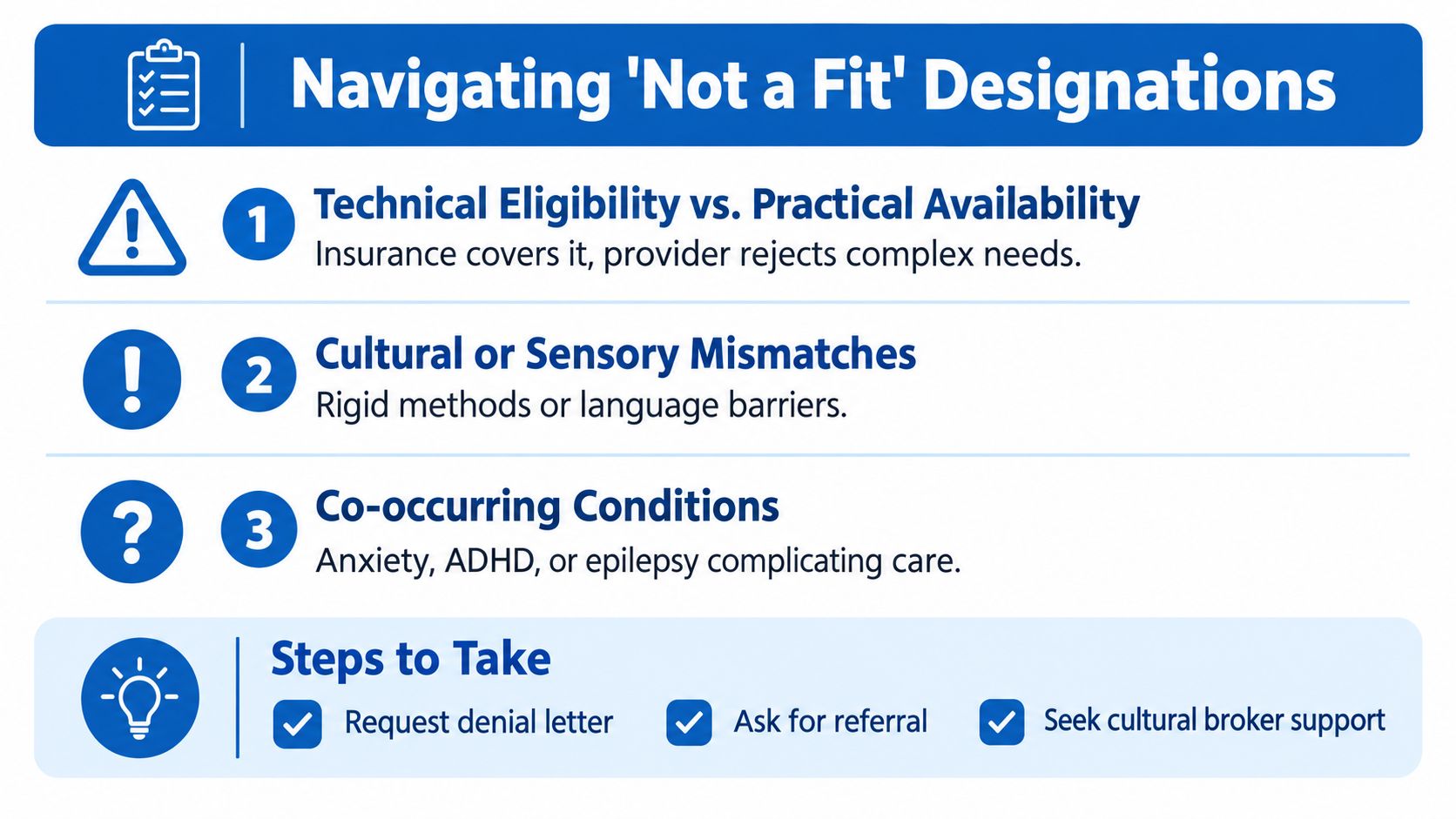
A provider may lack staff trained to support aggression, elopement, self-injury, complex communication, sleep disruption, or medical comorbidities. It may have a full caseload, a narrow service area, insurance reimbursement concerns, or safety procedures that don't match your child's needs.
Ask for a clear explanation without arguing about the diagnosis. You need usable information:
- Capacity: Is the issue a full caseload, staffing, geography, or hours?
- Experience: Has the team supported children with similar communication, behavior, or medical needs?
- Safety: What crisis protocols, nurse consultation, supervision, and restrictive-practice policies are in place?
- Continuity: What happens if a therapist leaves, a session is canceled, or the initial match doesn't work?
- Family role: How much parent training and communication does the program provide?
- Referral help: Can the provider suggest another clinic that may have a better match?
A rejection is information, not a verdict. Use it to refine the next search and identify what a safe, sustainable provider must be able to do.
Request a written denial or explanation when possible. Ask the diagnostic clinic, pediatrician, school team, or state autism resource program for peer recommendations. Keep a log of calls and denials if you later need to discuss network adequacy or authorization with an insurer.
When a provider accepts your child, ask the same questions before committing. A nominally available service isn't practically accessible if the team can't support the child's actual profile, communicate with caregivers, or maintain coverage when staffing changes.
Mapping Your Next Steps With Confidence
A diagnosis can leave you with a folder of reports, several phone numbers, and no clear order for what to do first. A short sequence turns that pile into a workable plan.
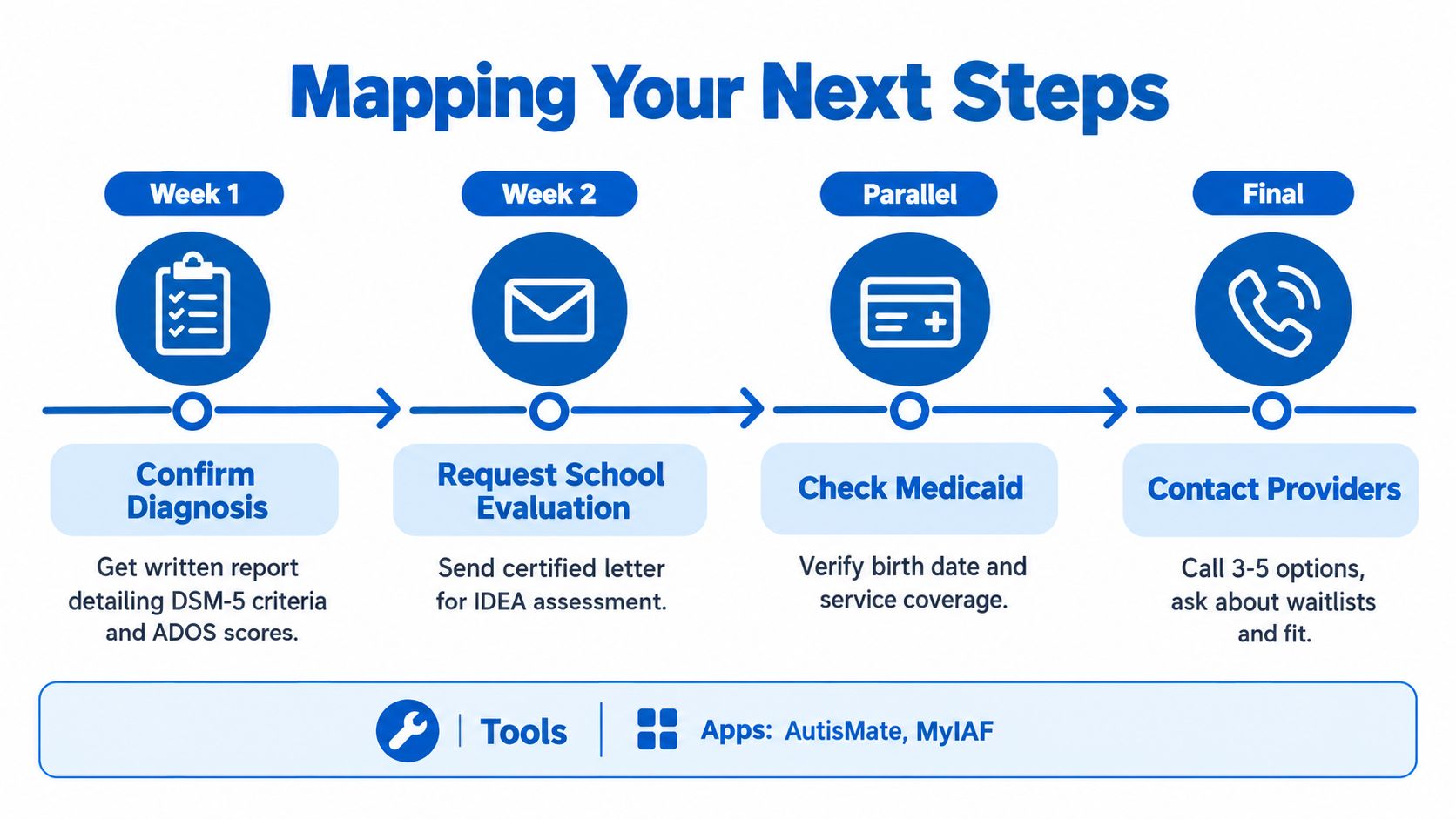
Start with documents and deadlines
Keep the diagnosis report, recommendations, insurance card, and pediatric records together. Ask the diagnosing professional whether the report contains the details insurers, Medicaid plans, schools, or therapy providers may request. For a child under age three, contact the state early intervention program promptly. For a school-aged child, send a written evaluation request and save proof of delivery.
Build a short provider list
Choose two or three candidates for each service lane your child may need. For ABA, ask about communication profile, support needs, medical considerations, setting, schedule, parent training, and waitlist length. For speech or occupational therapy, ask how the clinician coordinates with school staff and other providers.
Call the insurer with the provider's name and service details. Ask whether the provider is in network, whether prior authorization is required, which documents are needed, how renewals work, and whether out-of-network benefits or a single-case agreement could apply. Ask the provider for a written estimate of expected family costs.
A short introductory call can show what a directory cannot. Notice whether the person answers plainly, explains limits, and describes how the plan would change if the first approach is not working.
Use one tracking page
Create columns for:
- Date and contact: Who you spoke with and how to reach them.
- Information requested: Reports, referrals, authorizations, or forms.
- What was promised: Appointment, benefits check, referral, or follow-up.
- What happened: Response, denial, waitlist status, or deadline.
- Your next action: The one task that keeps the process moving.
This record helps when agencies use different terms for similar services. It also gives you a clear summary for a case manager, school advocate, insurer, or provider.
Review the plan over the next six to twelve months, not only at the first coverage check. Track deductibles, copays, denied or delayed claims, travel, missed work, and services available only out of network. A service is covered on paper but inaccessible if the wait is too long, the provider cannot support your child's needs, or the family cannot sustain the total cost.
ABA Finder offers location-based provider options in select states, insurance and out-of-network benefit review, and guidance on affordability resources whose eligibility varies by program and provider. If you are comparing providers or mapping payment questions, visit ABA Finder for a no-obligation conversation about your location, your child's needs, and options that may be available, without assuming eligibility, funding, or provider placement.
Our Latest Insights













Every Child Deserves Access To Quality ABA Therapy
Whether you're searching for providers, exploring financial assistance, or trying to better understand your insurance options, we're here to help you take the next step with confidence.