



Autism Treatment Near Me: 10 Ways to Find Local Care
Searching for autism treatment near me? Compare nearby ABA providers, useful directories, and the questions to ask about insurance and costs.

Searching for autism treatment near me often starts with a parent juggling too much at once, an insurance letter open in one tab, a long waitlist in another, and a child who needs help sooner rather than later. The hard part isn't just finding a provider, it's figuring out which nearby option can be used, given your plan, your state, your schedule, and the kind of support your child with autism needs.
This guide walks through ten local search tools and provider options as a practical workflow, not a ranking. It starts with a no-cost referral and affordability service, then moves through larger ABA networks, in-home choices, center-based programs, and multidisciplinary clinics, so you can compare what's nearby, what each setting may open up, and what to ask before you call. It also explains ABA, which stands for applied behavior analysis, a therapy that uses structured practice to build skills, and it touches on insurance terms in plain language so the next step feels less overwhelming.
Table of Contents
1. ABA Finder
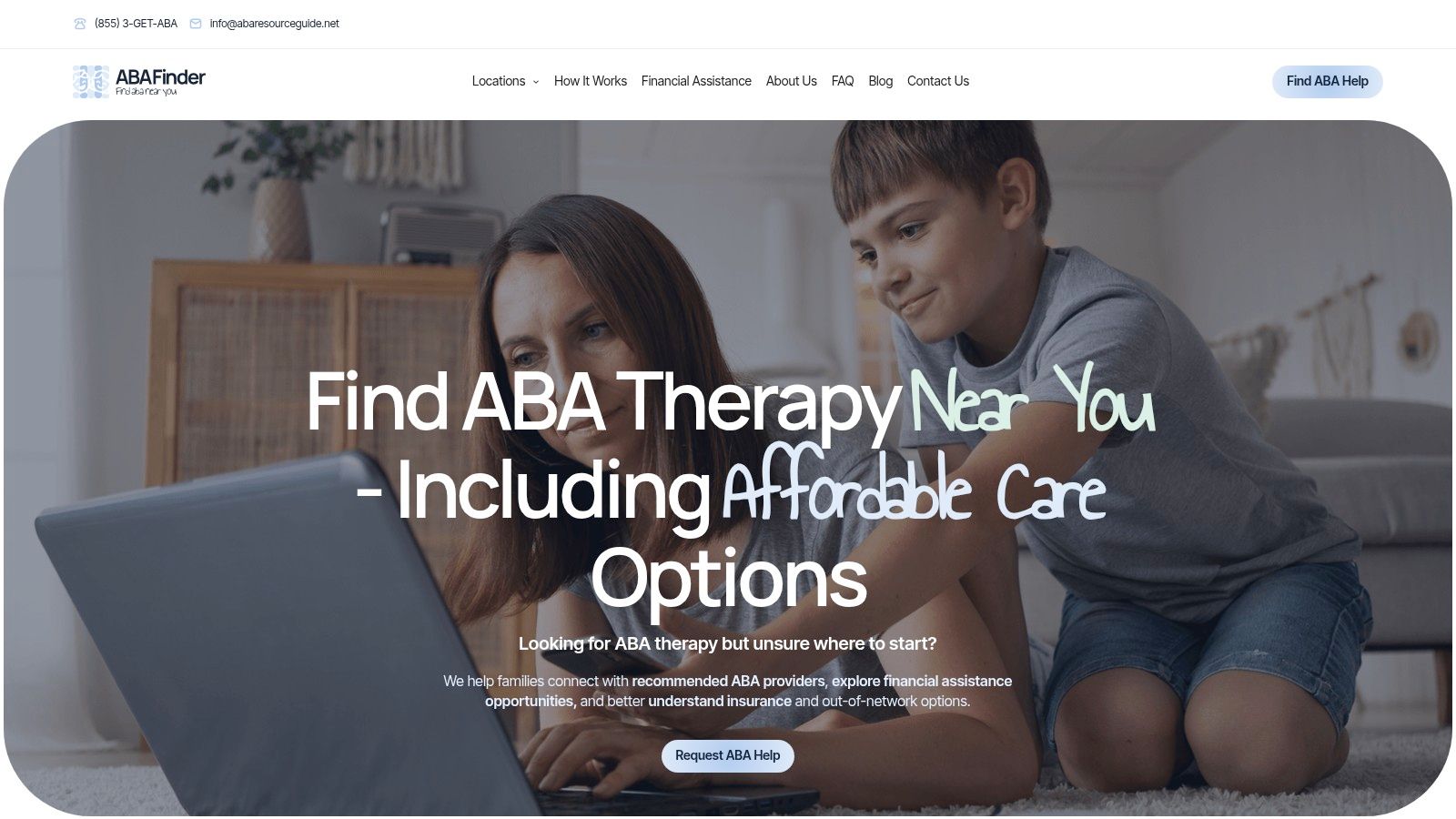
A parent can hit a wall fast, a diagnosis in one hand, a short list of providers in the other, and an insurance card that raises more questions than answers. ABA Finder can be the first useful call in that moment. It's a free, privacy-conscious referral and affordability service that helps parents and caregivers sort through ABA options, payment paths, and next steps without pressure.
The value is practical. Instead of handing over a name and a phone number, ABA Finder uses secure intake, a needs assessment, and location-based provider matching in states including Connecticut, Florida, Georgia, Maryland, Massachusetts, New Jersey, New York, North Carolina, South Carolina, Virginia, and Washington. It also helps families review insurance and out-of-network possibilities, then points them toward affordability routes such as grants, income-based payment programs, and other assistance when those options may exist.
Why it fits a real local search
A “near me” search can look reassuring and still leave a family stuck. Proximity does not tell you whether a provider takes your plan, has room, or offers the right setting. ABA Finder is set up to reduce that uncertainty by focusing on likely coverage paths and introductions to recommended providers when available, while being clear that it cannot promise funding or placement.
Practical rule: If you're comparing options tonight, start with the place that can help you separate “nearby” from “usable.”
Families often like this model for a few simple reasons:
- No-cost entry point: The consultation does not add another bill before you have found care.
- Insurance and out-of-network review: Helpful when the nearest in-network clinic has a waitlist or no openings.
- Affordability guidance: Useful when the first answer from a provider is not the last answer you need.
- Plain-language education: FAQs and articles can help parents understand what to ask next.
For a broader overview of how ABA providers are typically organized, the internal guide on ABA provider options and referral guidance can help you compare local matching before you start making calls.
2. LEARN Behavioral
A local search for autism treatment often starts with a simple question: who serves your area? LEARN Behavioral is built for that kind of check. It connects families to regional brands and local teams across many states, so the first step is often finding the office closest to your child with autism rather than sorting through one national name.
The details still matter. One location may offer center-based care, another may provide home-based services, and some may include caregiver or school resources that help explain how treatment fits into daily routines. The company name can stay the same while the service menu changes by location, so the locator matters more than the banner.
Before you call, use the location finder at LEARN Behavioral and ask the basics that a family can verify nearby:
- Service setting: Does this office offer center-based care, home-based care, or both?
- Care coordination: How do they work with schools and caregivers?
- Local availability: Is the nearest office accepting new referrals now?
- Brand clarity: Which regional name operates the site you are looking at?
ABA, or Applied Behavior Analysis, is the treatment model many families hear about first, and local offices may describe it in different ways. That is why the best next step is not to assume a clinic fits because it is nearby. It is to confirm what the site can provide, whether the waitlist is manageable, and which coverage path may apply through your plan.
A broad footprint can help when families have been told to look nearby but still need a place that is open, reachable, and clear about its services.
3. Butterfly Effects
Butterfly Effects is a strong option for families who want to compare home, center, school, and virtual ABA settings without restarting the search from scratch each time. That kind of flexibility matters when your schedule is packed, when a child does better at home, or when you need to see whether a center is even available in your area.
The provider also puts useful intake tools front and center, including a location finder and a coverage check by address. That can save time because you're not guessing whether the nearest office serves your ZIP code or your payer.
A better fit when setting matters
For some children with autism, the best early progress happens where daily routines already exist. For others, a structured clinic gives them fewer distractions and clearer expectations. Butterfly Effects gives families a way to compare those possibilities without needing to call separate organizations for every setting.
The website at Butterfly Effects says it accepts many major insurers and offers onboarding support, but local availability still matters more than the brand name. Some markets lean heavily toward in-home care, while others have broader center access.
Ask for the supervision model, the expected caregiver role, and whether services can shift between home and center if your child's needs change.
That question helps because a good “near me” result isn't only about distance. It's also about whether the provider can work in the setting your family can realistically keep using.
4. BlueSprig
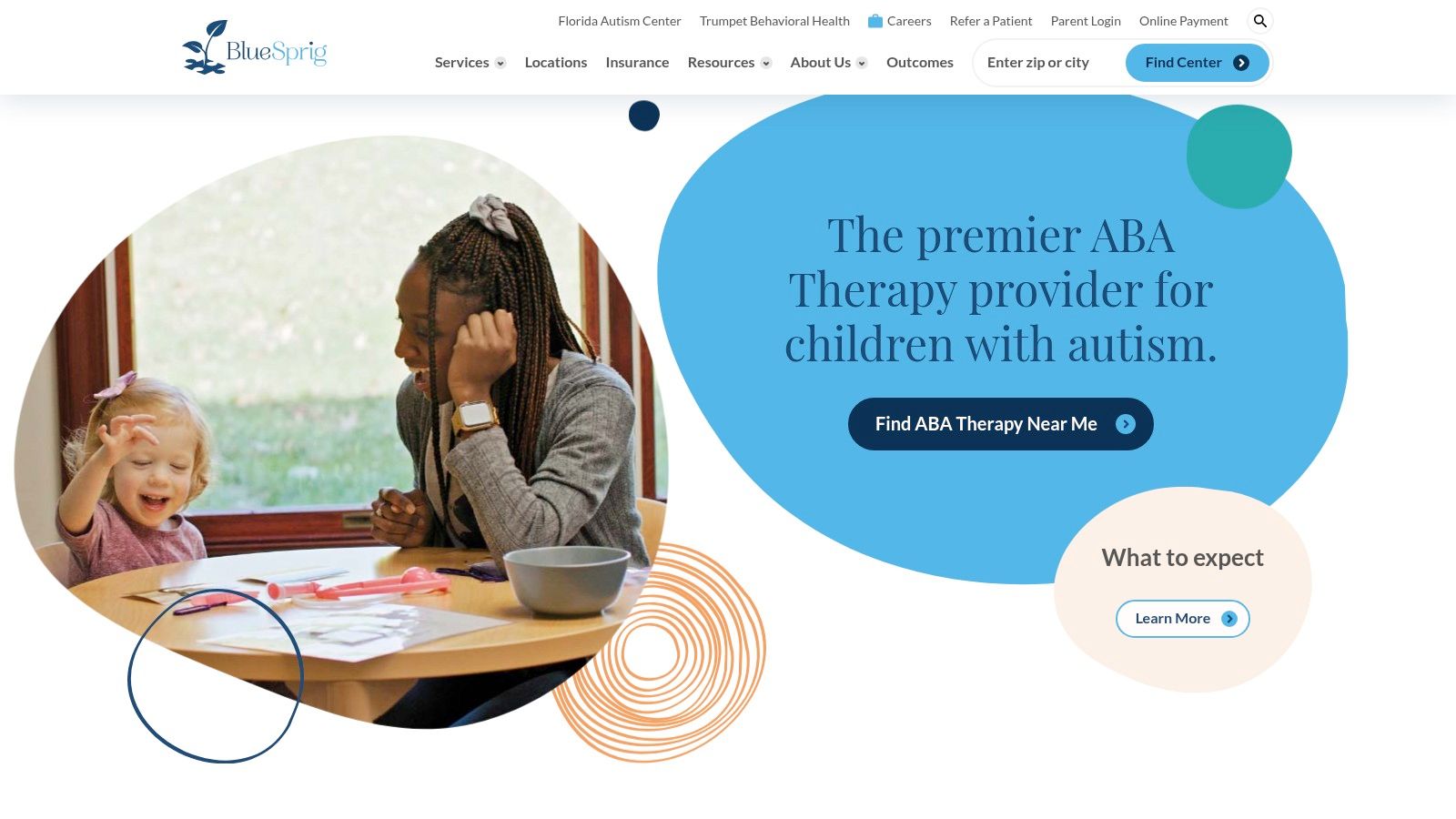
BlueSprig can be a good place to check if your family wants a large clinic footprint with community-based options and family education. The network includes Florida Autism Center affiliates, which may matter if you are comparing older clinic names with newer locations and want one search to cover more ground.
A wider footprint can make the local search easier, especially when nearby openings are limited. It can also mean a child with autism has a chance to practice skills outside the therapy room, which some families prefer over a center-only plan.
What to confirm before you call
Start with the location pages at BlueSprig. Ask whether the specific site offers in-center care, community-based support, or both, because services can differ by location.
If you are comparing Florida options, the local overview at Florida ABA provider options can help you see how regional matching works before you make a call.
A useful check usually comes down to three simple questions:
- Is the site accepting new referrals?
- Does it offer the setting your child needs?
- Can it help skills carry over outside the clinic?
ABA means applied behavior analysis, a therapy that breaks skills into smaller steps and teaches them through repetition and practice. Families often feel more comfortable when they know a provider can work on those skills in a room and also help them show up in daily life. BlueSprig's community focus can fit that need, as long as the local office truly offers it.
5. Behavior Frontiers
Behavior Frontiers is worth a look if your family needs both center-based and in-home ABA options and wants to understand the difference before choosing. The provider's network spans many states, and its public materials clearly separate in-home from center programs, which is helpful when you're trying to match treatment to family logistics.
The strongest part of that setup is clarity. A family can compare what a center program might look like against what in-home treatment means without assuming both are offered everywhere. That matters because one nearby office may be a good fit on paper but not in the setting your child will use.
Compare the setting, not just the address
Visit Behavior Frontiers and look at the local office listings first. Then ask whether your area has a center, home visits, or both, and whether school or community support is available where you live.
The closest option isn't always the easiest one to use, especially if the schedule, staffing model, or school coordination doesn't match your family's day.
Families who relocate also tend to like national footprints because the search process may feel more familiar from one state to the next. Still, school-based coverage and availability can differ by state and plan, so it's wise to ask about those details before you assume a local office can do everything you need.
6. Autism Learning Partners
A parent who is comparing nearby autism treatment options may want a provider that can handle both clinic visits and care at home. Autism Learning Partners, often shortened to ALP, fits that search pattern. It is a long-established provider, so families may feel more comfortable if they want a system with familiar intake steps and established care pathways.
The practical question is how ALP fits into a child's day. In some regions, it connects caregiver education, school coordination, and speech services, so therapy does not sit apart from school or medical care. That matters when a family is trying to build one plan, not several disconnected ones.
Check the setting before you call
Start with the location pages at Autism Learning Partners. Look for whether the nearby site offers center-based care, home visits, or both. In a metro area where waitlists can be long, the local service map matters more than the brand name alone.
ABA means applied behavior analysis, a therapy approach that uses structured teaching and observation to build skills. If your family is also sorting out insurance, meaning the health plan rules that decide what may be covered and under what terms, ask how the intake process works with your plan and what documentation they need.
For a broader side-by-side look at how families compare providers, the page on ABA therapy reviews and provider comparison can help frame the questions.
A few questions are especially useful with ALP:
- Can my child receive services at home, in clinic, or both?
- Do you coordinate with school teams?
- Are speech services offered at this location?
- What does intake look like if demand is high?
Those questions turn a general provider name into a workable local plan.
7. Hopebridge Autism Therapy Centers
Hopebridge is a strong fit for families with younger children who want a center-based, structured day program and may also need diagnostic evaluations at the same site. Many of its centers focus on early childhood, typically from around 15 months to 10 years, which means it's usually a better match for preschool and early school-age needs than for teens.
That narrow age focus can be helpful. Parents can quickly tell whether the model fits their child before investing time in a longer intake process. Some sites also offer speech and occupational therapy, which can simplify care when a child needs more than ABA alone.
A one-stop setup, where available
Start with the location pages at Hopebridge Autism Therapy Centers and read the services listed for each center. The site's transparent center-by-center breakdown makes it easier to tell whether a particular office offers evaluation, ABA, OT, or speech.
That matters because one center may offer several disciplines, while another may offer only ABA. Families should ask whether the center can coordinate the full plan or whether some services would need to come from outside providers.
A center can look convenient on a map and still be incomplete for your child's real needs.
Hopebridge's multiple centers per metro may help shorten commutes, which is often a deciding factor for families who are balancing work, school drop-off, and therapy appointments. The tradeoff is that the model is more age-limited, so it's less likely to fit an older child or teen who needs a different service mix.
8. Little Leaves Behavioral Services
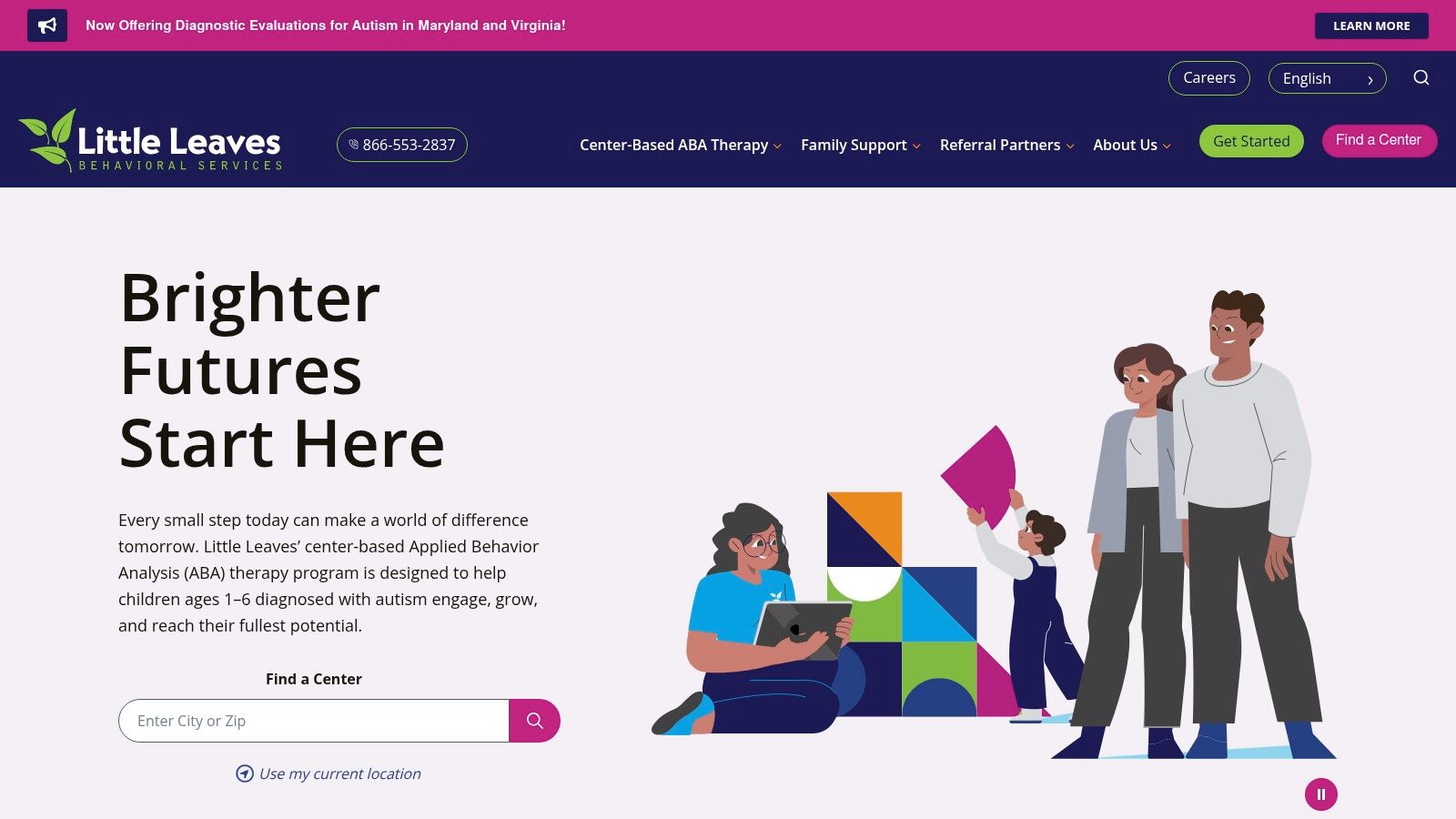
A parent comparing autism treatment near me options may find Little Leaves easier to sort through because the fit is very specific. The centers are designed for young children, generally ages 1 to 6, in a highly structured, preschool-like setting. That narrow age range acts like a filter, helping families decide quickly whether it is worth making a call.
The center-only model is the other key point. Some children do better with home-based support, while others need a steady routine in one place, much like a classroom that repeats the same cues each day. Little Leaves follows that second path, which can be reassuring for families who want predictability and a set daily rhythm.
Best for families who want a tight routine
Check the location and hours information at Little Leaves Behavioral Services. The public site helps you see whether there is a center in Maryland, Virginia, or Florida and whether the schedule fits your day.
Before you call, it helps to ask a few plain questions:
- Does the center work with outside speech or occupational therapy providers?
- What ages does this site serve right now?
- Are daytime hours workable for your family?
- Is there any home-based support, or is the program center-only?
Those answers matter because a preschool-style day program can be a good match for one child and the wrong fit for another. If your child is older, or if home routines are your main goal, another provider may fit better. If your family wants structure, consistency, and a clear age focus, Little Leaves is fairly easy to evaluate early in the search process.
9. Cortica
Cortica is useful when a child needs more than ABA alone and the family wants medical, speech, occupational, and behavioral care coordinated in one place. That multidisciplinary model can reduce the back-and-forth that often comes with juggling separate offices and separate notes.
The intake process is a major part of the appeal. A central intake visit helps build an individualized care path and keeps the team on the same page, which can be reassuring when your child has overlapping needs. Families often find this especially helpful when ABA is only one part of the picture.
A coordinated clinic can reduce the runaround
Visit Cortica and review the clinic listings by region. Because not every location offers every discipline, it's smart to ask exactly which services are available at your nearest site before you plan around it.
If your child also needs medical follow-up, speech therapy, or occupational therapy, a single coordinated clinic may simplify your week. If you only need ABA and the nearest clinic is far away, though, the travel burden can outweigh the convenience.
The best multidisciplinary clinic is the one that can actually fit your child's care plan and your family's schedule.
That's the lens to use with Cortica. It may be a strong match when coordination matters more than raw distance, but the number of sites is smaller than the largest ABA-only networks, so proximity still needs careful checking.
10. Kyo
A family searching for autism treatment near me may find Kyo useful when clinic trips are hard to fit into daily life. Its in-home, community-based ABA model can work well around school pickup, work schedules, and routines at home.
ABA, or applied behavior analysis, is a therapy approach that uses careful observation and repeated practice to build skills. Kyo also includes caregiver coaching and data sharing, so parents can see what is being tracked and ask better questions along the way.
Start with the local service map at Kyo. The online intake process can help you confirm quickly whether your area is covered, which matters before you spend time on calls or forms.
A few questions are worth asking first:
- Does Kyo serve your neighborhood or nearby community?
- Can sessions happen at home, in the community, or both?
- What support is included for caregivers?
- Does the first step work online, or does it require a phone call?
- Is there a waitlist for your area?
Families who want center-based care may need to keep looking, since Kyo has fewer physical clinics than larger networks. For parents who prefer services to fit around home life, that tradeoff can still make sense. If your plan depends on insurance coverage, ask whether the local team can verify benefits and explain any payment path before you begin.
Top 10 Local Autism Treatment Providers Comparison
| Provider | Core features | Quality (★) | Cost & Value (💰) | Best for (👥) | Unique edge (✨) |
|---|---|---|---|---|---|
| ABA Finder 🏆 | Secure intake, needs assessment, location-based provider matches (select states) | ★★★★ | 💰 Free intake & consult; insurance & out‑of‑network review; grant/assistance guidance | 👥 Families needing fast, low‑commitment guidance on providers & payment | ✨ Streamlines insurance/OON review + affordability options; privacy‑conscious |
| LEARN Behavioral | Multi‑state network; center & home services; caregiver/school resources | ★★★★ | 💰 Insurance + OOP; varies by region | 👥 Families wanting local clinic/home flexibility | ✨ Regional brands with centralized clinical support |
| Butterfly Effects | Home, center, school, virtual; location finder & coverage check | ★★★★ | 💰 Accepts many insurers; coverage check tool | 👥 Families seeking varied settings & caregiver training | ✨ Coverage check + strong caregiver coaching focus |
| BlueSprig | In‑center & community programs; many clinics per state | ★★★★ | 💰 Insurance + community‑program options | 👥 Families preferring clinic/community‑based care | ✨ Broad footprint, expanded by legacy site integrations |
| Behavior Frontiers | Center & in‑home care; BCBA supervision; individualized plans | ★★★★ | 💰 Insurance + individualized billing; site variance | 👥 Families wanting BCBA‑led, flexible delivery models | ✨ Clear in‑home vs center program descriptions |
| Autism Learning Partners (ALP) | Clinic & home services; school/medical partnerships; long history | ★★★★ | 💰 Insurance relationships; waitlists possible | 👥 Families valuing experienced, established providers | ✨ Decades of clinical systems & school coordination |
| Hopebridge Autism Therapy Centers | Center‑based early childhood programs; diagnostics; OT/ST at some sites | ★★★★ | 💰 Insurance + possible bundled services | 👥 Families of young children (≈15 mo–10 yrs) | ✨ One‑stop eval→therapy; school‑readiness day programs |
| Little Leaves Behavioral Services | Intensive, preschool‑style center programs for ages 1–6 | ★★★ | 💰 Clinic‑based billing; insurance varies | 👥 Families focused on highly structured early‑learner models | ✨ Age‑focused, highly structured routines for school readiness |
| Cortica | Multidisciplinary clinics: ABA + medical/OT/ST; centralized intake | ★★★★ | 💰 Integrated care billing; varies by clinic | 👥 Children needing ABA alongside medical/therapy services | ✨ Coordinated care model with centralized care planning |
| Kyo | Tech‑enabled in‑home ABA; caregiver coaching; online intake/scheduling | ★★★★ | 💰 Insurance + flexible/tech-enabled coordination | 👥 Families preferring in‑home care with digital tools | ✨ Fast online intake, interactive map, data transparency |
Your Next Call Details and Questions to Gather First
Before contacting any provider, gather your child's age, any diagnosis paperwork you have, your insurance card and plan name, your state, preferred locations and schedule, and any therapy hours a clinician has recommended. That small packet of information makes the first conversation more useful, because the provider can tell you whether they even serve your area and whether their model fits what your child needs.
Ask whether the provider is in network with your plan, how out-of-network benefits may apply, what the intake and waitlist process looks like, and what a first assessment includes. If you're using Medicaid, ask the plan or state office how eligibility, prior authorization, and medical necessity work for your child, because those details can change what's covered and where you can go.
Confirm every detail with your insurer or a state Medicaid office, since coverage may depend on your plan and state and no provider or resource can promise approval. It also helps to ask about travel limits, cancellation policies, and whether caregiver training is part of the service plan, because those practical details can shape the actual cost of care more than the posted label ever will.
If you're feeling buried in choices, that doesn't mean you're behind. It means you're doing what careful parents do, checking the facts before you commit time and energy to one path.
ABA Finder can help you sort through nearby ABA options, insurance questions, and affordability pathways without adding more confusion. If you want a calmer way to compare providers serving your area, visit ABA Finder and start with a no-obligation conversation about what might fit your family.
Our Latest Insights








Every Child Deserves Access To Quality ABA Therapy
Whether you're searching for providers, exploring financial assistance, or trying to better understand your insurance options, we're here to help you take the next step with confidence.