



Behavioral Health Insurance: A Family Guide to ABA Coverage
Learn how behavioral health insurance works for ABA therapy. Understand parity laws, Medicaid, private plans, and out-of-network options for autism care.

While 91% of Americans have public or private health coverage, 54% of insured consumers still don't receive the mental-health treatment they need, so knowing how to work through insurance is essential, not optional. Behavioral health insurance may list ABA as a covered service, yet authorization rules, provider shortages, reimbursement rates, and network restrictions can still stand between your child and consistent care.
You may be calling insurers during work breaks, leaving messages for ABA providers, and hearing that the next opening is months away. Then a representative tells you, “ABA is covered,” and the relief quickly fades when the provider isn't in-network, the plan requires prior authorization, or the allowed amount is too low for the clinic to accept the case.
This guide is designed to make those details less intimidating. You'll learn how Medicaid, commercial insurance, and out-of-network benefits work, what to ask before treatment starts, why claims are denied, and how to document a network gap or appeal. Coverage is only the starting point. The practical goal is usable access to appropriate care under your specific plan and state rules.
Table of Contents
When Your Insurance Card Says ABA Is Covered, What That Really Means
A parent receives an autism diagnosis, finds an ABA provider who seems like a good fit, and calls the number on the insurance card. The representative confirms that Applied Behavior Analysis, commonly called ABA, appears in the behavioral health benefits. For a moment, the family believes the hardest part is over.
Then the provider says they aren't accepting new in-network clients. Another clinic has a long waitlist. A third can offer appointments only if the family pays upfront while the insurer reviews an out-of-network request. The plan may cover ABA on paper, but the family still doesn't have a workable path to sessions.

Coverage and access are different questions
Nominal coverage means the plan lists ABA or related behavioral services as a benefit. Practical access means your child can reach a qualified provider, the provider has capacity, the plan authorizes the recommended services, and the reimbursement arrangement makes treatment financially workable.
Behavioral health insurance is not one uniform product. It sits at the intersection of federal parity requirements, state insurance mandates, Medicaid rules, employer plan design, provider networks, and medical-necessity reviews. Two families in the same area may receive very different answers because their plans have different funding arrangements or administrative rules.
Federal policy expanded behavioral-health protections over time, but insurance coverage still doesn't automatically create appointments. The history of autism insurance coverage helps explain why a benefit summary alone can't answer the questions that matter most to your family.
Practical rule: Treat “ABA is covered” as the beginning of your verification process, not the final answer.
The rest of your review should establish six things: whether your plan applies, what documentation it requires, who may provide services, how authorization works, what the insurer's allowed amount is, and what happens if no suitable in-network provider is available. That framework turns a confusing insurance card into a series of answerable questions.
Mental Health Parity Laws Explained for Families
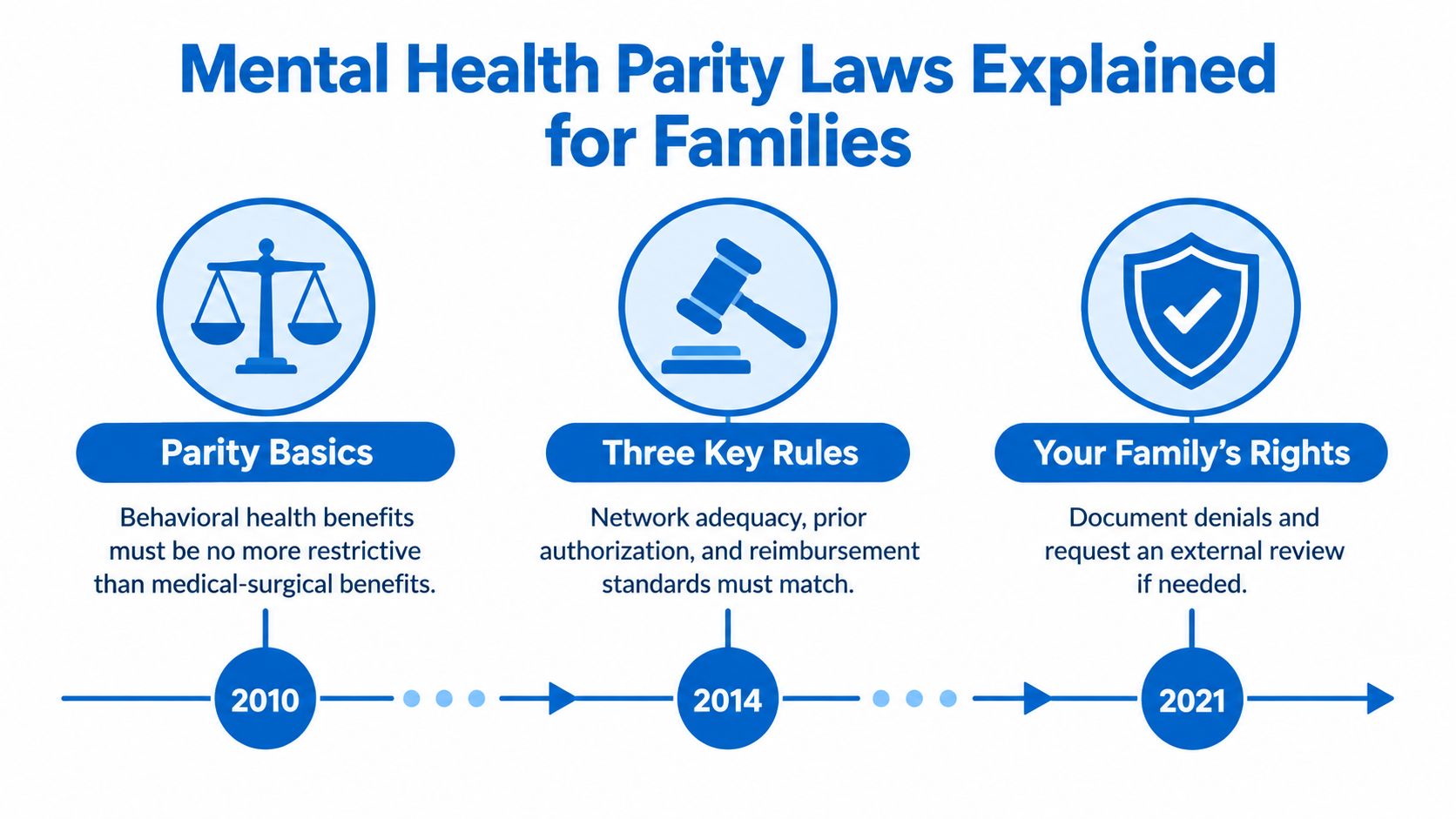
Parity means behavioral-health benefits should generally be managed no more restrictively than comparable medical and surgical benefits. A straightforward way to think about it is a highway with two lanes. Parity says the behavioral-health lane shouldn't have a lower speed limit than the medical lane because it serves behavioral care. It doesn't guarantee that both lanes are open, free of construction, or moving at the same speed in practice.
The three major milestones
The Mental Health Parity Act of 1996 prohibited certain group health plans from applying annual or lifetime dollar limits to mental-health benefits that were more restrictive than limits for medical and surgical care. It didn't require broad equality for deductibles, copayments, treatment limits, or substance-use-disorder services.
The Paul Wellstone and Pete Domenici Mental Health Parity and Addiction Equity Act, enacted on October 3, 2008, expanded protections to substance-use-disorder services and addressed a wider range of financial requirements and treatment limitations. Implementing regulations were published on February 2, 2010. The parity policy history explains why families must look beyond a benefit label and examine cost sharing, visit rules, authorization, and network classifications.
Beginning in 2014, the Affordable Care Act required new individual and small-group plans to cover mental-health and substance-use-disorder services as Essential Health Benefits and to apply federal parity protections. Federal estimates projected that the law would give 32.1 million Americans access to plans containing compliant behavioral-health benefits, while another 30.4 million people with some behavioral-health benefits would gain stronger parity protections, as documented in the same policy review.
What parity may not settle
Families often encounter two kinds of limits:
- Quantitative limits are easy to count, such as a dollar cap, number of visits, or stated hours.
- Nonquantitative limits are management rules, such as medical-necessity criteria, prior authorization, treatment-plan reviews, provider credential standards, or network admission requirements.
The second category can be harder to spot. A plan might not say “ABA is excluded,” yet still delay access through repeated authorization reviews or classify services differently from comparable medical care. Parity doesn't mean every treatment, provider, or requested hour must be approved. It means restrictions should be applied consistently under the law and the plan's rules.
A denial may justify asking for the insurer's comparative analysis of nonquantitative treatment limits, especially when behavioral-health authorization appears more burdensome than similar medical services. Keep the explanation practical. Request the criteria in writing, ask which rule caused the denial, and save every letter, reference number, and deadline.
Parity is a floor, not a promise of a nearby appointment. Provider availability, plan funding, state rules, and reimbursement still determine whether the protection becomes usable care.
Medicaid, Commercial Plans, and Out-of-Network Routes Compared
Most families encounter one or more of three payment routes: Medicaid, a private or commercial plan, and out-of-network reimbursement. The right route depends on eligibility, plan language, state requirements, provider availability, and authorization decisions.
Medicaid deserves careful attention for children. The Commonwealth Fund's explanation of Medicaid's behavioral-health role reports that Medicaid covered 43% of youth with a major depressive episode or substance-use disorder, representing approximately 2.41 million young people. Among Medicaid enrollees with a recent major depressive episode or substance-use disorder, 53% received needed treatment during the preceding year. The same 53% figure applied to adult Medicaid enrollees with any mental illness or substance-use disorder.
For a child enrolled in Medicaid, Early and Periodic Screening, Diagnostic, and Treatment, or EPSDT, generally applies from birth through age 20. EPSDT requires states to cover medically necessary services within Medicaid's covered benefit categories when those services are needed to correct or improve a child's physical or mental condition. That may include autism-related services, even when a specific service isn't listed in the standard adult plan. States still decide medical necessity, provider qualifications, documentation, and authorization requirements. The federal EPSDT guidance explains the general framework.
Commercial plans may be governed by employer terms, state mandates, and federal requirements. State mandate provisions vary. A review of mandates found common age limits between 18 and 21, annual dollar limits around $36,000, and provider qualification requirements such as BCBA certification, but those conditions differ substantially by state. Check the state mandate review alongside your plan documents.
| Pathway | Typical coverage scope | Common restrictions | Best for |
|---|---|---|---|
| Medicaid | Medically necessary services under applicable Medicaid categories, potentially supported by EPSDT for children | Prior authorization, treatment-plan reviews, state-specific provider and documentation rules | Families whose child is enrolled or may qualify for Medicaid |
| Commercial plan | Benefits defined by the employer or individual plan, state requirements, and federal protections | Deductibles, coinsurance, age or annual limits, network rules, authorization | Families using employer-sponsored or individual insurance |
| Out-of-network route | Possible reimbursement when the plan includes out-of-network benefits or approves an exception | Higher cost sharing, allowed-amount limits, balance-billing risk, proof of network inadequacy | Families facing unavailable in-network providers or unsuitable access |
If no appropriate in-network provider is available, ask about a single-case agreement or network-gap exception. Insurers may require directory screenshots, call logs, wait-time records, referrals, treatment recommendations, and written confirmation that listed providers aren't accepting new clients. Guidance on out-of-network benefits can help you prepare questions before calling.
The Real Math Behind ABA Reimbursement Rates
A plan may advertise 80% coverage, but that percentage doesn't tell you what the insurer considers the underlying price. The calculation usually depends on the allowed amount, which is the plan's recognized rate, rather than the provider's billed charge.
For example, if a provider bills more than the plan allows, your share may be based on the allowed amount, and the remaining balance may create additional exposure where balance billing is permitted. Out-of-network benefits can also involve a separate deductible, different coinsurance, and a lower reimbursement basis. Ask for the actual allowed amount before assuming the coverage percentage reflects your likely cost.
Why hourly rates affect appointment supply
A national analysis estimated mean reimbursement of $65.16 per hour for therapeutic behavioral services delivered by a BCaBA, behavior technician, or unspecified-level provider, compared with $94.72 per hour for master's- or doctoral-level providers, according to this analysis of behavioral-service reimbursement. The proposed TRICARE rate of $68 per hour for a board-certified analyst was more than 25% below the U.S. mean reported in that analysis.
These rates matter because clinics must pay for more than the time spent beside your child. Their costs can include wages, supervision, documentation, travel, scheduling, compliance, assessments, and administrative work. If contracted reimbursement doesn't support those costs, a provider may decline network participation or limit appointment capacity.
A strong benefit can still produce a weak access pathway if qualified providers can't sustainably accept the plan's rates.
Ask your insurer for the specific rates for BCBA, BCaBA, behavior technician, supervision, and assessment services. Ask whether different billing codes have different allowed amounts, whether the plan pays the same rate for in-network and approved out-of-network care, and whether balance billing is allowed.
The ABA therapy cost-per-hour guide can help you organize cost questions, but your insurer's written benefit information and the provider's estimate should control your personal planning. Don't compare only percentages. Compare the allowed amount, billed charge, deductible, coinsurance, authorization, and total expected hours.
How to Review Your Plan's ABA Benefits Step by Step
A phone representative's answer is useful, but it may not be enough to plan treatment. Ask for written confirmation whenever possible, and record the representative's name, call date, reference number, and exact wording.
Start with the plan itself
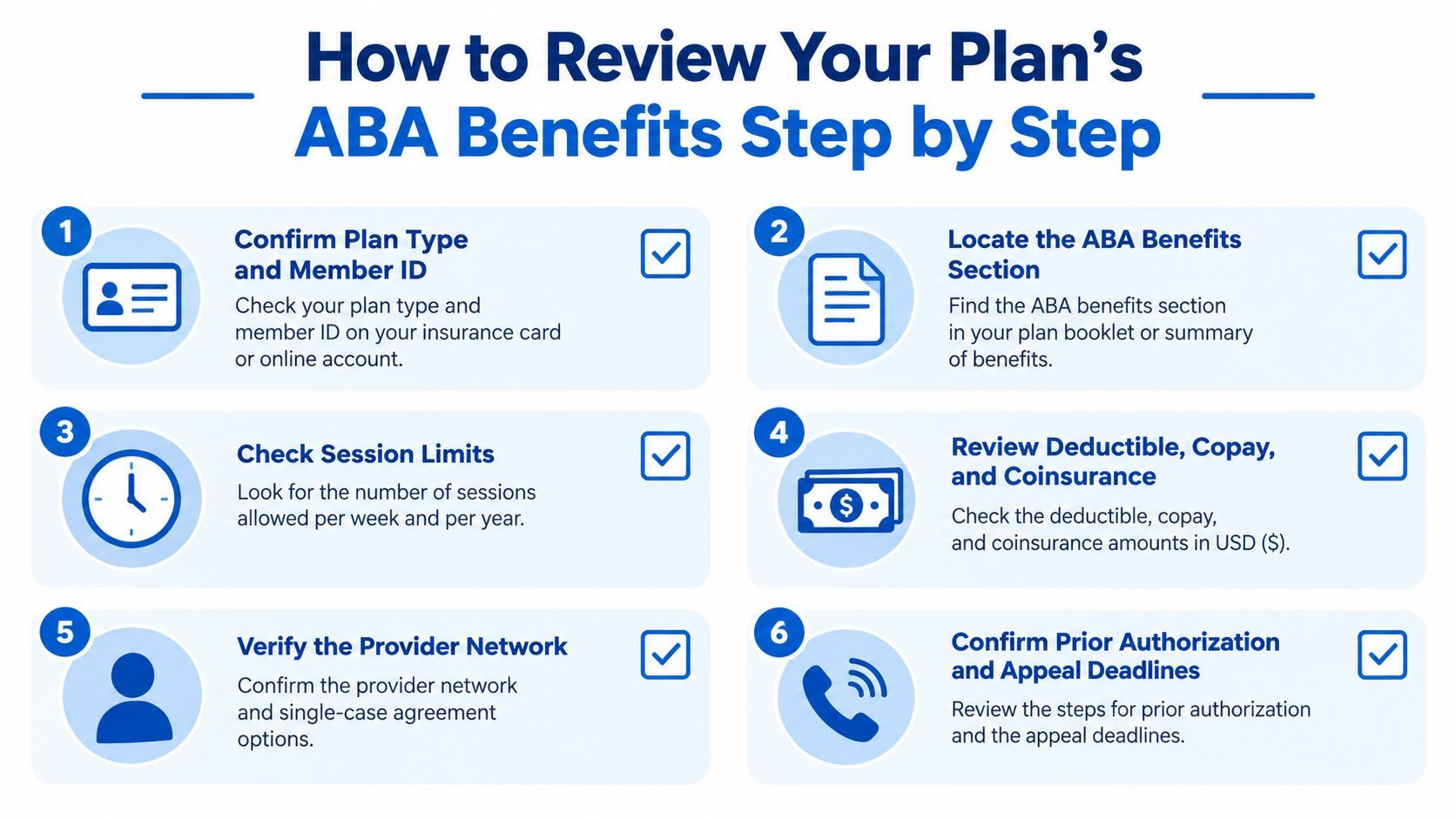
Confirm the plan type and funding status. Ask whether the plan is fully insured, self-funded, an individual plan, or a Medicaid managed-care plan. Ask which rules apply to autism-related behavioral services and who makes utilization decisions.
Find the ABA benefit language. Request the certificate of coverage, summary plan description, behavioral-health policy, and medical-necessity criteria. Search for ABA, autism services, behavioral treatment, developmental services, exclusions, and habilitative care.
Check state mandate applicability. Ask whether your state's autism mandate applies to this plan, whether the employer plan is exempt from state insurance regulation, and whether age, dollar, or provider limits apply.
Verify the treatment conditions
Ask about documentation. Confirm whether the plan requires an autism diagnosis, referral, evaluation, treatment plan, progress notes, standardized assessments, or a provider statement of medical necessity. Ask where each document must be sent.
Map authorization and reassessment. Ask whether prior authorization is required before the first session, how many sessions or hours an authorization covers, when renewal is due, and what happens if the provider submits a renewal late. Medicaid guidance allows utilization management and medical-necessity review, but it doesn't allow blanket limits that ignore a child's individual need for medically necessary services. The CMS Medicaid autism-services toolkit explains why "ABA isn't covered" may mean a specific service, code, provider type, or approval standard wasn't recognized.
Verify provider credentials and network status. Ask whether the BCBA, BCaBA, technician, supervising clinician, and assessment provider must meet separate credential rules. Confirm that the specific clinic, not just the insurer's directory, is accepting new clients under your plan.
- Benefit exclusion: the plan says the service isn't covered.
- Authorization failure: approval wasn't obtained or expired.
- Medical-necessity denial: the insurer says the documentation or criteria weren't met.
- Coding error: the claim used an incorrect code, modifier, or provider detail.
- Exhausted limit: the plan says an annual, age, dollar, or service limit has been reached.
- Identify the plan and funding type.
- Confirm whether the state mandate applies.
- Request ABA benefits and medical-necessity criteria.
- Check age, dollar, hour, and visit limits.
- Verify credentials, network status, and available capacity.
- Document prior authorization, renewal, appeal, and out-of-network rules.
Keep a denial log that labels the problem accurately:
Request the reason in writing, ask for the criteria used, and correct simple administrative errors first. If the restriction appears inconsistent with comparable medical care, request the relevant parity analysis and consider an internal appeal or complaint to your state regulator. For employer plans, the Department of Labor may be relevant.
Why Claims Get Denied and How to Respond
A denied ABA claim doesn't always mean the plan never covers ABA. The denial may describe an exclusion, but it may also point to an authorization lapse, a coding mismatch, a credentialing issue, or a medical-necessity review.
Match the response to the denial
Read the explanation of benefits and locate the denial code or reason. If the plan says not covered, request the exact exclusion and ask whether a related service may be covered under another benefit category. CMS doesn't require or endorse ABA as the single treatment for autism. Its guidance recognizes that services such as caregiver training, behavioral coaching, or therapy-related services may fit within different Medicaid categories when they meet the category's rules and are delivered by qualified providers.
If the issue is prior authorization, ask whether the provider can submit a retroactive review or corrected request. Don't assume payment is available for sessions delivered before approval. Ask what documents are required and whether the authorization deadline can be extended.
For a medical-necessity denial, request the insurer's criteria, the clinical reviewer's explanation, and the records considered. Your provider may be able to submit a treatment plan, progress notes, assessment, or clarification. This is general navigation information, not a clinical recommendation, so discuss the appropriate documentation with the treating provider.
A coding or credentialing error may be fixable without a full appeal. Ask the billing office to verify the procedure code, modifier, service date, provider identifier, supervision details, and network status. For an exhausted limit, request the plan's calculation and ask whether an exception, alternate benefit, or appeal route exists.

Why challenging a denial matters
Federal enforcement corrections affected more than 18 million participants across over 39,000 group health plans, according to the 2025 federal parity report. That report also described one insurer removing prior authorization for outpatient in-network behavioral-health services after identifying 48 affected claims involving 22 members.
Virginia's 2024 carrier data recorded 7,953,579 denied claims out of 44,482,942 total claims, an overall denial rate of 17.9%, while separately examining differences across medical, mental-health, and substance-use benefits. These figures don't determine your claim, but they show why a denial deserves diagnosis rather than automatic acceptance.
Families who report stopping ABA because insurance didn't cover it may also develop more negative beliefs about whether treatment can improve behavior. A caregiver study found substantially higher odds of that belief among families reporting that coverage-related barriers ended ABA, with an odds ratio of 7.05 and a 95% confidence interval of 2.11–23.6, as reported in the autism-services review cited earlier. Coverage interruptions can affect continuity and confidence, so save every deadline and appeal promptly.
Your Next Steps - Turning Coverage Into Care
Start with the facts your plan can confirm in writing:
Then compare those rules with real provider availability. Call more than one listed provider, ask whether they're accepting new clients, record wait times, and save evidence when a directory doesn't match reality. If no suitable in-network provider is available, ask the insurer about a network-gap exception or single-case agreement before committing to out-of-network charges.
You don't need to solve every insurance problem in one phone call. A written benefit summary, a denial letter, a provider estimate, and a clear call log can turn a stressful situation into a manageable file. If the explanation doesn't make sense, ask the insurer to restate it in plain language and identify the next appeal step.
Insurance navigation is confusing because the rules are layered. Needing help isn't a failure, especially when your family is balancing diagnosis, scheduling, work, school, and treatment decisions at the same time.
ABA Finder offers no-cost, no-obligation help reviewing likely insurance and out-of-network pathways and identifying provider options in its service areas. Visit ABA Finder to discuss your plan questions, explore documentation for a network exception, and understand possible next steps without assuming that coverage or funding is guaranteed.
Our Latest Insights
















Every Child Deserves Access To Quality ABA Therapy
Whether you're searching for providers, exploring financial assistance, or trying to better understand your insurance options, we're here to help you take the next step with confidence.